Your Day Master Has Two Versions of You — Strong and Weak. Here's Which One You're Living.
Two people are both 丙 Yang Fire. Same Day Master, same "generous, radiant optimist" description in every profile they read.
One of them lights up a room, launches things, and people follow. The other burns out by Wednesday, gives away more than they have, and quietly wonders why everyone else seems to have more stamina.
Same stem. Opposite lives.
The difference is not personality. It is strength — whether your Day Master is well-supported in your chart, or running on reserves. It is the single most useful thing you can know about your own chart, and it is the reason generic Day Master descriptions so often feel half-right and half-wrong.
Every stem below gets both versions: three ways it shows up strong, three ways it shows up weak, and the one move that converts the weaker version into an actual advantage.
Let us kill this immediately, because it stops people reading.
A weak Day Master is not a deficient person. It is a chart that draws more from its environment than it generates on its own. That produces genuinely different capabilities — sensitivity to other people, adaptability, the ability to read a room and change shape inside it. Plenty of extremely successful people run light Day Masters. They simply succeed through environment, allies and timing rather than through raw force.
The honest framing is this:
- Strong Day Master = you have supply. Your risk is overreach — spending it on the wrong things, or refusing to spend it at all and going rigid.
- Weak Day Master = you have sensitivity. Your risk is depletion — spending before refilling, and building your life somewhere that drains you.
Neither is luckier. They need opposite maintenance, which is why the same advice helps one and wrecks the other.
How to tell which one you are
Strength is not guesswork and it is not vibes. It is counted from four things in your chart:
- Season — were you born in the month that feeds your element?
- Roots — does your stem appear hidden inside your branches?
- Support — how much Resource and how many Peers stand in your chart?
- Drain — how much Output, Wealth and Officer pull against you?
Add the support, subtract the drain. Supported and rooted reads strong. Rootless, out of season and outnumbered reads weak. Somewhere between reads balanced, which behaves like a mild version of whichever side it leans.
You can run this by hand, or open your chart in Ming Map and read the verdict directly — it counts roots across all four pillars rather than the shortcut most free calculators use, which is looking only at the birth month and calling it done.
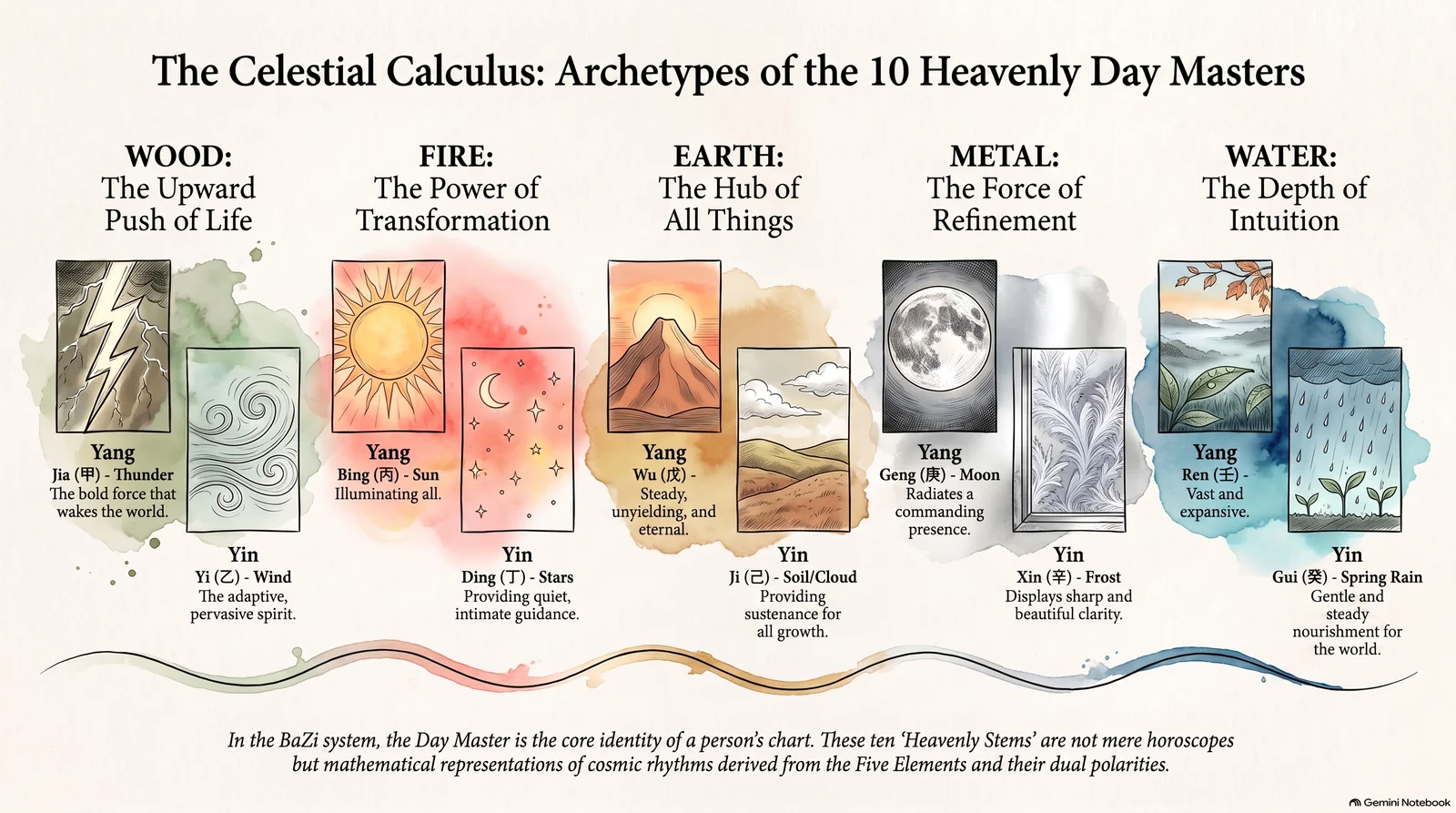
甲 Yang Wood — the Great Tree
Strong 甲 shows up as: an upright spine that does not bend to pressure; genuine long-range vision, planning in decades rather than quarters; a natural pillar other people organise themselves around.
Weak 甲 shows up as: principles you hold privately but cannot voice in the room; long ambition with no root under it, so plans restart every year; exhaustion from carrying a structural role you were never resourced for.
The move: Strong 甲 grows rigid — it must be used or it turns into stubbornness dressed as integrity. Give it a project big enough to justify its height. Weak 甲 must stop trying to be the tree in poor soil. Get rooted first: one mentor, one body of knowledge, one stable base. A tree does not grow taller by pushing harder; it grows taller by rooting deeper.
乙 Yin Wood — the Vine
Strong 乙 shows up as: relentless survival — the person still standing after conditions that flattened everyone else; social grace that opens doors force never would; strategic flexibility, winning by going around rather than through.
Weak 乙 shows up as: adaptability that curdles into having no position at all; dependence on whoever is currently holding you up; being read as agreeable and therefore quietly overlooked.
The move: Strong 乙 must choose a structure worth climbing — vines with nothing to climb sprawl and go nowhere. Weak 乙 must stop attaching to unstable supports. Your gift is genuinely climbing, not standing alone; the whole game is what you attach to. Pick the trellis deliberately and your flexibility becomes leverage instead of drift.
丙 Yang Fire — the Sun
Strong 丙 shows up as: warmth that arrives before you speak; unforced optimism people borrow when their own runs out; visibility — you are seen, and you are comfortable being seen.
Weak 丙 shows up as: brightness that runs on a timer and collapses without warning; giving until there is nothing left, then withdrawing and calling it introversion; needing external audience to feel lit at all.
The move: Strong 丙 must aim the light — the sun shines on everything equally, which is exactly why it can heat nothing in particular. Choose what you are illuminating. Weak 丙 must stop confusing output with worth. Refuel first: daylight before noon, one hour with someone who lifts you, and protect the recovery like an appointment. Isolation is what makes this one worse, not better.
丁 Yin Fire — the Lamp
Strong 丁 shows up as: precise, targeted influence — you change the one person who changes the room; intuition that arrives ahead of the evidence; steady presence that outlasts louder people.
Weak 丁 shows up as: flickering — brilliant one week, unreachable the next; absorbing other people's moods until you cannot find your own; talent that stays private because being seen costs too much.
The move: Strong 丁 must guard its fuel and choose its few — a lamp with too many rooms to light dims everywhere. Weak 丁 must build a container. Lamps need shelter; you need boundaries, routine, and one or two people who steady you. Protect the wick and the light is remarkably durable.
戊 Yang Earth — the Mountain
Strong 戊 shows up as: immovable reliability — the person everyone builds on; long patience that outlasts faster competitors; a calm that spreads through a crisis.
Weak 戊 shows up as: stability you perform for others while feeling unsteady inside; slowness that is actually avoidance; taking on weight to be needed, then resenting the weight.
The move: Strong 戊 must be careful that steadiness has not become refusal to move — mountains are stable and also stuck. Schedule change deliberately. Weak 戊 must regain ground before carrying anyone: make the bed, cook the real meal, do the ordinary thing at the ordinary time. Routine is not avoidance for you, it is the mechanism. Anxiety loses its footing the moment the day has a shape.
己 Yin Earth — the Field
Strong 己 shows up as: you make things grow — people, teams, ideas leave you better than they arrived; resourcefulness that finds a use for anything; quiet indispensability.
Weak 己 shows up as: giving past the point of depletion and calling it love; absorbing everyone's problems until you carry a field of other people's crops; self-sacrifice that nobody asked for and nobody sees.
The move: Strong 己 must plant deliberately rather than letting anything take root in you. Weak 己 must let a field lie fallow. This is the hardest one to hear: your worth is not the harvest you provide. Rest is not laziness, it is soil management — and an exhausted field grows nothing for anyone.
庚 Yang Metal — the Blade
Strong 庚 shows up as: decisive cuts other people cannot make; unflinching honesty that fixes what politeness protects; endurance through hardship that would break softer material.
Weak 庚 shows up as: sharpness with no target, landing on the people nearest you; a reformer's instinct without the standing to reform anything; blunt from overuse and never re-sharpened.
The move: Strong 庚 must choose what it cuts — an axe used on everything eventually damages the things it was meant to protect. Weak 庚 needs forging, not more swinging. Metal is made by heat and pressure applied deliberately: pick one demanding standard, one hard skill, one discipline, and let it shape you. Untempered metal just chips.
辛 Yin Metal — the Jewel
Strong 辛 shows up as: taste and precision others pay for; magnetic polish — people notice and remember you; standards that lift everything around you.
Weak 辛 shows up as: perfectionism that prevents finishing; devastating self-criticism aimed inward; needing to be admired to feel real, and feeling hollow when the admiration stops.
The move: Strong 辛 must let some things be merely good — the pursuit of flawless is where your energy quietly goes to die. Weak 辛 must stop polishing in private and let the work be seen unfinished. A jewel has no value in a drawer. Ship at eighty per cent; the market grades far more kindly than you do.
壬 Yang Water — the Ocean
Strong 壬 shows up as: genuine scale of thought — you see the whole system while others see their part; adaptive power that reroutes around obstacles instead of fighting them; a connector who moves people and ideas across distances.
Weak 壬 shows up as: vision with no vessel, so nothing lands; scattered momentum, many currents and no direction; restlessness mistaken for ambition.
The move: Strong 壬 needs banks. Water without a channel floods; with one, it generates power. Constraint is not the enemy of your vision, it is the thing that makes it real. Weak 壬 must stop starting and go deep before moving: research, plan, sleep on the big decision. Depth is your actual asset, and depth needs stillness to form.
癸 Yin Water — the Dew
Strong 癸 shows up as: subtle, penetrating insight — you notice what everyone else walks past; imagination that arrives quietly and turns out to be right; calm influence exerted from the edges rather than the centre.
Weak 癸 shows up as: insight that never becomes action; hypersensitivity to atmosphere, absorbing rooms until you cannot tell which feelings are yours; idealism that stays theoretical because reality feels too coarse for it.
The move: Strong 癸 must let the insight surface — working in shadows is your comfort, not your ceiling. Weak 癸 must refill before deciding. Sleep, water, one hour where nothing is required of you. Do not make the large decision while you are empty; it reads completely differently once you are not. The quiet is the work here, not the reward for it.
The pattern underneath all ten
Read those back and one shape repeats.
Every strong Day Master fails the same way: it does not spend. Strength that never gets used turns into rigidity — stubbornness, perfectionism, immovability, refusal. The prescription for a strong chart is always some version of give it a job: express it, invest it, submit it to a structure, point it at something that deserves it.
Every weak Day Master fails the same way: it spends before it refills. The prescription is always some version of build the base first: root, attach, shelter, rest, learn, ally. Not because you are fragile — because your particular engine runs on supply from outside, and running it dry is the only way it actually fails.
That is why the same advice helps one and harms the other. "Push harder" is medicine for a strong chart that has gone passive and poison for a light one already running on empty. "Rest and receive" restores a light chart and rusts a strong one.
Three questions worth sitting with
- Which version have you been living? Most people recognise themselves immediately in one column. That recognition is usually accurate.
- Which version does your current life demand? A light chart in a job built for a strong one will read as personal failure when it is actually a mismatch of supply.
- What is the one maintenance move you keep skipping? For strong charts it is almost always choosing. For light charts it is almost always resting before giving.
Find out which one you are
Day Master strength is countable, not intuitive — and getting it wrong flips every piece of advice that follows.
Run your chart free on Ming Map and it will name your Day Master, count its roots across all four pillars, and tell you plainly whether you are running strong, light, or balanced — along with which elements actually support you. No account needed, and the chart is computed on your device.
FAQ
Can my Day Master strength change over time? The natal verdict is fixed — your chart does not change. But the ten-year Luck Pillars you move through shift the conditions, so a light Day Master can spend a decade well supported and feel considerably stronger, and a strong one can spend a decade under drain and feel unusually stretched. The base is fixed; the weather is not.
Is a balanced Day Master better than both? It is easier to advise, not automatically more successful. Balanced charts have fewer extremes to manage but also fewer extremes to leverage. Many high performers run distinctly strong or distinctly light and simply built a life that fits.
Why do free calculators disagree about my strength? Most check only whether you were born in the season of your element and stop there. Season is one input of four — roots, support and drain matter as much, and a chart can be born out of season and still read strong on the strength of its roots. If two tools disagree, the one counting all four is the one to trust.
Does a weak Day Master mean I will not be successful? No. It means your success runs through environment, allies and timing rather than raw output. Choosing the right place and the right people is not a consolation strategy for you — it is the strategy, and it is a genuinely powerful one when you stop fighting it.