A $3.9M Feng Shui Fraud, and the One Rule That Would Have Stopped It
In November 2024, Thai police arrested one of the country's best-known feng shui masters at his home in Pathum Thani at half past four in the morning. By the time the Crime Suppression Division finished taking statements, 117 people had come forward claiming losses of around $3.9 million.
The mechanism of the case is worth studying, because it is not what most people assume.
He did not, as far as the complaints go, give anyone a bad reading. The charges are about what came after the reading. One family — an elderly woman and her daughter — called him because their house kept needing repairs. He came, he looked, and then he prescribed: a ceremony, a pair of stone kirin imported from China, a piece of stone said to come from a Chinese cemetery, and a burial plot in Chonburi. The family paid roughly $2 million. The kirin never arrived; they were handed two smaller stone lions instead. When they asked for the $1.1 million they had paid for the kirin, they were refused.
His explanation to investigators was almost more damning than a denial: he really had ordered the stone from China, he said, but he had become addicted to gambling and spent the clients' money. Police later traced more than $2.7 million through an online betting site.
Strip away the scale and the celebrity and you are left with a very ordinary structure: a diagnosis was used to generate a purchase. That is the part worth talking about, because it happens every day at prices nobody reports to the police.
Feng shui is about a place, not an object
Feng shui — 風水, wind and water — is the study of how a physical site behaves. The classical literature is remarkably consistent about this. The foundational text gives the line the whole tradition rests on: qi rides the wind and disperses, meets water and halts. The mountain-and-water traditions are about reading ranges, watercourses, and the way land falls. The compass traditions are about sitting and facing — direction, and time.
Every one of those is a property of a location. Where the door is. Which way the building faces. Where the water runs and where the ground drops. What period the structure was built in, and how that interacts with its orientation now.
An amulet has none of these properties. It is small, portable, and has no fixed relationship to the land. Move it from the shelf to your pocket and nothing about your site has changed — not the facing, not the light, not the airflow, not the drainage, not the approach to your front door. There is no mechanism by which a carried object modifies the qi of a plot of land, and — this is the surprising part — the classical texts never claim there is one. You can read the feng shui canon end to end and never find an instruction to buy a blessed object.
That is not a small omission. It is the entire commercial layer of the modern industry, and it is absent from the source material.
Why objects, and not advice?
Because objects can be sold, and advice cannot.
Consider what a real correction looks like. Your bed sits under a beam — move it two metres. A corridor pushes qi straight out the back door — put something in the path to slow it. The entrance is dark and the approach cluttered — clear it and light it.
Notice what those have in common: they are free, or nearly free. There is no margin in them. A practitioner whose income depends on selling remedies cannot build a business on telling people to move their bed.
So a remedy layer gets invented, and it has a shape you can learn to recognise: the diagnosis never terminates. The stone requires a ceremony. The ceremony requires a second object. The second object must be a matched pair. The pair must come from a specific place — which raises the price and explains the delay. Then something else is discovered. A genuine assessment of a site ends: you look, you say what is wrong, you say what to do, and you are finished. A sales structure does not end, because ending is the failure state.
Faith is a different thing
Worth saying plainly: wearing an amulet as an act of devotion is not what is being criticised here. Amulets belong to religious practice — merit, protection, memory, a relationship to something one believes in. That is coherent on its own terms and not ours to argue with.
The confusion — and the opening the con walks through — is when a devotional object is re-labelled as a technical correction to a building. Two traditions get welded together, and the weld is where the money goes in. Something people already revere is priced as though it were engineering.
Three questions that end most of these conversations
If someone reading your house — or your chart — moves toward a purchase, ask:
- What physically changes if I don't buy this? A real adjustment has a mechanism you can state in one sentence: the light improves, the airflow changes, the sightline from the door is broken. If the answer needs the object's price or provenance to make sense, it is not a mechanism.
- How would we both know, in six months, whether this worked? Ask for the specific thing that should improve. Vagueness here is not humility; it is the design.
- Why must this come from there? Imported, consecrated, from a particular mountain or cemetery — provenance is the standard device for making a price unquestionable and a delivery date indefinite. In this case it bought a year of waiting for a kirin that never shipped.
What the case actually teaches — and where BaZi comes in
That family called a feng shui master because their house kept needing repairs. A house that keeps needing repairs has something wrong with it — settlement, water, drainage, how it was built or sited. That is a question about the land, and exactly what the tradition was built to ask. The honest answer might have been unglamorous and cost a couple hundred dollars to investigate. Instead they received $2 million of stone. The stone never came, and the house still needed repairs — because nothing about the site had been addressed.
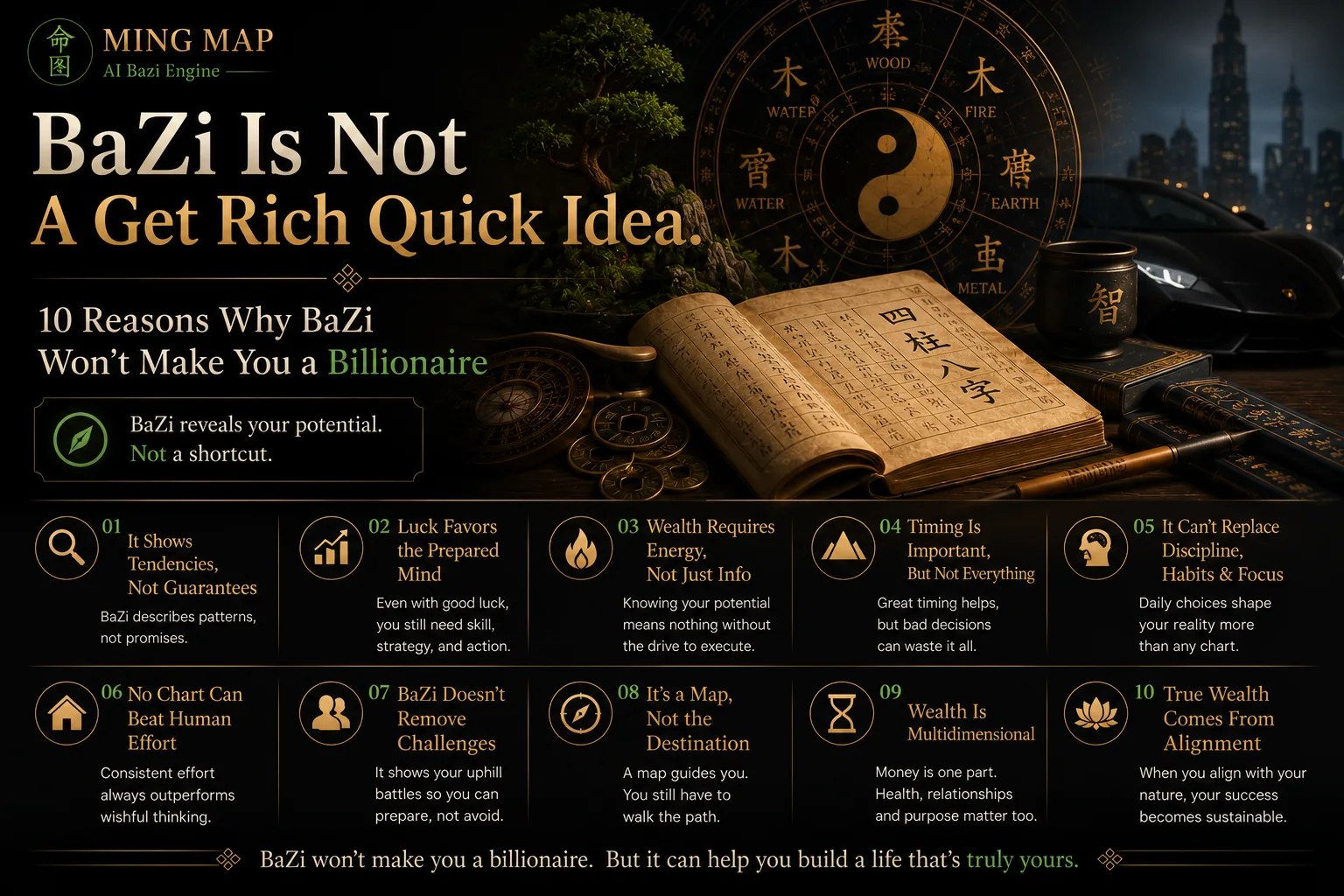
Here is the throughline to your own life. The two great Chinese systems of self-knowledge — feng shui (your place) and BaZi (your birth chart, your timing) — are, in their authentic form, diagnostic. They tell you what is there and what to do about it, and then they stop. Neither one, in its classical source, ends at a cash register. The moment a reading turns into a product you must buy to be safe, you have left the tradition and entered a shop.
And you do not have to take our word for any of it: learning BaZi is completely free on Ming Map. Read how the elements, the Ten Gods, and the luck cycles actually work, then read your own chart. Once you understand the machine, no one can sell you a fake part for it.
Your luck sits in your choices, your timing, and the ground you actually stand on. It has never sat in something you can carry out of a shop.
The feng shui master, Thanawan Jiracharoenwes, has been charged with fraud and money laundering and has denied intent to defraud. As of writing, no verdict has been reported; anti-money-laundering authorities ordered roughly $1 million in assets seized in February 2026. Case details as reported by Thai media.