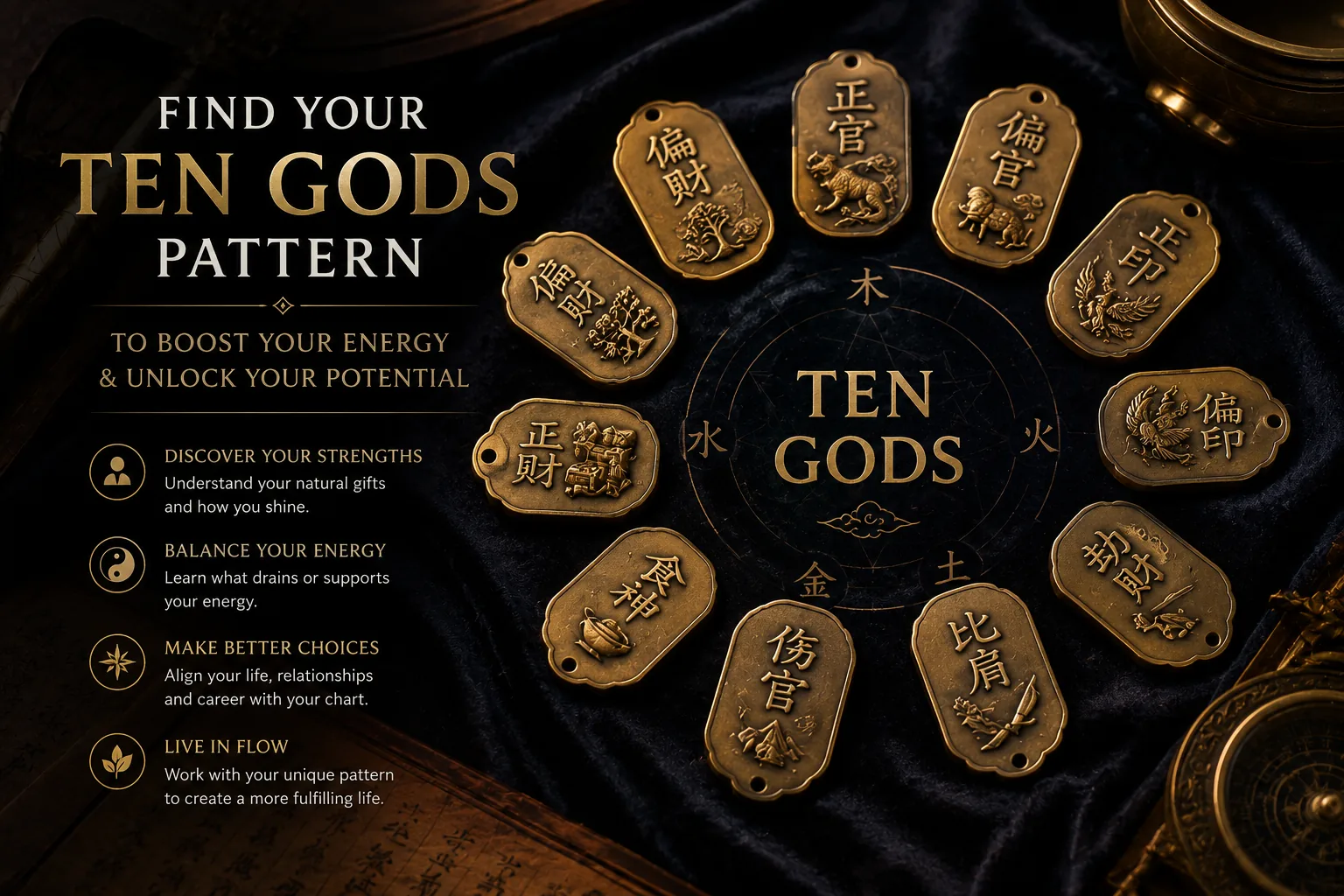
The Ten Gods in BaZi: What They Mean and How to Read Them
If you have opened a BaZi chart and been told your chart contains a "Seven Killings" or a "Hurting Officer," and you have quietly wondered whether you should be worried — you are not the only one. The names sound like sentences. They are not. They are relationship labels, and once you understand how they are built, the whole chart stops reading like a fortune and starts reading like a diagnosis.
This is the guide to the Ten Gods (十神). Not the pop-astrology version where the Seven Killings means bad luck and the Direct Wealth means you will be rich. The classical version — where each of the ten is a role, useful in the right chart and stretching in the wrong one, and where a real reading always ties the Ten Gods back to your Day Master, your strength, and your Useful God.
You will finish this article able to derive the Ten Gods yourself, name every one of them, and read what each one is telling you when it is active, absent, over-represented, or under attack. That is the actual literacy the chart is asking for.
What are the Ten Gods in BaZi?
The Ten Gods (十神, shí shén) are the ten possible relationships between your Day Master and every other stem in the chart. They are not deities. They are not stars. They are not luck tokens. They are the classical BaZi shorthand for what role does this other stem play, relative to you.
Your Day Master is the Yang or Yin stem sitting on the Day pillar — the you of the chart. Every other heavenly stem in the four pillars (Year, Month, Day, Hour) and every hidden stem tucked inside the branches gets classified against your Day Master by two questions:
- What is the five-element relationship? Does that stem generate you, get generated by you, control you, get controlled by you, or match you?
- What is the polarity? Is it the same Yang/Yin as your Day Master, or opposite?
Five element relationships, split into two by polarity, gives you exactly ten roles. That is where the "Ten Gods" number comes from. Not ten personality types. Not ten luck stars. Ten relationships, each of which the classical system attaches a name and a life-domain to.
The full list, in the order the tradition teaches them:
- 比肩 (Bǐ Jiān) — Friend / Parallel — same element, same polarity as your Day Master
- 劫財 (Jié Cái) — Rob Wealth — same element, opposite polarity
- 食神 (Shí Shén) — Eating God / Food God — the element you generate, same polarity
- 傷官 (Shāng Guān) — Hurting Officer — the element you generate, opposite polarity
- 偏財 (Piān Cái) — Indirect Wealth — the element you control, same polarity
- 正財 (Zhèng Cái) — Direct Wealth — the element you control, opposite polarity
- 七殺 (Qī Shā) — Seven Killings — the element that controls you, same polarity
- 正官 (Zhèng Guān) — Direct Officer — the element that controls you, opposite polarity
- 偏印 (Piān Yìn) — Indirect Resource / Partial Seal — the element that generates you, same polarity
- 正印 (Zhèng Yìn) — Direct Resource / Proper Seal — the element that generates you, opposite polarity
Five pairs. Each pair is one element-relationship split by polarity. The "same-polarity" variant is the partial (偏) or rough version — same energy, less polished. The "opposite-polarity" variant is the proper (正) or refined version — the same energy, tempered by the polarity contrast.
That distinction — partial versus proper — is the classical BaZi insight that pop horoscopes flatten. It is why the system does not stop at five elements. It uses ten stems. Because the same element can be a gift (your Direct Officer, the structure that legitimises you) or a strain (your Seven Killings, the pressure that grinds you) depending on nothing more than the polarity match.
How do I find my Ten Gods?
Mechanically, the process is exactly three lookups. You can do it by hand with a ten-stem table if you want to.
Step 1: Find your Day Master. Cast your BaZi chart (any calculator works, including the Ming Map engine). Locate the stem on the Day column — that is your Day Master. It will be one of 甲乙丙丁戊己庚辛壬癸 (Yang Wood, Yin Wood, Yang Fire, Yin Fire, Yang Earth, Yin Earth, Yang Metal, Yin Metal, Yang Water, Yin Water).
Step 2: For each other stem in the chart, ask the two questions above. Element relationship, then polarity.
Step 3: Read off the Ten God label.
Here is the working example. Suppose your Day Master is 甲 (Yang Wood). You look at the Year stem and it is 庚 (Yang Metal).
- Relationship: Metal controls Wood. So 庚 is controlling you.
- Polarity: 庚 is Yang, 甲 is Yang. Same polarity.
- Ten God: Same-polarity controller = Seven Killings (七殺).
Now the Month stem is 辛 (Yin Metal).
- Relationship: Metal still controls Wood. Still controlling you.
- Polarity: 辛 is Yin, 甲 is Yang. Opposite polarity.
- Ten God: Opposite-polarity controller = Direct Officer (正官).
Same element (Metal). Two entirely different labels. And the classical reading is that they behave entirely differently — the Yang Metal (庚) is raw, aggressive, sharpening pressure; the Yin Metal (辛) is refined, structured, legitimate authority. If both appear transparently in the same chart, the tradition calls that 官殺混雜 (mixed Officer and Killing) — a classical form of pattern damage, because you cannot tell whether authority in your life is legitimate or coercive. The polarity distinction is not cosmetic. It is diagnostic.
Every chart has a full Ten Gods map: one for every heavenly stem (four pillars = four stems, minus the Day Master = three), plus one for every hidden stem in the branches (branches carry one to three hidden stems each). By the time you finish mapping, you have somewhere between seven and twelve Ten God assignments scattered across the chart. That density is the reading.
If you would rather not do this by hand, every BaZi engine — Ming Map included — computes the full Ten Gods map for you in the Ten Gods card. What you actually need to know is what the labels mean once they show up. That is the rest of this article.
Which Ten Gods are lucky?
None of them. This is the single most important thing to understand before you read any further.
There is no universally lucky Ten God. There is no universally unlucky Ten God. Every one of the ten can be a gift or a burden. The reading depends on:
- Whether the god matches your favourable elements (the ones your chart needs more of, given your Day Master strength and pattern).
- Whether the god appears in the right quantity — one clean transparent copy versus three overlapping copies is a completely different reading.
- Whether the god has support or is being attacked by another god in the chart.
- Whether it sits on the Month Branch — the pillar the classical tradition treats as the anchor for pattern identification.
The Seven Killings, which sounds terrifying, is the core of the elite executive pattern (the 七殺格) when it is properly controlled. The Direct Wealth, which sounds wonderful, is a source of exhaustion for an already-weak Day Master who cannot hold onto it. The Direct Officer, the "legitimate authority" star, is a career-crusher for a weak chart that cannot bear the responsibility being handed to it.
So when someone tells you your chart has a "bad Ten God," ask them relative to what. If they cannot answer in terms of your Day Master's strength and your Useful God, they are reading a horoscope column, not a BaZi chart.
The right question is not "which Ten Gods are lucky." The right question is which Ten Gods, in what quantity, on what pillars, does my chart need? That is a Useful God question, and it is the one the classical system was built to answer.
With that framing in place, we can now walk the ten of them.
The Companion group: 比肩 and 劫財
The Companion Group (比劫) is your own element mirrored back at you. Same element as your Day Master. This is the group that governs peers, siblings, competitors, and — critically — your own capacity to hold your ground.
比肩 (Bǐ Jiān) — Friend / Parallel
Same element, same polarity as your Day Master. If you are 甲 (Yang Wood), your Friend is another 甲.
What it represents in life. Peer support, allies, siblings, colleagues, business partners on equal footing. Your own willpower. Independence. The refusal to be pushed around. When a chart has a healthy Friend, the person tends to have a strong sense of self, functional peer relationships, and the psychological floor to say no to things.
When it is active — meaning transparent in your stems, or activated by a Luck Pillar or annual pillar bringing more of your own element — you feel steadier. You have more energy for your own agenda. You attract people who see you as an equal. Groups become easier to join, and easier to leave.
Over-represented. A chart with three or four transparent Friend stems, or a heavily rooted same-element branch stack, tends toward stubbornness, tunnel vision, and difficulty collaborating on terms other than your own. There can also be a Wealth problem: peers absorb material resources. The classical warning is that too much Friend in a Wealth-focused chart scatters the wealth to other people — you earn, others benefit.
Under-represented. No Friend anywhere in the chart, especially in an already-weak Day Master, produces a chronic sense of being alone in your own life. Not lonely as an emotion — lonely as a structure. You struggle to find peers who match your level. You do not have the internal support to hold a boundary. If this is you, the reading is not that you are cursed; it is that your chart benefits from a Luck Pillar or annual pillar bringing Companion energy in, which classical tradition treats as a genuine restorative period.
Clashed or combined away. Same-element branches clashed (say, 寅申 clash removing a Wood root for a 甲 Day Master) or a Friend stem combined away by another stem creates the same functional effect as it being absent: temporary loss of footing, peer conflict, a felt sense that your allies have thinned out.
劫財 (Jié Cái) — Rob Wealth
Same element, opposite polarity. If you are 甲 (Yang Wood), your Rob Wealth is 乙 (Yin Wood).
What does Rob Wealth mean in BaZi? The literal translation is "to rob or steal Wealth" — 劫 (rob) 財 (wealth). The name is a warning built into the label. Same-element energy but with the opposite polarity has an aggressive edge that pure 比肩 does not. Where Friend is a peer, Rob Wealth is a rival. Same team, sometimes; competing agenda, also often.
What it represents in life. Competitors. Business partners who might undercut you. Siblings who might compete for parental resources or affection. Ex-collaborators who now do what you do. Also — and this is critical — your own competitive drive, ambition, and willingness to take from others what you believe is yours.
Rob Wealth is not evil. Many highly effective people have prominent Rob Wealth in their charts. The god carries a competitive fire that pure Friend energy lacks. Elite athletes, aggressive dealmakers, founders who need to out-hustle a market — Rob Wealth shows up in their charts often.
When it is active. You feel more competitive. You notice rivals more sharply. You become less willing to share. You might make aggressive moves you would not normally make. Depending on the rest of the chart, this looks like effective ambition or destructive rivalry.
Over-represented. Multiple transparent Rob Wealth stems, or a chart where the entire Companion Group is stacked, is the classical picture of chronic financial leak. Wealth arrives, Rob Wealth takes it. If you have ever wondered "why can't I hold onto money," and you look at your chart and find a stacked 劫財 configuration with a weakly-rooted Wealth god, this is the classical reading. Not a moral failure. A structural pattern. The classical response is: introduce Officer or Killing (structure, discipline, external accountability) that controls the Companion energy — that is what channels the aggression rather than letting it drain the pocketbook.
Under-represented. No Rob Wealth in a passive, weak chart produces the picture of a person who lets themselves be walked over financially — undercharges, undernegotiates, gets outmanoeuvred by more aggressive people. The chart benefits from Companion energy in Luck Pillars to develop the competitive edge.
Clashed. A Rob Wealth combined away by a bonding stem is one of the classical "clarifications" the tradition celebrates — the aggressive edge is smoothed, the Wealth god can breathe.
The Output group: 食神 and 傷官
The Output Group (食傷) is the element your Day Master generates. What you produce. What flows out of you. Creativity. Speech. Skills. Children. Craft. Career output.
食神 (Shí Shén) — Eating God / Food God
The element you generate, same polarity. If you are 甲 (Yang Wood), your Eating God is 丙 (Yang Fire).
What it represents in life. The classical translation is "the god of eating" — the star of sustenance, sweetness, gentle output. Eating God is what happens when your energy flows out easily and enjoyably: creative work you love doing, craft that sustains you, food-and-hospitality expression, teaching, parenting, gentle art. It is also — and this is one of the tradition's most poetic threads — associated with daughters in classical relationship mapping for women.
When it is active. You produce. Not frantically, not in a grand blaze — you produce in a way that feels sustainable. You enjoy what you make. You want to feed people, teach people, share what you know. In work terms: you find yourself writing, cooking, teaching, building, creating, and the process itself feels nourishing.
In a pattern. The 食神格 (Eating God pattern) is one of the classical tradition's most productive structures. The ideal chain is 食神生財 — Eating God generates Wealth — creativity turned into livelihood, sustainably. This is the pattern of the successful artisan, the beloved chef, the working writer, the productive craftsperson.
Over-represented. Too much Eating God in a weak Day Master produces the chronic-output-with-no-refill problem: you keep giving, you keep producing, you keep feeding others, and you burn out. The tradition calls this "the mother who cannot stop feeding her children even as she starves." The rescue is Companion or Resource — refill the source before continuing to output.
Under-represented. No Eating God in the chart, especially in a strong Day Master, is the picture of blocked expression. Energy accumulates internally with nowhere to go. Creative frustration. A sense that "there is so much in me and none of it comes out." A Luck Pillar bringing Eating God is often the moment such a chart begins to publish, launch, or become a parent.
Attacked by 偏印 (Indirect Resource). The single most dangerous configuration for an Eating God chart is 梟神奪食 — the Owl God devours the Food. Indirect Resource, same polarity as the Eating God's parent element, controls and blocks the Eating God output. The creative work stalls. The children star suffers (in classical readings for women). The rescue is Wealth energy, which controls the Indirect Resource and frees the Eating God to flow again. If your chart has a strong Eating God and a strong Indirect Resource both transparent, this is the interaction to watch.
傷官 (Shāng Guān) — Hurting Officer
The element you generate, opposite polarity. If you are 甲 (Yang Wood), your Hurting Officer is 丁 (Yin Fire).
What it represents in life. Hurting Officer is the brilliant, expressive, unconventional side of Output. Same output-energy as Eating God — but the polarity contrast makes it sharp rather than sweet. It is the star of talent, virtuosity, unconventional expression, provocative art, technical genius, disruptive innovation, and — as the name says — of "hurting the Officer": disrupting authority, breaking rules, refusing to accept established structure.
Many extraordinary artists, performers, inventors, and public intellectuals have prominent Hurting Officer in their charts. It is a gift. It is also, unregulated, one of the fastest ways to make enemies of people with power.
When it is active. You want to say the true thing loudly. You want to make the work that has not been made before. You want to challenge the person in charge. You feel a rising discomfort with rules that do not make sense to you.
In a pattern. The 傷官格 has three classical structures. 傷官生財 — Hurting Officer generates Wealth — is the entrepreneur, the innovator, the performer who monetises their brilliance. 傷官佩印 — Hurting Officer wearing the Seal — is the intellectual whose expression is tempered by wisdom, the professor, the visionary who works within institutions. 傷官駕殺 — Hurting Officer tames the Killing — is the person who channels their disruptive expression against real threats, the fighter, the reformer.
The classical warning: 傷官見官. When Hurting Officer meets Direct Officer in the same chart without a Seal to mediate, the tradition calls it classically inauspicious — career disruption, conflict with authority, legal exposure. The one exception the tradition names is 金水傷官 — Metal Day Master with Water Hurting Officer — where the climate-cooling effect of Water on Metal makes the combination clear and productive rather than destructive. Otherwise, if you have a strong Hurting Officer and a Direct Officer both transparent, the reading is that career-authority friction is baked into the chart until something mediates it.
Over-represented. Excessive Hurting Officer produces the person who cannot stop provoking. The talent is real; the political cost is also real. Every project becomes a fight with someone. Every job ends with a resignation-slash-firing. The rescue is Resource (印) to temper the expression, or Wealth (財) to channel it into productive output.
Under-represented. No Hurting Officer, especially in a chart that would benefit from expressive energy, produces the picture of the person with real talent who cannot get themselves to show it. Everything comes out polite, safe, conservative — and forgettable.
The Wealth group: 偏財 and 正財
The Wealth Group (財) is the element your Day Master controls. What you take charge of. What you extract value from. Money, yes, but also women (in classical male readings), possessions, assets, and — at a deeper level — everything you consider yours to command.
偏財 (Piān Cái) — Indirect Wealth
The element you control, same polarity. If you are 甲 (Yang Wood), your Indirect Wealth is 戊 (Yang Earth).
What it represents in life. Unpredictable money. Deal flow. Side income. Speculation. Business ventures. Windfalls. Generosity. Opportunity that is not on the org chart. In classical relationship mapping for men, Indirect Wealth also carries the meaning of the father, and — separately — of unofficial romantic partners.
Indirect Wealth is the entrepreneur's star. The dealmaker's star. The person who sees openings other people miss and moves on them. When it is active and well-supported, you notice money you did not know was there and know how to reach for it.
Over-represented. Multiple transparent Indirect Wealth stems in a weak Day Master is the classical picture of the person who sees deals constantly but cannot close them, or cannot hold onto the profits. Money flows past. Opportunities scatter attention across too many bets. The chart benefits from Companion energy to hold onto what the Wealth god surfaces.
Under-represented. No Indirect Wealth means opportunities feel narrow. You do not naturally see the side deal, the arbitrage, the unusual play. Careers tend toward salary rather than speculation. This is not bad — it is a specific style. Whether it suits you depends on whether your Useful God is Wealth or something else entirely.
正財 (Zhèng Cái) — Direct Wealth
The element you control, opposite polarity. If you are 甲 (Yang Wood), your Direct Wealth is 己 (Yin Earth).
What it represents in life. Steady, earned income. Salary. Predictable revenue. Tangible assets. Prudence. Stewardship. Long-term compounding. In classical male-reading relationship mapping, Direct Wealth is the wife.
Direct Wealth is the star of the person who builds wealth rather than speculating for it. When it is active and well-supported, you find yourself drawn to stable jobs, to saving, to building assets slowly, to relationships that last.
Over-represented. Too much Direct Wealth in a weak Day Master is exhausting — the chart cannot control the wealth it is being asked to hold. Symptoms include chronic overwork, feeling like the money you earn owns you rather than the other way round, and — in relationships — feeling drained by the partner rather than sustained by them. The rescue is Companion energy: peer support, self-strengthening, allies who help carry the load.
Under-represented. No Direct Wealth means the chart lacks natural stability-orientation. Every income stream feels ad hoc. This is not necessarily a problem — many creative and executive charts do fine without much Direct Wealth — but the person often has to build stability deliberately rather than have it as a default.
The Officer group: 七殺 and 正官
The Officer Group (官殺) is the element that controls your Day Master. Authority. Structure. Pressure. Discipline. Everything that exercises power over you — including power you have chosen to submit to for your own reasons.
七殺 (Qī Shā) — Seven Killings
The element that controls you, same polarity. If you are 甲 (Yang Wood), your Seven Killings is 庚 (Yang Metal).
What does Seven Killings mean? The literal translation is "the seven killings" — 七 (seven) 殺 (killing). It sounds catastrophic. In classical practice it is not. It is the raw, aggressive, unmediated form of authority-pressure. The pressure that does not ask permission. The threat that has to be dealt with. The challenge that will grind you down or transform you, depending on whether you can meet it.
Executives, generals, surgeons, athletes, entrepreneurs under existential pressure — the Seven Killings shows up prominently in their charts, often more prominently than the Direct Officer. It is the star of forged-under-pressure competence.
When it is active. You feel pressure. Real, external, non-negotiable pressure. Deadlines. Threats. Competitors. Bosses who demand more than you can comfortably give. Health scares. Legal fights. The classical reading is not that the year is bad; it is that the chart is being asked something.
In a pattern. The 七殺格 has two classical channels. 食神制殺 — Eating God restrains the Killing — is the disciplined channel: raw power controlled by measured output. The executive who manages under pressure. The surgeon whose skill contains the danger. 殺印相生 — Killing generates Seal generates Day Master — is the wisdom channel: pressure flows through learning and mentorship into the person, sharpening them without breaking them. The strategist. The scholar-general. The leader whose authority is grounded in what they know.
When it is unmanageable. The classical warning is severe. If the Day Master is weak with no support and the Killing is strong with no channel, the reading is illness, conflict, danger. The pressure lands on someone who cannot bear it. This is where the star's terrifying name earns its keep — untamed Seven Killings damages the person carrying it.
Over-represented. Multiple transparent Killings, or a heavily-rooted Killing branch, in a chart without proper channelling structures, is one of the classical pictures of chronic stress, health difficulties, and adversarial relationships. The chart benefits from Eating God, Seal, or Companion energy to bear the load.
Mixed with Direct Officer (官殺混雜). When both Seven Killings and Direct Officer are transparent in the same chart, authority becomes confused. Some of your bosses treat you legitimately, some coerce you. Some responsibilities feel meaningful, some feel like traps. The classical rescue is to remove one of them via combining stem — 合官留煞 (combine away the Officer, leave the Killing) or 合煞留官 (combine away the Killing, leave the Officer). Whichever remains becomes the clear channel.
正官 (Zhèng Guān) — Direct Officer
The element that controls you, opposite polarity. If you are 甲 (Yang Wood), your Direct Officer is 辛 (Yin Metal).
What it represents in life. Legitimate authority. Status. Formal roles. Titles. Institutional responsibility. Reputation. Discipline you have consented to for your own reasons. In classical female-reading relationship mapping, Direct Officer is the husband.
Direct Officer is the star of the credentialled professional, the respected executive, the institutional leader, the person whose authority is recognised. When it is well-supported — especially in the classical 官印相生 chain (Officer generates Seal generates Day Master) — the reading is one of the most prestigious structures in the tradition.
When it is active. You are being offered responsibility. Roles come with titles. Institutions want to place you. Reputation matters more than usual. You feel accountable to a legitimate structure.
In a pattern. The 正官格 requires the Officer to be clear — a single Officer, transparent, not mixed with Killing, supported by Wealth (which feeds it) or Seal (which transmits it to the Day Master). The single most important thing in this pattern is clarity: one Officer, unmixed. Everything else is secondary.
Attacked by Hurting Officer. The classical warning 傷官見官 — when Hurting Officer meets the Direct Officer without a Seal to mediate — describes exactly the tension between disruptive expression and legitimate authority. Career damage, authority conflicts, sometimes legal trouble. If your chart shows both, the classical rescue is a well-placed Seal, which controls the Hurting Officer and protects the Officer.
Over-represented. Too much Direct Officer in a weak Day Master is crushing — responsibility beyond capacity, chronic feeling of being managed rather than managing, career pressure that becomes health pressure. The rescue is Seal (learning, mentorship, protection) or Companion energy (self-strengthening, peer support).
Under-represented. No Direct Officer produces a chart that has difficulty accepting legitimate authority — including its own. Careers tend toward independent, unstructured, or non-hierarchical arrangements. Often successful, but rarely at the institutional level.
The Resource group: 偏印 and 正印
The Resource Group (印) is the element that generates your Day Master. What supports you. What feeds you. Learning. Mentors. Nurturing. Protection. The star of study, of parents (mother especially, in classical readings), of what you inherit and what you absorb.
正印 (Zhèng Yìn) — Direct Resource / Proper Seal
The element that generates you, opposite polarity. If you are 甲 (Yang Wood), your Direct Resource is 癸 (Yin Water).
What it represents in life. Orthodox, traditional support. The mother (classical reading). Formal education. Credentials. Institutional teachers. Books. Structured learning. Protection. The star of the person who is properly supplied by legitimate systems of nurturing and learning.
When it is active. You feel supported. Mentors appear. Learning clicks. Ideas absorb easily. Institutions treat you well. You are being fed by the systems around you.
In a pattern. The 正印格 is one of the classical scholar-official patterns. Well-supported by Officer above (官印相生) and receiving Day Master below, it produces the picture of the credentialled professional, the academic, the person whose authority is grounded in what they know.
Over-represented. Too much Direct Resource creates a specific problem the tradition names carefully: stagnation. Endless learning without output. Certifications without deployment. Reading without shipping. Ideas without execution. The classical rescue is Wealth energy — force yourself to convert learning into revenue or physical results.
Under-represented. No Direct Resource, especially in a weak Day Master, is the picture of a chart that does not have natural learning support. Everything has to be figured out alone. Mentors do not appear on their own. Institutions do not open doors. The person can compensate — but the compensation is real work, and the chart benefits enormously from a Resource-favourable Luck Pillar arriving.
偏印 (Piān Yìn) — Indirect Resource / Partial Seal
The element that generates you, same polarity. If you are 甲 (Yang Wood), your Indirect Resource is 壬 (Yang Water).
What it represents in life. Unconventional support. Non-traditional learning. Intuitive knowledge. Niche skills. Step-parent energy (as opposed to the biological-mother energy of Direct Resource). The autodidact's star. The person who learns from unusual sources — obscure teachers, direct experience, cross-disciplinary borrowing, mystical or occult traditions.
Indirect Resource shows up prominently in the charts of researchers, mystics, therapists, analysts, and anyone whose expertise is not the standard textbook path.
When it is active. Unusual insights arrive. You are drawn to strange teachers, obscure books, non-standard training. You develop niche expertise. You become the person people come to for the thing that is not on the syllabus.
Over-represented. Too much Indirect Resource is the classic over-thinking configuration — analysis paralysis, endless research, ideas that cannot commit to a channel because there is always another framework to consider. Especially damaging in an Eating God pattern: 梟神奪食 (the Owl steals the Food) is exactly Indirect Resource devouring the Eating God's productive output.
Under-represented. No Indirect Resource produces a chart that tends to think inside the box — conventional, credentialled, uncomfortable with knowledge that does not have institutional backing. Successful within systems; less well-equipped for problems the systems do not yet know how to solve.
How to actually read a Ten Gods map
Now that you know all ten, here is how to actually read them together in a chart. The classical method does not add up "good gods" and "bad gods." It does this instead:
Step 1: Identify the Month Branch's dominant hidden stem. That is the classical starting point for pattern identification. Which Ten God is it, relative to your Day Master? That god names the pattern — Direct Officer pattern (正官格), Wealth pattern (財格), Eating God pattern (食神格), and so on. This is the pattern that anchors the whole reading.
Step 2: Assess your Day Master strength. Strong enough to bear the pattern's demands, or weak and needing support? See the strong vs weak guide for how the classical root-scoring method works.
Step 3: Derive your Useful God. The Useful God is the specific element (and, crucially, the specific stem within that element) your chart most needs to function. This is what makes some Ten Gods favourable and others unfavourable for you specifically.
Step 4: Read every other Ten God against that Useful God. A Direct Officer in a chart whose Useful God is Wealth-generating-Officer is a treasure. The same Direct Officer in a weak chart whose Useful God is Resource-protecting-Day-Master is a burden. Same god. Opposite readings.
That is the whole method. Everything else — the impressive-sounding pattern names, the classical warnings, the interactions between gods — hangs off those four steps.
Why can't I just look up my Ten Gods and know what they mean?
Because the same Ten God means different things depending on the rest of the chart. This is the point people miss most often.
A prominent Seven Killings can mean elite executive under transformative pressure in one chart and chronic health struggle in the next. A prominent Direct Wealth can mean steady building of family fortune in one chart and exhausting responsibility for someone else's needs in the next. A prominent Hurting Officer can mean world-class artist in one chart and career self-sabotage in the next.
The tradition has a phrase for people who read Ten Gods labels out of context and pronounce verdicts: they are giving mechanical pattern readings, and the classical books warn explicitly against them. A chart is a system. The Ten Gods are its variables. You have to run the system.
FAQ
Are the Ten Gods actual deities? No. The name is metaphorical. They are relationship labels — the ten possible roles another stem can play relative to your Day Master. The "god" translation is loose; some practitioners prefer "the ten relationships" or "the ten stars" instead. Nothing is being worshipped.
Which is the most powerful Ten God? Not a well-formed question. Power in a BaZi reading is not owned by a specific god — it is a property of how a god sits: which pillar, how well-supported, whether transparent or hidden, whether it appears once or many times. The Seven Killings in a well-controlled chart is genuinely powerful; the same Seven Killings in an unsupported chart is genuinely destructive. Same god.
Can a chart have all ten Ten Gods? Rarely, but yes — some charts happen to include every one of the ten roles, either transparently in the stems or hidden in the branches. Traditionally such charts are called "complete" — they cover every life domain. This is not automatically lucky. A complete chart with no clear Useful God can be less effective than a narrower chart with strong pattern clarity.
Why do the Chinese names sound so dramatic? Because the tradition personified the roles as court positions and household roles from the classical Chinese state — Officers, Killings, Seals, Wealth, Resources, Robbers, Companions, Food. It was a mnemonic system for scholars. The drama is memory-aid, not verdict.
What does it mean if I have no Wealth god in my chart? Your Wealth element does not appear in any stem or branch. Classical reading: you do not have a natural relationship to material extraction — money is not something the chart pulls toward you by default. This is not the same as being destined for poverty. Many highly-paid people have no Wealth god and instead have strong Officer or Output. You can still earn — you just earn through another god rather than directly.
My chart has 官殺混雜 — what should I do? The classical rescue is to identify which of Direct Officer or Seven Killings sits on the Month Branch (that is the pattern's anchor) and then use a combining stem to remove the other one. In practice, this is a Luck Pillar reading — you are looking for a period that brings the combining stem — not something you "do." Meanwhile, in life terms: pay careful attention to whether the authorities in your life are legitimate or coercive, and separate the two consciously.
Is Rob Wealth always bad? No. Rob Wealth is essential in some patterns — particularly in charts where the Day Master is weak and needs Companion support, and in some Seven Killings structures where Rob Wealth participates in specific combining stem interactions that resolve pattern damage. It is a hard god to carry, especially in Wealth patterns, but "bad" is the wrong frame.
What is the difference between Eating God and Hurting Officer, really? Both are Output. Eating God flows out gently and sustainably; Hurting Officer flows out brilliantly and disruptively. The polarity contrast is what makes the difference. In practice: Eating God is the person you enjoy being around while they work; Hurting Officer is the person whose work is unforgettable even when they are difficult. Both are creative. Only one is comfortable.
How do the Ten Gods relate to my Useful God? Your Useful God is a specific stem, not a general element. The Ten Gods framework tells you what role that stem plays for you. So if your Useful God is 丁 (Yin Fire) and your Day Master is 甲, then your Useful God is your Hurting Officer — meaning your chart's health depends on well-channeled expressive-disruptive energy. If your Useful God is 丙 (Yang Fire) instead, it is your Eating God, and your chart depends on gentle-sustainable output. Different diagnosis, different life.
Can Ten Gods change over time? The Ten Gods derived from your natal stems do not change. But the activation of different gods changes constantly — every Luck Pillar and every annual pillar brings new stems and branches that carry their own Ten God labels relative to your Day Master. This is how the tradition reads dynamic fortune: the natal Ten Gods are the fixed variables; the Luck Pillar and annual Ten Gods are the moving ones.
The bottom line
The Ten Gods are not a horoscope. They are the classical BaZi vocabulary for describing every role another stem plays in your life. Ten roles, five element relationships split by polarity, and the polarity distinction is not decorative — it is what tells you whether a controller is Direct Officer (legitimate authority) or Seven Killings (raw pressure), whether an output is Eating God (sustainable craft) or Hurting Officer (disruptive brilliance).
None of them are lucky. None of them are unlucky. Each is useful in the right chart, in the right quantity, on the right pillar, with the right support. The real question is not "which god do I have," but "how does this specific configuration read against my Day Master strength and my Useful God."
That is what a real BaZi chart can tell you, and it is what a horoscope column cannot.
See your full Ten Gods map. Open your free BaZi chart on Ming Map → — it derives every one of the ten roles across your stems and hidden stems, ties them to your pattern and Useful God, and shows which are working for your chart and which are stretching it. Also available on iOS and Android.