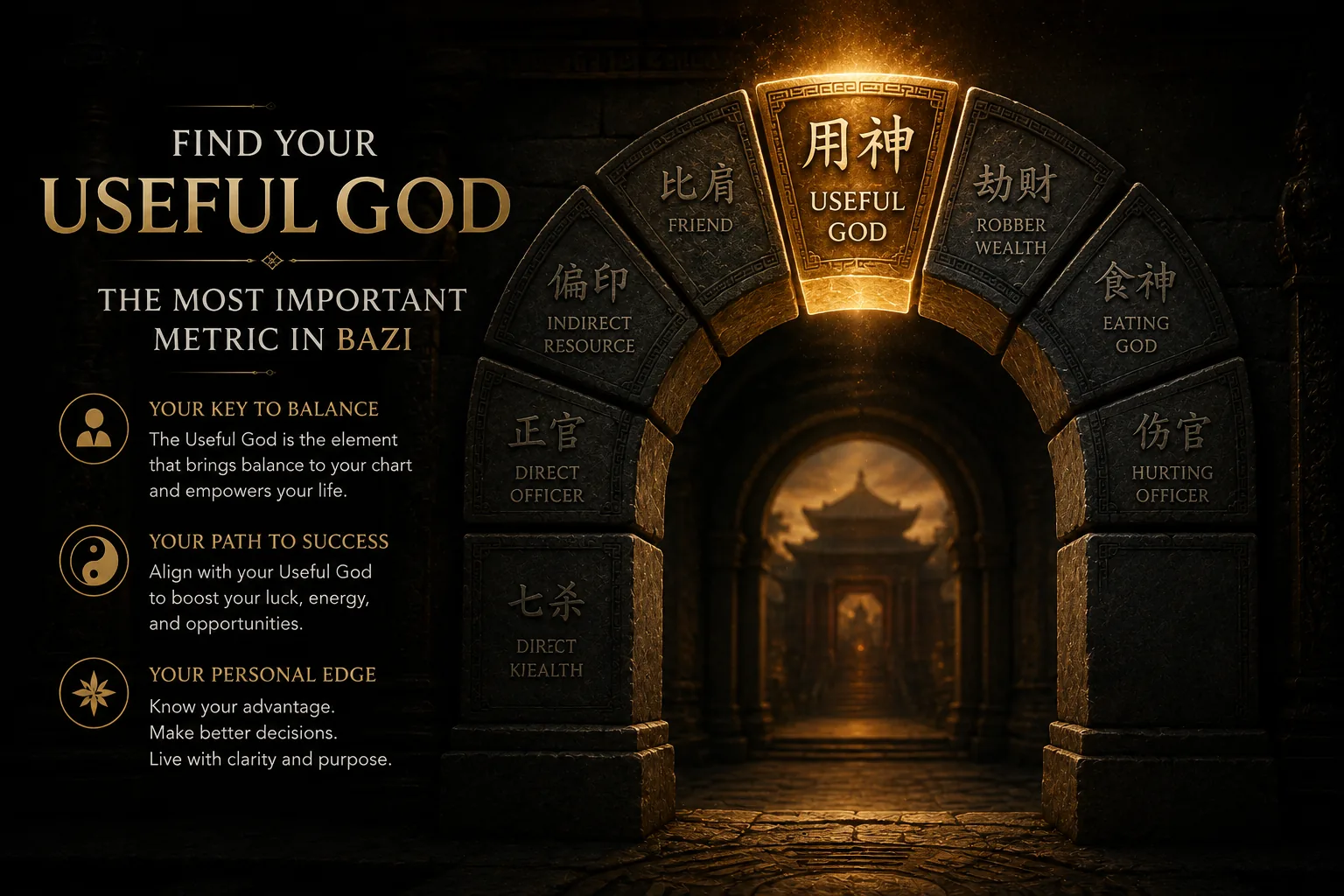
What Is the Useful God (Yong Shen) in BaZi?
If you have spent any time reading about your BaZi chart, you have almost certainly run into the phrase Useful God (用神, yòng shén) — sometimes translated as "favourable god," "yong shen," or "your lucky element." You probably nodded along, wrote it down, and then quietly noticed that nothing you read actually explained what it is, or why one app told you it was Yin Wood while another said it was Yang Water and a third refused to tell you at all.
You are not doing anything wrong. This is the single most important concept in the entire classical system, and it is also the one that gets the most badly mangled online. Almost every "free BaZi calculator" either skips it, faked it with an invented "balance score," or picked a plausible-sounding element and moved on.
So let's do it properly. This is the reference guide to the Useful God — what it means, where it comes from, how to find yours, and what to do once you have it. If you are lost about your own chart and searching for something concrete, start here.
You will want your Day Master and pattern to hand as you read. If you don't know those yet, open your Day Master guide in another tab, then come back.
What people are really asking when they type "what is my Useful God"
What is my Useful God? — the search behind almost every visit to this page. What people mean is usually one of three questions in a trench coat:
- Which element am I supposed to be leaning into?
- Why does my life feel like it works in some seasons and drags in others?
- Which of the ten stems (甲乙丙丁戊己庚辛壬癸) should I be feeding, and which should I be careful of?
The Useful God answers all three at once. It is not a horoscope. It is not a talisman. It is the classical answer to a very specific structural question: given the shape of your chart, which element is the one it is built to protect?
Get that right and everything else — favourable colours, favourable directions, favourable careers, favourable years, favourable people — starts to fall out of it like consequences of a proof. Get it wrong and every piece of advice you receive after that is pointing you in the wrong direction.
What the Useful God actually is
The classical name is 用神 — literally "using god." Ignore the "god" part. It is borrowed vocabulary from the Ten Gods framework, not theology. A cleaner translation is the pivot element or the element the chart is built around.
Here is the working definition. Your Useful God is the one element in the classical system that, when supported, makes your chart work — and when damaged, throws everything off. Every other favourable/unfavourable judgment (which stems help you, which years agree with you, which people wear the right energy for you) is derived from it. Not around it. From it.
Think of it structurally. Your chart is a small ecosystem. There is one keystone species — remove it and the ecosystem collapses; feed it and everything else falls into place. The Useful God is the keystone.
Two more properties that will matter later:
- The Useful God does not change. It is fixed at birth. What changes is whether the current year and Luck Pillar are feeding it or attacking it — which is why your life feels good in some decades and hard in others while your Useful God stays the same.
- The Useful God has a bodyguard. Classical texts call it the Supporting God (相神, xiāng shén). More on that below, because it is the concept most modern readings drop entirely, and it is where the analysis gets seriously good.
The one thing "Useful God" is NOT
It is not simply "the element you are missing from your chart."
This is the most common mistake, and it is baked into a lot of pop-BaZi content and apps: count the five elements, find the one with the lowest count, call it the Useful God. Done.
That is not the classical method. It is a shortcut invented for calculators that could not model the pattern system. The classical Zi Ping method (子平法), which is what the serious tradition uses, derives the Useful God from your pattern (格局, gé jú) — the shape of your chart — and your Day Master strength. Two people can have identical element counts and completely different Useful Gods, because their patterns are different.
If a tool tells you your Useful God without ever mentioning your pattern, that tool skipped a step. It might still be right; more often it is wrong. The pattern is the entire game.
How do I find my Useful God?
Now we get to the mechanical answer. In the classical system, finding the Useful God is a definite procedure with four steps. It is not intuition. It is not a vibe. It is a decision tree.
Step 1 — Start at the Month Branch
Look at the branch under your month pillar — the second of the four branches (子丑寅卯辰巳午未申酉戌亥). This is the single most important cell in your chart for pattern identification. The classical texts are unanimous on this: 月令為根本 — "the month command is the root."
Why? Because the month branch controls the ambient qi at the moment you were born. It has more weight than any other single position in the chart for establishing which element dominates. It is the branch whose hidden stems (the 藏干 — the stems concealed inside the branch) become the starting candidates for your pattern.
Step 2 — Read the hidden stems
Every earthly branch conceals one to three heavenly stems. 子 hides 癸 alone. 寅 hides 甲, 丙, 戊. 辰 hides 戊, 乙, 癸. There is a full lookup table for this — you don't guess.
Within those hidden stems, one is the commanding stem (月令司令) — the one that rules that month. In the four "pure" branches (子午卯酉), the commanding stem is obvious; there is only one. In the "growth" branches (寅巳申亥) it is the primary stem — 甲 for 寅, 丙 for 巳, and so on. In the four "tomb" branches (辰戌丑未), the commanding stem depends on whether one of the branch's hidden stems is transparent — that is, visible among your four heavenly stems. If a hidden stem transparently appears in the stems above, it takes command. If none of them do, the primary hidden stem (本氣) is used as the commanding proxy.
Whichever stem commands the month, that stem's relationship to your Day Master (as one of the Ten Gods — Direct Officer 正官, Wealth 財, Seal 印, Food God 食神, Seven Killings 七殺, Hurting Officer 傷官, Rob Wealth 劫財, or Friend 比肩) is your pattern.
That pattern is the door your Useful God comes through.
Step 3 — Judge your Day Master strength
Before you can name the Useful God, you need to know if your Day Master is strong (身強), weak (身弱), or balanced. This is not eyeballed — it is rooted in classical rules about how many of your four branches "root" your Day Master's element (its own element, or the element that generates it), and how the seasonal timing counts. You can read the full method in the strong vs weak Day Master guide.
For now, the short version: a strong DM is nourished; a weak DM is drained. The classical rule of thumb is:
- If your Day Master is strong, the Useful God is usually the element that gives it something to do — spends its energy productively (Wealth, Food God, or Officer/Killing).
- If your Day Master is weak, the Useful God is usually the element that supports it — Seal or Friend.
This is only a heuristic. It gets refined by the pattern. Do not stop here.
Step 4 — Apply the pattern's rule
This is the step almost every free tool skips. Each of the eight classical patterns has its own explicit rule for naming the Useful God. Once you know which pattern you have, the Useful God is essentially named for you by the classical formula.
The eight patterns and their Useful God logic — the actual, complete, cited-from-the-classical-record answer — get their own section below. Let's go through them one at a time, because this is the entire point.
The eight patterns and their Useful Gods
Every non-external chart in classical BaZi belongs to one of these eight patterns. Once you know yours, most of the interpretive work is already done for you — you don't have to reinvent it.
1. Direct Officer (正官格) — the Useful God is the Officer, protected by Wealth or Seal
Your pattern is Direct Officer if the commanding stem of your month branch relates to your Day Master as Direct Officer — the element that controls your Day Master with opposite Yin/Yang polarity. Yang Wood (甲) uses Yin Metal (辛) as its Direct Officer. Yang Fire (丙) uses Yin Water (癸). And so on down the ten stems.
The Useful God is the Officer itself. The whole shape of the chart is built around it. Your favourable elements are the ones that support the Officer — either Wealth (財), which feeds the Officer, or Seal (印), which cushions your Day Master so the Officer's pressure becomes authority rather than crush.
Your unfavourable elements are the ones classical texts call the Officer's enemies: Hurting Officer (傷官), which directly attacks the Officer (this is the famous 傷官見官 configuration — "Hurting Officer meets Officer," a red flag in career readings); Seven Killings (七殺) mixed in alongside the Officer (this is 官殺混雜, "Officer and Killing muddled," which turns clean authority into confused pressure); and heavy Rob Wealth (劫財), which eats the Wealth that was supposed to feed the Officer.
Concrete example. You are Yin Wood (乙) born in a month whose commanding stem is Yang Metal (庚). Yang Metal is your Direct Officer. Your Useful God is 庚. You lean into stems that support it (moist Earth like 己 Yin Earth, which generates Metal) or protect it. You are wary of Yang Fire (丙) — Yin Wood's Hurting Officer — which will directly damage the Officer that your entire chart is built around.
2. Wealth (財格) — the Useful God is Wealth, and the whole engine is DM → output → Wealth
Why can't I hold onto money? If you found this article by typing that question, and your pattern turns out to be Wealth, the answer is often in your chart's structure. The Wealth pattern occurs when the month branch's commanding stem is Wealth for your Day Master — the element your Day Master controls. Yang Wood controls Earth, so Yang Wood in an Earth-command month is a Wealth pattern.
The Useful God is Wealth itself. The favourable structure classically stated as 食傷生財 — "output generates Wealth" — means your Day Master's productive output (Food God 食神 or Hurting Officer 傷官) is what turns into Wealth in your life. Not luck. Not appearances. Output.
Your favourable elements: Food God / Hurting Officer (they produce your Wealth), and often the Officer (Wealth that feeds Officer, 財旺生官, is the prestigious wealth-into-status pathway). If your Day Master is weak, add moderate Seal as a stabiliser.
Your unfavourable elements: Rob Wealth and Friend (比劫), which steal Wealth away — this is often the classical structural reason for the "money comes but doesn't stay" complaint. Also heavy Seal, which chokes off the Food God / Hurting Officer that generates the Wealth in the first place.
Concrete example. Yang Fire (丙) born in a Metal-command month. Metal is your Wealth. Your Useful God is Metal — specifically the Yang Metal (庚) if the commanding stem is 庚, Yin Metal (辛) if it's 辛. Your favourable output stems are Yang Earth (戊) and Yin Earth (己) — they turn your energy into Wealth. Your careful list starts with Yin Fire (丁), your Rob Wealth, who represents peers and partners who quietly compete with you for what you earn.
3. Seal (印格) — the Useful God is the Seal, protected against Wealth
The Seal pattern (印格) forms when the commanding stem generates your Day Master. Yang Wood generates from Water. Yin Fire generates from Wood. And so on.
The Useful God is the Seal — protection, nourishment, credentials, mother-figure energy, formal education, institutional support. This pattern belongs to the person whose chart is built around receiving support and channelling it into achievement.
The classical warning is stark: 財壞印 — "Wealth destroys the Seal." Wealth in this pattern is not helpful; it directly damages the Useful God. Which is why Seal-pattern people often feel drained by pure money-chasing environments and thrive in structured, credentialled, institutional ones. If you are wondering why you keep leaving high-paying jobs to go back to school, or why your quiet mentor relationships mean more to you than deals — read your pattern before you diagnose yourself as unambitious.
Favourable: Officer and Seven Killings (they generate the Seal — the classical 官印相生 or 殺印相生 chain), and moderate Seal itself.
Unfavourable: Wealth (destroys the Seal), heavy Food God / Hurting Officer (drains the Day Master and starves the Officer that was feeding the Seal).
4. Food God (食神格) — the Useful God is the Food God, and its arch-enemy has a name
Food God (食神格) forms when the commanding stem is what your Day Master generates, at matching polarity. Yang Wood generates Yang Fire — so Yang Wood in a Fire-command month with 丙 transparent above is a Food God pattern.
The Useful God is the Food God. Your chart is built for productive output — writing, teaching, cooking, healing, making things, feeding others.
The classical arch-enemy has its own name: 梟神奪食 — "the Owl steals the food." The Owl is Partial Seal (偏印), the same-polarity Seal element. When Partial Seal appears against a Food God pattern, it strangles the output. Creative block. Ideas that never ship. Half-finished manuscripts. Skills that never quite land in the world. If you are a Food God pattern and you feel constantly stopped just before the finish line, look for the Owl in your chart or in your current year.
Favourable: Wealth (the Food God's natural downstream — 食神生財, "Food God generates Wealth"), moderate Food God itself, and (in the specific Killing-controlling structure 食神制殺) an active Seven Killings that the Food God gets to master.
Unfavourable: Partial Seal (the Owl), Direct Officer (Food God attacks Officer, weakening both), and heavy Rob Wealth if it is diverting the Wealth downstream.
5. Seven Killings (七殺格) — the Useful God is the Killing, but only if it is controlled
Seven Killings (七殺, sometimes translated as Indirect Officer, 偏官) is the same-polarity version of the Officer. It is raw, undomesticated authority. Where the Direct Officer is a boss, the Seven Killings is a challenger.
Here is the classical trick: in the Seven Killings pattern, the Killing itself is still the Useful God — but only because it is being controlled. Uncontrolled Seven Killings is destructive. Controlled Seven Killings, in the classical phrase, produces "generals and chancellors."
There are two great structures for control. 食神制殺 — Food God restrains the Killing — produces the disciplined warrior, the surgeon, the competitive executive, the person who converts raw pressure into precise action. 殺印相生 — Killing generates Seal, which nourishes the Day Master — produces the strategic scholar, the general with theory, the leader who reads.
Favourable: whichever controller your chart runs on (Food God or Seal) plus enough Day Master strength to sit under the Killing.
Unfavourable: for a Food-controls-Killing chart, an incoming Seal that would destroy the Food God controller is the disaster case. For a Killing-generates-Seal chart, incoming Wealth destroys the Seal and the whole chain collapses.
If you have Seven Killings as your pattern and you feel exhausted by high-pressure environments where you have no control mechanism — that is the classical signature. Your Useful God is doing its job only when the controller is present. This is often the pattern for people who thrive brilliantly in one type of workplace and collapse in another that looks similar from the outside; the difference is whether the environment supplies the controller.
6. Hurting Officer (傷官格) — the Useful God depends on which structure your chart chose
Hurting Officer (傷官) is what your Day Master generates at opposite polarity. Yang Wood's Hurting Officer is Yin Fire (丁). Bold, brilliant, non-conforming, allergic to hierarchy, and — when it turns on the Officer — actively dangerous to career stability. The classical shorthand is 傷官見官, "Hurting Officer meets Officer": a warning that shows up in almost every serious career reading.
The Hurting Officer pattern has three main structures. 傷官生財 — the Hurting Officer generates Wealth — is the entrepreneur / performer / innovator engine. Rebellious brilliance channelled into material output. 傷官佩印 — the Hurting Officer wears the Seal — pairs raw expression with the discipline of formal knowledge, and produces high intelligence with an establishment position. 傷官駕殺 — the Hurting Officer tames the Killing — is the fierce, competitive, aggressive-achievement version.
The Useful God is whichever piece your particular chart is built around. For 傷官生財 it is Wealth. For 傷官佩印 it is the Seal. For 傷官駕殺 it is the Killing (once controlled). This is a pattern where you must read the specific structure — the pattern name alone is not enough.
There is one famous exception: 金水傷官 — a Metal Day Master with Water as Hurting Officer, born in winter. This is the one configuration where 傷官見官 is not destructive, and where the Officer is actually welcome. Refined, clear, analytical, eloquent. If you are Yang Metal (庚) or Yin Metal (辛) born in a Water month, this is worth knowing.
7. Yang Blade (陽刃格) — the Useful God is the controller, not the Blade
The Yang Blade (陽刃) forms only for Yang Day Masters (甲丙戊庚壬) when the month branch is the Day Master's peak stage — 卯 for 甲, 午 for 丙 and 戊, 酉 for 庚, 子 for 壬. It is a very specific situation. Yin Day Masters do not have a Yang Blade at all.
The Yang Blade is the Day Master at extreme concentration — full power, no dilution. Without a controller: dangerous. Accidents, extremism, self-inflicted harm, blown-out relationships. With a controller: formidable achievement.
So the Useful God in this pattern is not the Blade itself — the Blade is what's being managed. The Useful God is the controller: Direct Officer (陽刃用官) or Seven Killings (陽刃用殺). This is one of the classical structures that produces exceptional achievement when it works, because the raw power is real. It is also one where "success" looks a lot like being contained by structure — and Yang Blade people who resent structure are often unwittingly resenting the exact thing their chart needs.
Favourable: whichever controller your chart chose, and (usually) the Seal that supports it.
Unfavourable: Food God / Hurting Officer (they attack the controller), and heavy Rob Wealth / Friend (they multiply the Blade further — adding fuel to a fire that already has a discipline problem).
8. Jian Lu / Month Companion (建祿月劫) — the Useful God has to be found elsewhere
This is the honest one. If your month branch is your Day Master's own element (Yang Wood in 寅, Yang Fire in 巳, and so on), the classical texts are explicit: this is not a pattern. It is a condition. Shen Xiaozhan states it flatly: 建祿 has no pattern name.
Your Day Master is naturally strong and self-sufficient. You cannot use your own element as your Useful God. So you look elsewhere in the chart — to the most prominent transparent stem that is not your Day Master's element — and that stem's Ten God role becomes the pattern the chart adopts. If Officer is transparent, you effectively read it as an Officer pattern with a strong Day Master. If Wealth is transparent, a Wealth pattern with a strong Day Master. And so on.
What if my Useful God is missing from my chart? If you are in a Jian Lu / Month Companion condition and no clear Useful God candidate is transparent anywhere in your chart, this is the honest scenario where the classical texts admit the chart lacks a clear pivot. The Useful God can also arrive later — activated by a Luck Pillar or a specific year — even when it is missing from the natal chart. This is one of the reasons the same person can feel "found" in one decade and "lost" in another. The pivot only shows up when it enters the picture.
The Supporting God — the one concept almost every reading skips
Once you know your Useful God, you are only halfway. The classical texts insist on one more concept: the Supporting God (相神, xiāng shén) — the element that enables your Useful God to function.
Shen Xiaozhan is uncharacteristically forceful about this. Roughly: protecting the Useful God matters more than protecting the Day Master, and protecting the Supporting God matters more than protecting the Useful God itself.
Read that again. The most important element in your chart is not the pivot — it is the pivot's bodyguard. Because if the Supporting God is knocked out, the Useful God cannot do its job, and the whole pattern collapses even though the Useful God is technically still there.
Some real Supporting God examples:
- Direct Officer with Wealth support. Useful God = Officer. Supporting God = Wealth. If a heavy Rob Wealth year eats your Wealth, the Officer starves — and it doesn't matter that the Officer is still visible in your chart.
- Direct Officer with Seal support. Useful God = Officer. Supporting God = Seal. If Wealth attacks the Seal, the Seal can no longer cushion the Day Master, and the Officer's pressure turns from authority into pure grind.
- Seven Killings controlled by Food God. Useful God = Killing. Supporting God = Food God. If a Seal-year enters and destroys the Food God, the controlled Killing becomes uncontrolled Killing. This is one of the classical illness / conflict signatures.
- Wealth generating Officer. Useful God = Wealth. Supporting God = the Food God or Hurting Officer generating that Wealth. Kill the generator, and the Wealth becomes an inheritance rather than an engine.
Knowing your Supporting God is what makes a real reading actionable. Anyone can tell you your favourable element. A serious reading tells you your Supporting God — the one thing in your chart that, if you protect it, protects everything else.
Once you know your Useful God, what do you do with it?
Here is where a lot of guides collapse into vague suggestions about wearing green shirts. Let's be more concrete.
Once you know your Useful God, you know:
- Which stems, on any given day, are feeding you and which are draining you — because every day has a stem (the day's 天干), and its relationship to your Useful God is calculable.
- Which years are structurally supportive and which are stress-tests — because every year has a stem and a branch (the year pillar), and their relationships to your Useful God and Supporting God tell you the year's shape. This is exactly the machinery driving our 2026 forecast.
- Which Luck Pillar decades of your life are set up to be your best. Not superstitiously — structurally.
- Which people, roughly, are good energy company for you and which are quietly costing you. Not in a mystical sense — in the sense that their dominant stems either feed your Useful God or attack it.
- Which industries and career shapes are aligned with your pattern's productive engine. Wealth-pattern people who force themselves into pure-service roles with no output-to-value chain often feel their careers make no sense; Seal-pattern people who chase pure profit environments often feel hollow. The pattern is telling you what your engine is built for.
- Which specific stem to lean into for practical guidance — not just "Wood," but 乙 Yin Wood specifically, or 甲 Yang Wood specifically. Polarity matters, because in the classical Ten Gods framework the Yang and Yin versions of the same element are opposite roles. Yin Wood might be your Useful God while Yang Wood is the impurity mate that damages it. "Wood is good for you" would be half right, half wrong. "Lean into 乙, be careful with extra 甲" is the actionable version. Any reading that only names elements without their stems is leaving the specificity on the table.
What does it mean when my Useful God is weak?
What does it mean when my Useful God is weak? — the search phrase, and a real, honest question. It usually means one of three things.
Version 1: The Useful God is transparent but under-rooted. It shows up in your heavenly stems but has no matching branch to anchor it. Classical wording: 用神無根. The pattern is technically formed but fragile. You may feel that your life has a shape, a direction, a "thing you're supposed to be doing" — but you struggle to sustain it. The remedy is any year or Luck Pillar that adds the missing root branch. Those decades will feel like your life "clicks."
Version 2: The Useful God is present but under attack. It is transparent and rooted, but another element in the chart is actively damaging it — Hurting Officer against a Direct Officer pattern, or Wealth against a Seal pattern. The pattern is technically formed but wounded. Look for whether a rescue element (see below) is also present. If it is, you have what the classical texts call 敗中有成 — "success within failure" — and the chart still works, often with a very characteristic story of "everything went wrong and then it worked out."
Version 3: The Supporting God is weak. The Useful God itself is fine, but the element that enables it is under-rooted, combined away, or being attacked. This is the sneakiest version, because on paper your chart looks fine. In practice you feel like your engine is missing something you can't name.
For all three versions, the classical remedies are: identify the specific weakness, watch the Luck Pillars for arrivals that fix it, and — in daily life — favour the stems and directions that fortify the specific vulnerable element rather than a generic "favourable element" list.
Can I have more than one Useful God?
Can I have more than one Useful God? — a common question, and the classical answer is: strictly speaking, no. The Useful God is a single element, singular by design. It is the pivot.
But — and this is where the pop version misleads — the favourable elements around your Useful God are plural. Your Useful God + your Supporting God + the elements that generate or protect either of them together make up your favourable list. It is normal to see two, sometimes three elements marked favourable in your chart. That is not "multiple Useful Gods." That is one Useful God with its ecosystem.
There is also a special situation called 病藥 — "disease and cure." When your chart has a specific structural problem (a disease element damaging the pattern), the classical texts identify the cure — the element that removes the disease. In some readings, this cure is called the "medicinal Useful God." It is still one pivot; it is just that the pivot's job is to cure a specific structural illness rather than to build a productive engine. Charts with the disease-and-cure structure often have very legible, dramatic life stories: the shape of the life is about the illness and the cure.
Why do two apps tell me two different Useful Gods?
Because they are using two different methods, and only one of them is classical.
The three most common "Useful God" methods you see online are:
- Missing element method. Count the five elements; whichever is missing or lowest is called the Useful God. This is not classical Zi Ping and it is often wrong.
- Balance score method. Assign invented numerical weights to each element in the chart, compute a "balance score," pick a favourable element off the score. This looks precise. It is invented math — none of it maps to the classical texts. Different apps use different weights and get different results, which is exactly why you get contradictions.
- Pattern method (Zi Ping). The classical procedure — month branch, pattern identification, Day Master strength, pattern-specific rule. This is what serious readers use, and it is what Ming Map uses.
If you want a quick test for whether a tool is doing the classical thing: ask which pattern it identified for you. If it can't name your pattern (Direct Officer, Wealth, Seal, Food God, Seven Killings, Hurting Officer, Yang Blade, or the Jian Lu condition), it isn't using the classical method. It is guessing, no matter how confident the output looks.
FAQ
Is the Useful God the same as my lucky element? Yes and no. Your favourable elements — the ones that feed and protect your Useful God — are effectively your "lucky elements" in the pop sense. But most tools that promise your "lucky element" skip the pattern step, so they often get it wrong. The Useful God is a specific classical concept with a specific derivation. "Lucky element" is what people call it after the derivation is done — or, more often, after the derivation is skipped.
Am I doing something wrong if my life isn't matching my Useful God? No — you are almost certainly in a Luck Pillar or year where your Useful God is under-supplied or under attack. Your Useful God is fixed at birth, but its activation shifts across your life. A chart whose Useful God is Fire will feel supported in Fire-heavy decades and stretched in Water-heavy ones. This is not a moral judgment about your effort. It is your chart's weather.
Can my Useful God change over time? The natal Useful God does not change. What changes are the activated favourable elements — via Luck Pillars, annual pillars, and combinations that bring hidden stems to the surface. So the same person can feel like a different set of elements matters in their 30s than in their 50s, even though the Useful God underneath is the same.
Am I meant to be alone if my pattern is Seven Killings? No. Seven Killings pattern people often have very intense relational lives, not solitary ones. What Seven Killings needs is a controller — a Food God or a Seal — showing up somewhere in your life, sometimes literally as a specific partner-type. Look at what the chart is asking you to structure, not at whether the chart is asking you to be alone. Almost no classical pattern points to enforced solitude; that is a modern misread.
My chart shows Jian Lu / Month Companion and no clear Useful God — is that bad? It is a real condition, not a curse. Classical texts describe it directly: your Day Master is strong enough that no pattern forms from the month branch, and you have to find your Useful God from the transparent stems elsewhere. If no clear candidate is present, your chart is genuinely waiting for a Luck Pillar or year to bring one in. When that arrival happens, life often "makes sense" in a way it didn't before.
Should I get a tattoo of my Useful God? Genuinely no comment on tattoos, but here is the underlying question: can I amplify my Useful God through symbols? The classical answer is that environmental influence — colours, directions, materials, careers, relationships, timing — is real and stackable, but it works at the margin. It cannot rewrite the natal chart. Wearing your Useful God's colour every day will not overcome a Luck Pillar that is attacking it. Compound many small alignments and yes, they add up. But no single object is the answer.
Is the Useful God the same across all Chinese metaphysics traditions? The concept exists across traditions but is defined differently. In the Zi Ping tradition (the mainstream classical BaZi method), the Useful God is what this article describes. In the Blind School tradition, the derivation differs. In Purple Star Astrology (紫微斗數), the concept doesn't exist at all — that system uses stars, not stems. If you have received "Useful God" readings from different traditions and gotten different answers, it may just be that they were using different systems.
Why does the classical method emphasise the Month Branch so much? Because the Month Branch controls the ambient qi at your moment of birth — the seasonal texture your Day Master had to grow inside. A Wood Day Master born in a Water month is a completely different creature than one born in a Fire month, even if everything else about their charts is identical. The Month Branch is the ecological niche. Everything downstream flows from what that niche produces.
Closing note
The Useful God is not a talisman. It is not "the element that makes you lucky." It is a structural fact about your chart — the specific stem your chart was built to protect, and the source of everything else the classical system will tell you about which years, which people, which places, which stems are working in your favour and which are quietly working against you.
You do not need to memorise the eight patterns. You do not need to compute your Month Branch's commanding stem by hand. What you need is a tool that will do the derivation correctly — one that can tell you which classical pattern your chart is, and derive your Useful God from that pattern rather than from an invented balance score.
That is exactly what Ming Map is built to do. Enter your birth date and it will identify your pattern, name your Useful God with polarity (down to the specific stem — 甲 or 乙, 丙 or 丁), name your Supporting God, and show you which years and Luck Pillars are feeding it or attacking it. No invented math. No guessed thresholds. Every claim is traceable to a specific classical rule.
If you have been searching for something concrete about your own chart — start there. Your Useful God is the door.
Related guides: Day Master · Strong vs Weak Day Master · Ten Gods · Five Elements · Luck Pillars · 2026 Forecast