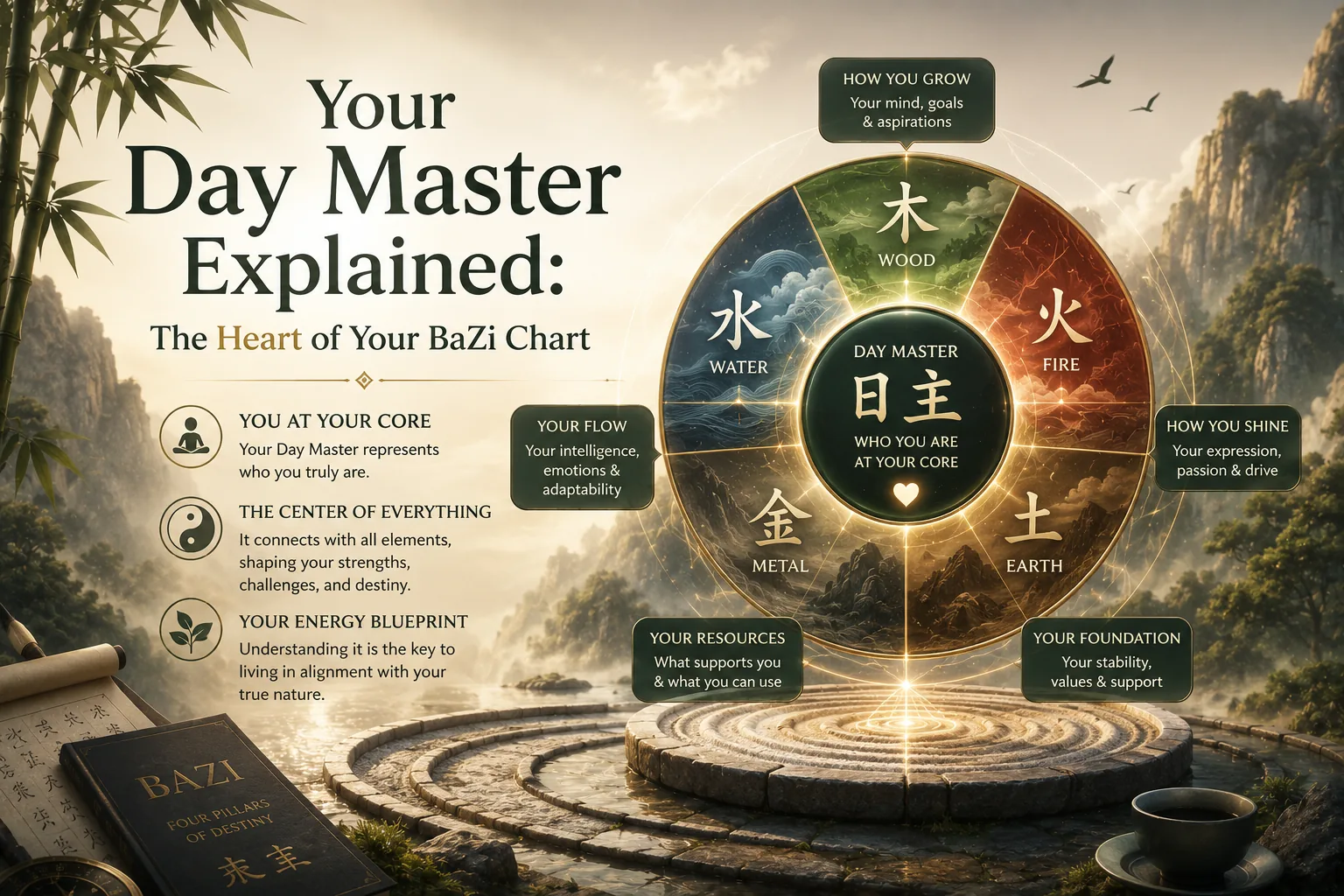
Your Day Master Explained: The Heart of Your BaZi Chart
If you have arrived here, chances are you have already run a BaZi chart somewhere and been told: your Day Master is 丙 Yang Fire, or your Day Master is 乙 Yin Wood, or one of the other ten. And underneath that label, quiet but real, you are asking: what does that actually mean for me?
Not in the horoscope sense. Not the "Yang Fire people are outgoing" fortune-cookie version. You want to know: is this why I burn out? Is this why I can't hold onto money? Is this why relationships feel like they take twice as much energy as they should? Am I meant to be alone? Am I doing something wrong?
Your Day Master is the closest thing BaZi has to a single answer to those questions. It is not the whole answer — a full reading needs your other pillars, your Useful God, your Ten God constellation, and your Luck Pillars — but it is the centre of gravity. Every other part of your chart is read in relation to it.
This guide walks all ten Day Masters at real depth: the classical image, the natural strengths, the shadow tendencies, what nourishes you, what depletes you, and how the strong/weak axis changes the whole prescription. If you already know your Day Master, jump to your stem below. If not, we will show you how to find it in about ninety seconds.
What is my Day Master?
Your Four Pillars are Year, Month, Day and Hour. Each pillar is two characters — a Heavenly Stem (天干) sitting on top of an Earthly Branch (地支). The Heavenly Stem of your Day pillar is your Day Master (日主), also called 日元 or 日干.
That single character represents you. Not your role, not your job, not your persona — the core self that everything else in your life either supports, drains, controls, or is controlled by.
There are exactly ten possibilities, because there are ten Heavenly Stems. They map to the five elements in Yang and Yin form:
- 甲 Jiǎ — Yang Wood
- 乙 Yǐ — Yin Wood
- 丙 Bǐng — Yang Fire
- 丁 Dīng — Yin Fire
- 戊 Wù — Yang Earth
- 己 Jǐ — Yin Earth
- 庚 Gēng — Yang Metal
- 辛 Xīn — Yin Metal
- 壬 Rén — Yang Water
- 癸 Guǐ — Yin Water
You cannot deduce this from your birth year alone (that just gives you your zodiac animal, which is only the Year Branch). You need the exact date of birth, converted through the classical calendar to the correct Day pillar. Any real BaZi engine — including Ming Map — will name it in seconds.
What does my Day Master say about my personality?
The classical texts describe each Day Master through a natural image: a tree, the sun, a mountain, a jewel. These images are not decoration. They are the compressed, memorable shorthand that classical BaZi masters use to encode how the stem behaves under pressure.
A Yang Wood person really does behave more like a tall tree than a vine. A Yin Water person really does move more like rain than an ocean. When you understand your image, you understand — in a way no personality test can quite match — the rhythm you are built to work in, the environment that grows you, and the environment that quietly dries you out.
Below is the full walkthrough of all ten. Read your own carefully. Then read the one across from you (甲/乙, 丙/丁, 戊/己, 庚/辛, 壬/癸) — because the Yang-Yin pair shares an element but differs sharply in how it uses that element. Understanding the contrast is how you stop confusing yourself with someone who looks similar on paper.
甲 Yang Wood — the Tall Tree
Image. The mature, upright tree. Pine, oak, cedar. Roots that go deep, a trunk that will not bend easily, a crown that reaches for the sun. Classical texts also call 甲 the living qi of Wood — the upward, generative force that pushes life through everything.
Natural strengths. You are principled, direct, ambitious in a slow-burn way. You build vertically — careers, families, institutions — and you like the structure to be visible. You do not usually enjoy being told what to do, but you enjoy being the person people rely on. You are the friend who says the true thing at dinner. You are the founder who cares about the mission more than the exit.
Shadow tendencies. Rigidity. You would rather break than bend. You mistake your convictions for laws of nature, and you can be surprisingly bad at small compromises. Under stress you go silent and stubborn instead of adaptive. In relationships, you can be the one who says "this is who I am, take it or leave it" — and then are hurt when people leave.
What nourishes you. Water (印 Resource) — reading, mentors, deep study, slow reflection. Rich soil at your feet — meaningful home, meaningful place. Fire (食傷 Output) as sunlight, but only if you have enough Water in the ground first.
What depletes you. Too much Metal (官殺) — chronic authority pressure, being cut back, endless correction from above. Too much Fire with no Water — visibility without rest. Being uprooted repeatedly — too many moves, too many career shifts, no place to sink roots.
In the chart. Well-rooted 甲 (with real Wood and Water in the branches) grows into whatever it takes on. Weak 甲 (Fire-heavy or Metal-heavy natal chart with little Water) is a young sapling in a bright room — needs shade, needs water, and must resist the pressure to grow taller before the roots are ready.
乙 Yin Wood — the Vine, the Grass, the Flower
Image. Living Wood in its supple form — vines, grass, flowers, cultivated plants. Everything green that bends without breaking. 乙 is the body of Wood: leaves, petals, tendrils.
Natural strengths. Adaptability is your genius. You survive rooms where 甲 gets cut down. You find sunlight through cracks. You are relational, socially aware, aesthetically alive. You often make your way through the world by cultivating — cultivating relationships, gardens, taste, craft. You are the one who quietly knows everyone. Your work often has an unusual longevity because you never depended on brute strength.
Shadow tendencies. People-pleasing. You bend so well that sometimes you forget which way you wanted to grow. You can be quietly resentful when others take credit for the ground you prepared. You are prone to entangled relationships — friendships that become co-dependencies, partnerships where you cannot tell which needs are yours anymore.
What nourishes you. A trellis — a structure to climb (a strong partner, an institution, a mentor). Gentle Water. Warmth without scorching. Being chosen — 乙 blooms when it feels safely rooted in someone else's ground.
What depletes you. Being expected to lead structurally like 甲. Excess Metal cutting your growth. Prolonged drought — emotional starvation from partners who do not water you back. Extreme Fire with no shade — 乙 in an unregulated 丙午 environment withers fast.
In the chart. Strong 乙 (with Wood roots and Water) is the vine that climbs the whole wall. Weak 乙 needs its Water and its trellis before anything else. If you are weak 乙 and asking why does everything feel harder for me than it seems to for other people — often the answer is you are trying to live like 甲 without the frame for it.
丙 Yang Fire — the Sun
Image. The Sun. Not a candle, not a bonfire — the ultimate radiant source. 丙 illuminates whether it wants to or not. It cannot hide. It rises, it sets, and its light lands on everything in between.
Natural strengths. You are naturally warm, generous, and visible. Rooms notice when you walk in. You radiate — encouragement, ideas, presence, sometimes just heat. You are often the person other people turn to for optimism, for energy, for the reason to keep going. You are good at making things public: launches, communities, movements, brands.
Shadow tendencies. You confuse warmth with self-worth. When you are not shining, you feel invisible — and you overreact to that invisibility by scaling up your output until you burn out. You can also be unaware of what you scorch — the friend whose feelings you missed, the employee you overwhelmed, the partner who cannot get a word in edgewise. The Sun does not think about shade.
What nourishes you. Wood (印 Resource) as fuel — a real mission, a real philosophy, real study. Earth (食傷 Output) to give your heat a place to land — students, audiences, communities that need what you have. Sleep. Genuinely, sleep. 丙 without rest is the fastest burnout profile in the entire system.
What depletes you. Rain (壬癸) with no wood between you and it — cold criticism straight onto the source. Prolonged solitude with no one to shine on. Endless competition with other 丙 (peers who match your wattage and just... don't stop).
In the chart. Strong 丙 (Fire-abundant or well-rooted in 巳午寅戌) is unmistakable. Weak 丙 (Water-heavy or Fire-scattered) is the Sun behind clouds — real light, still, but always working around the weather. Weak 丙 that keeps trying to shine harder without rebuilding fuel is one of the classic burnout profiles. If you are weak 丙 asking why am I so tired all the time, that is often the answer.
丁 Yin Fire — the Lamp, the Candle, the Refined Flame
Image. Contained, deliberate fire — the lamp, the candle, the hearth, the smith's forge. Fire that has been given a purpose. 丁 does not blast; it illuminates specific things very well.
Natural strengths. Precision. Intuition. Depth of focus. You are the person other people call when the situation needs to be understood, not just publicised. You are the private counsellor, the expert, the craftsman, the technician, the healer who works one to one. Your light is smaller than the Sun's, but it lands on things the Sun can never see — the specific problem, the specific person, the specific detail.
Shadow tendencies. Under-visibility. You do good work and no one knows. You watch louder people get promoted while you get "reliable." You are prone to quiet resentment. You also, sometimes, hold onto the flame too tightly — you make yourself indispensable so no one else can do what you do, and then you are trapped by your own irreplaceability.
What nourishes you. Wood (印 Resource) — but the right kind of wood, dry and refined; a good teacher, a specific tradition, a lineage. A well-tended container: a workshop, a studio, a private practice, a team small enough that your light matters. Being seen by the few people who understand what you do.
What depletes you. Wind — chaotic environments, loud competition, big rooms. Prolonged darkness — long stretches with no one to serve. Being asked to be 丙 — to be the loud one, the face, the "personality." 丁 pretending to be 丙 gutters and dies.
In the chart. Strong 丁 (with Wood roots and steady support) is the eternal flame in the temple. Weak 丁 needs to protect its container more than most Day Masters — small, deep, precise work; a few real relationships; disciplined rest.
戊 Yang Earth — the Mountain
Image. The high, immovable mountain. Bedrock. The dam that holds back the river. 戊 is Earth in its most solid, structural form — Earth as architecture.
Natural strengths. Reliability. You are the person other people build their lives around. Colleagues trust you. Family relies on you. You keep your word. You think in decades, not quarters. You are unusually good at holding a position — literally, geographically, emotionally, financially. When storms come, other people stand next to you.
Shadow tendencies. Immovability disguised as principle. You confuse stubbornness with strength. You can be slow to update your model of the world, slow to say what you feel, slow to admit you need help. Under prolonged pressure you go inward instead of adapting — and then you wonder why everyone else moved on without you. You can also isolate — mountains are large, but they are alone.
What nourishes you. Fire (印 Resource) — a warming purpose, a warming home, a warming faith. Water (財 Wealth) in measured amounts — 戊 dams water, and running a reservoir is one of the great 戊 careers. Trees on your slope — Wood (官殺) that gives you responsibility and a role.
What depletes you. Excessive Water with no channel — chaos with no structure to hold it. Being asked to be nimble when your gift is stability. Loneliness. Erosion — small daily criticisms and disappointments over many years that quietly wear the mountain down.
In the chart. Strong 戊 (Earth-heavy, with Fire warming it) is the institution that outlasts empires. Weak 戊 (Wood-heavy or Water-heavy natal chart) is asked to hold more weight than it has been given foundation for — and often responds by holding it anyway, silently, until something cracks. Weak 戊 in that position needs to build the foundation before adding load: rest, mentors, structure, saying no.
己 Yin Earth — the Field, the Garden, the Soil
Image. Cultivated, fertile ground. The garden, the paddy, the vineyard, the topsoil. 己 is Earth as nurturance — the substrate from which life grows.
Natural strengths. You are quietly generative. Things grow around you. Colleagues become better colleagues. Friends become their best selves. Your children thrive. Your gardens produce. You have a diplomatic, accommodating intelligence — you understand what different people need in different seasons, and you provide it without making a fuss about it.
Shadow tendencies. Self-erasure. You over-give until there is nothing left in the soil. You are prone to being taken for granted — because you make it look easy, people assume it is easy. You can also be surprisingly resentful in private; the field that has been over-farmed for years turns bitter. And 己 can be muddy — indecisive, absorbing whichever influence is nearest.
What nourishes you. Fire (印 Resource) — sunlight, warmth, meaning; institutions, teachers, structured beliefs. Fallow seasons — the strict practice of rest. Wood (官殺) that gives you a reason to grow — a role, a responsibility, a person you serve on purpose.
What depletes you. Constant harvest with no rest. Cold rooms — emotional environments without warmth. Being expected to be as immovable as 戊. Trying to hold structure like a mountain instead of nourishing like a garden.
In the chart. Strong 己 (with real Fire warming and Earth support) is a field that feeds a village. Weak 己 that keeps giving without receiving is one of the most common "quiet crisis" profiles — you are asking why am I always the one holding it together, and the honest classical answer is: because you are, and you are not being watered back.
庚 Yang Metal — the Axe, the Sword, the Raw Ore
Image. Unrefined, powerful Metal. The axe, the sword, the raw iron, the ore in the ground. 庚 is Metal that has not yet been shaped — the strength is there, the edge is there, the weight is there.
Natural strengths. Decisive. Direct. You cut. You clarify. You will say the hard truth in the room where everyone else is dancing around it. You are extremely good in high-stakes situations — surgery, litigation, crisis management, hard business decisions. You have a natural authority that people either follow or fear. You are the person other people call when the situation needs to be ended.
Shadow tendencies. Bluntness read as cruelty. You can wound people without noticing. You mistake efficiency for intimacy — the shortest route through a conversation is not always the best one. You can be terrible at things that require slowness: emotional processing, ambiguous relationships, mourning, waiting. And 庚 without refinement can become destructive — cutting for the sake of cutting, judging for the sake of judging.
What nourishes you. Fire (官殺) — the forge that refines you into a weapon with a purpose. Real challenge. Real accountability. Earth (印) as ore-bed — a solid identity, a solid tradition. Water (食傷) sharpens the blade — reflection, ideas, articulation.
What depletes you. Prolonged idleness — an unforged 庚 rusts. Environments where directness is punished. Endless small talk. Being surrounded by people who cannot handle the truth you naturally speak.
In the chart. Strong 庚 (Earth support, moderate Water) is a forged blade that lasts. Weak 庚 in a Fire-heavy environment (see the 2026 forecast for the 丙午 example) is the raw ore that gets melted before it can be shaped — the classical warning is severe. Weak 庚 needs protection before it needs sharpening: mentors, structure, health-first choices, guardrails.
辛 Yin Metal — the Jewel, the Blade, the Refined Ornament
Image. Refined, finished Metal. The jewel, the polished blade, the surgical instrument, the delicate ornament. 辛 is Metal that has already been worked — every bit of it has purpose.
Natural strengths. Precision. Discernment. Taste. You are the person whose judgment other people quietly rely on. You notice details others miss. You have an instinct for quality, for image, for what will and will not endure. Aesthetic professions, legal professions, judicial professions, high-precision technical professions all suit you. You often care — perhaps more than any other Day Master — about reputation and standing.
Shadow tendencies. Image-management as identity. You can spend so much time keeping the surface flawless that you forget what is underneath. You are prone to perfectionism that stops you from shipping. You can be quietly, elegantly, devastatingly cutting when hurt — the polished blade goes deeper than the raw axe. And 辛 can be fragile — a beautiful blade breaks under force that raw ore would absorb.
What nourishes you. Water (食傷) — polishing, refinement, articulation, reflection. Earth (印) — the setting the jewel sits in; institutions, tradition, standing. Being seen for your precision, not just your performance.
What depletes you. Rough handling. Crude environments. Being asked to be 庚 — to be the raw, direct one — when your gift is refinement. Prolonged exposure to unrelenting Fire (官殺) without support: brilliant careers that burn the person out.
In the chart. Strong 辛 (Earth-rooted, moderate Water) is a jewel with a setting worthy of it. Weak 辛 needs the setting before the polish — pick your platforms carefully, protect your health, and do not accept high-title-low-support roles that will eat you alive.
壬 Yang Water — the Ocean, the River
Image. The great body of water in motion. The ocean, the great river, the tide. 壬 moves — always. It carves canyons over time. It carries ships. It reaches every shore eventually.
Natural strengths. Vision, mobility, and range. You think in horizons, not in nearby fields. You are drawn to travel, to scale, to systems that connect. You are unusually resourceful — like water, you find a way around obstacles. You are often the person who can see the whole map when others are focused on their tile. Finance, trade, deal-making, media, logistics, and international careers suit you.
Shadow tendencies. Restlessness. You struggle to stay. You mistake motion for progress. Under stress you flood — you take on too many streams at once, and none of them end up carrying real weight. You can also be elusive in relationships — always partly somewhere else, always partly promising the next horizon, rarely fully here.
What nourishes you. Metal (印 Resource) as the source that keeps the river running — study, principles, disciplined thought, tradition. A channel — a real career, a real container, a real partnership that gives the water something to run through. Deep rest between currents.
What depletes you. Too much Earth (官殺) blocking you into a role that has no flow. Environments where you cannot move at all. Losing the source — running the river without renewing what feeds it. Loneliness without depth — you have wide, shallow relationships and are quietly starving.
In the chart. Strong 壬 (Water-heavy or Metal-fed) is a river that turns wheels along its whole length. Weak 壬 needs to concentrate — fewer streams, more depth, real containment. If you are weak 壬 asking why can't I hold onto money, part of the answer is often that Wealth (財) needs peer support to be captured — meaning you need collaborators, not more solo streams.
癸 Yin Water — the Rain, the Dew, the Quiet Water
Image. Water in its subtle forms — rain, dew, mist, groundwater, the spring. 癸 is water that has slipped past being noticed. It arrives where it needs to. It touches everything gently. It disappears if you try to grab it.
Natural strengths. Intuition, sensitivity, quiet penetration. You feel what other people cannot say. You often know the truth of a room before anyone speaks. You are drawn to depth work — therapy, research, writing, healing, art that requires long stillness. You are the person others feel unusually safe with. You are frequently the one holding the emotional water table of a family or a workplace without anyone naming it.
Shadow tendencies. Evaporation. You are prone to disappearing — into overwhelm, into other people's needs, into your own inner world. You can be quietly avoidant when directness is required. You can also feel too much, absorb too much, and then experience it as chronic fatigue, chronic anxiety, or chronic somatic difficulty because you never had a way to drain what you took in.
What nourishes you. Metal (印 Resource) — study, disciplined practice, tradition, structure. Silence. Genuine rest. Being specifically loved by a few real people, not diffusely loved by many. A container — a discipline, a practice, a place — that keeps you from evaporating.
What depletes you. Heat with no shade. Big loud rooms. Being asked to be 壬 — the mobile, expansive one — when your genius is subtle presence. Prolonged social exposure without recovery.
In the chart. Strong 癸 (with Metal source and moderate roots) is the spring that feeds a whole village. Weak 癸 (Fire-heavy or Earth-heavy natal chart) dries fast under pressure — and the classical prescription is unambiguous: protect your source. Fewer commitments, deeper ones. Real rest as a real strategy, not an afterthought.
Which Day Master is best?
The classical tradition is emphatic: none. There is no "best" Day Master, and any teacher who says otherwise is selling you something.
The whole point of the ten-stem system is that each stem is a different instrument, not a different rank. The Sun is not better than the Rain. The Mountain is not better than the Vine. The Axe is not better than the Jewel. What matters is whether your specific Day Master is supported in your specific chart — whether you have the fuel, the container, the room, and the roles you need to actually be your instrument.
A 丁 with the right container will outlast a 丙 with the wrong one. A 己 with real warmth will feed generations. A weak 甲 that finally gets Water is the tree that becomes a landmark. Your work is not to be a different Day Master. Your work is to be your Day Master, properly resourced.
How do I know if my Day Master is strong or weak?
This is the second question every serious BaZi reading answers, right after naming your Day Master. And it is one of the most misunderstood.
Strong and weak here are diagnostic, not moral. They describe how much support your Day Master has across the rest of your chart. They are not a measure of how strong a person you are.
The classical method — which every reputable engine, including Ming Map, follows — judges strength by weighing several concrete factors across all four pillars:
- Season. Were you born in a month whose branch feeds your Day Master's element? (Wood-born in 寅卯 spring months, Fire-born in 巳午 summer months, and so on.) In-season is the biggest single boost.
- Roots. Does your Day Master's element appear in the Earthly Branches of your four pillars? A stem "rooted" in the branches is dramatically stronger than one floating alone on top.
- Twelve-life-stage position. The classical system tracks each stem through twelve stages of vitality across the twelve branches — from Long Life (長生), through Taking Office (臨官) and Peak (帝旺), down to Death (死) and Extinction (絕). Where your Day Master sits in your Month Branch matters enormously.
- Peers and Resource vs Output, Wealth, and Officer. How many characters in your chart generate or share your Day Master's element (support), versus drain, use, control, or deplete it?
Lots of support → strong. Little support, surrounded by controlling and draining elements → weak. A chart where neither cleanly wins is often called balanced — and "balanced" here is not an arbitrary threshold, it is the diagnostic when neither the strong nor the weak conditions clearly fire.
We wrote a whole guide on this: Strong vs Weak Day Master. The short version is: strength decides what your chart wants next. A strong Day Master already has plenty of self-energy and benefits from elements that use it — Output, Wealth, or Officer. A weak Day Master needs support first — Companions or Resource — before it can take on more.
Can I have a weak Day Master?
Yes. Roughly as many people do as don't, and there is nothing wrong with it.
If you have been told your Day Master is weak, hear this clearly: a weak Day Master is not a broken chart. It is a chart with a specific set of instructions — get the right support in place before you take on more, and choose environments that generate you rather than drain you. Many of the most quietly excellent lives in the classical case-books belong to weak Day Masters who found the right container.
What a weak Day Master does mean, practically:
- Rest is a strategic asset, not an indulgence. Your battery is smaller. Refill it deliberately.
- Choose environments carefully. A weak Day Master in an environment full of what controls or drains it (a weak 甲 in a Metal-heavy institution, a weak 癸 in a scorching Fire environment) suffers in ways that look like personal failure and are actually chart-environment mismatch.
- Peer support matters more than usual. Companions (比劫) — real allies, real collaborators, real friendships — are not optional. They are one of the two engines your chart runs on.
- Resource matters more than usual. Mentors, study, tradition, a real philosophy, real rest, real reflection — the thing that generates your element is your fuel line. Neglect it and everything else collapses.
Conversely, a strong Day Master is not a "better" chart either. Strong Day Masters that never find an outlet become domineering, restless, or self-defeating. They need to give — to work, to build, to spend, to control. Their prescription is outlets, not more support.
How does the Day Master interact with the rest of the chart?
Everything else in your chart is read through the Day Master. This is why the same Chinese character can mean completely different things in two different charts.
Here is the machinery, briefly. Every other stem in your chart has a relationship to your Day Master. That relationship is one of five things: does it generate the Day Master, drain the Day Master, is the same element as the Day Master, is controlled by the Day Master, or does it control the Day Master? Cross that with polarity (same Yang/Yin or opposite), and you get the ten fundamental roles the classical system calls the Ten Gods:
- Resource (印) — the element that generates yours. Mothers, teachers, mentors, protection, study.
- Companions (比劫) — your own element. Peers, siblings, allies, rivals.
- Output (食傷) — the element you generate. Creativity, expression, children.
- Wealth (財) — the element you control. Money, spouse (for a male chart traditionally), things you can direct.
- Officer (官殺) — the element that controls you. Authority, career pressure, reputation, sometimes spouse (for a female chart traditionally).
The same stem — say, 庚 Yang Metal — is Seven Killings to a 甲 Yang Wood Day Master, Direct Officer to a 乙 Yin Wood Day Master, Peer to a 庚 Yang Metal Day Master, and Rob Wealth to a 辛 Yin Metal Day Master. Its meaning in your life is entirely determined by who you are.
This is why aggregating a chart to "you have three Wood and two Fire" is genuinely misleading. Polarity matters. Two Wood characters — 甲 and 乙 — can play opposite roles for the same Day Master. A serious reading always names the specific stem, not the element in the abstract.
What is the Useful God and how does it connect to my Day Master?
Once you know your Day Master and whether it is strong or weak, the classical tradition asks a further question: what is your chart's Useful God (用神)?
The Useful God is the single most important element in your chart — the one that, when present and healthy, makes everything else work. It is identified from the Month Branch through the classical pattern system (正官格, 財格, 印格, 食神格, 七殺格, 傷官格, 陽刃格, 建祿格), and it depends on your Day Master's strength.
- A strong Day Master's Useful God usually uses the Day Master — Output, Wealth, or Officer.
- A weak Day Master's Useful God usually supports the Day Master — Companions or Resource.
The Useful God is what your favourable elements actually are. Anyone giving you favourable elements without first identifying your pattern and Useful God is guessing. We wrote a full guide on this: What Is the Useful God in BaZi?
FAQ
How do I find my Day Master? It is the Heavenly Stem of your Day pillar. Any BaZi calculator will name it once you enter your birth date. Do not try to compute it from the year alone — the year branch gives you your zodiac animal only, not your Day pillar.
Is Yang Water Day Master good? None of the ten is "good" or "bad" — they are ten different instruments. Yang Water (壬) is a broad, mobile, deal-and-scale-oriented Day Master. Whether it is thriving depends on whether it is strong or weak in your specific chart, whether it has a channel (real career, real container), and how the rest of the chart supports or drains it.
What is a Yin Earth Day Master person like? Yin Earth (己) is the fertile field: quietly generative, diplomatic, nurturing, accommodating. Strengths: things and people grow around you. Shadow: self-erasure, over-giving, quiet resentment when the soil is never replenished. Nourished by Fire (warmth, purpose, teachers) and by real rest.
Is a strong Day Master better than a weak one? No. Both can lead excellent lives. They simply need different things. A strong Day Master needs outlets — real work, real challenges, real people to serve. A weak Day Master needs support — real resource, real peers, real rest — before taking on more.
Can my Day Master change? Your Day Master is fixed at birth and never changes. What changes is the environment — your Luck Pillars every ten years, the annual pillar every year — which will support or stress your Day Master differently over time. That is why the same person's life can feel radically different in different decades.
Why do I feel exhausted all the time? The classical questions to ask: is your Day Master weak in your chart, and are you living in an environment that drains it? A weak 甲 in an over-cutting Metal environment, a weak 丙 in a Water-heavy life without rest, a weak 癸 constantly asked to be publicly visible — all of these produce chronic fatigue that looks personal and is actually structural. It is not always the answer, but it is worth checking.
Why can't I hold onto money? Wealth (財) in the classical system is the element your Day Master controls. For a Day Master to hold Wealth, it needs to be strong enough to control it — which means having enough peer support (比劫) and Resource (印) to actually anchor what you earn. Weak Day Masters "see" money but do not hold it, and the classical prescription is not to hustle harder but to build peer support and container first.
Am I meant to be alone? No Day Master is fated to be alone. But some Day Masters have relationship patterns that require specific things to work well: 丁 needs the right small container, 乙 needs a trellis, 戊 needs someone who does not mistake steadiness for coldness, 癸 needs someone who understands quiet. When those specifics are missing, relationships feel harder — and that is a solvable pattern, not a life sentence.
Should I marry someone with a compatible Day Master? Day Master compatibility is one small factor in relationship reading — nowhere near the whole picture. Serious BaZi compatibility reads your Day pillar's branch (the Spouse Palace), the Ten God relationships between the two full charts, and the pattern interactions over your combined Luck Pillars. "My Day Master is 甲 and yours is 己 so we're a match" (因為 甲己合化土) is a real classical harmony pair, but it is not the whole story on its own.
Do I have to believe in BaZi for it to be useful? No. Treat the Day Master as a model — a compressed description of your defaults under pressure. If the description fits, use it. If it does not, discard it. The classical system has survived for a thousand years because it consistently gives people useful language for patterns they already half-noticed. That is the working relationship to have with it.
Every Day Master in this guide maps to a real, computable position in your chart: your Day Stem, your Month Branch season, your roots across the four pillars, and the Ten God constellation those combine to form. Enter your birth date on Ming Map to see your specific Day Master, your strength verdict, and the elements that actually support or deplete you — the classical rules, applied to your exact chart.