What Is BaZi? A Beginner's Guide to the Four Pillars of Destiny
If you're here, something in your life is not adding up. The same relationship pattern keeps arriving with different faces. Money slips through your hands no matter what you earn. You feel stuck without being able to name what's stuck. You've read the horoscope in your feed for years, and it has never once described you accurately, and yet you keep looking — because something out there must know why this keeps happening.
BaZi (八字) — literally "eight characters" — is the classical Chinese system that turns the exact moment you were born into a personal chart of who you are, what you're built for, and when the wind is at your back. It is also called the Four Pillars of Destiny (四柱命理). It is one of the oldest and most respected forms of Chinese metaphysics, refined over a thousand years by a scholarly tradition that includes physicians, statesmen, and monks — the same tradition that gave us the Zi Ping Zhen Quan (子平真詮), the classical text this guide is built on.
BaZi is not a horoscope column. It is not a Chinese zodiac quiz. It is not "you were born in the year of the Rabbit, so this year will be hard." Those are shadows of BaZi — the last 5% of the machinery, sold as though it were the whole thing. This guide is about the actual thing.
By the time you finish reading, you will know what the eight characters are, where they come from, what they say about you, and what BaZi can — honestly — tell you about your life. And you'll know the difference between a good BaZi reading and a bad one.
The one-minute answer, so you can decide whether to keep reading
BaZi takes four numbers about you — your birth year, month, day, and hour — and rewrites each one as two Chinese characters. That gives you eight characters total: the 八字. Those eight characters are not decoration. Each one is a specific element (Wood, Fire, Earth, Metal, or Water), in either its Yang (outward) or Yin (inward) form, sitting in a specific role. When you read how those eight interact — who supports whom, who controls whom, who clashes, who combines — you get a startlingly specific map of a person's temperament, strengths, blind spots, and life rhythm.
The most important of those eight is your Day Master (日主) — the Heavenly Stem of your Day pillar. That single character represents you. Everything else is read in relation to it.
The rest of this guide unpacks that.
Why people search for BaZi in the first place
Before we get technical, it's worth naming what actually drives someone to a page like this. A tradition doesn't survive a thousand years because people are bored. It survives because it answers questions that other systems fumble.
Here are the real questions readers arrive with. If any of these sound like you, keep going.
"Why do I keep making the same mistake?" In BaZi, patterns of behaviour aren't willpower failures. They're structural. If your chart has a strong 傷官 (Hurting Officer) energy without a Seal to regulate it, you will repeatedly clash with authority — bosses, institutions, rules — until you either learn what to do with that energy or you burn every institutional bridge you have. The system doesn't scold you. It shows you the wiring and asks what you'd like to do with it.
"Why can't I hold onto money?" In BaZi, wealth is a specific element (財) that behaves differently depending on your Day Master's strength and what surrounds it. A weak Day Master with strong Wealth is the classical picture of "money walks past you but you cannot hold it." That's not a character flaw. It's a diagnosable structural issue with a classical prescription — usually, peer support (比劫), sometimes a Seal to root you first.
"Am I meant to be alone?" No chart says "alone." But charts do say things like your Spouse Palace (Day branch) clashes with your natal Year branch, or your chart lacks 正官 / 正財 and your relationships default to unofficial or unstable configurations. Those are workable diagnoses, not sentences. Every one of them has classical guidance for what to build toward and when to move.
"Am I doing something wrong?" Often no. Often the honest answer BaZi gives is: you are in a Luck Pillar that is fighting you, and it will end. Or: you are in a Luck Pillar that supports you, and you are still resisting your own tailwind. Both are actionable. Both are more useful than "just work harder."
If those questions feel familiar, you are the reader BaZi was built for. Let's get into the machinery.
Where the "eight characters" come from
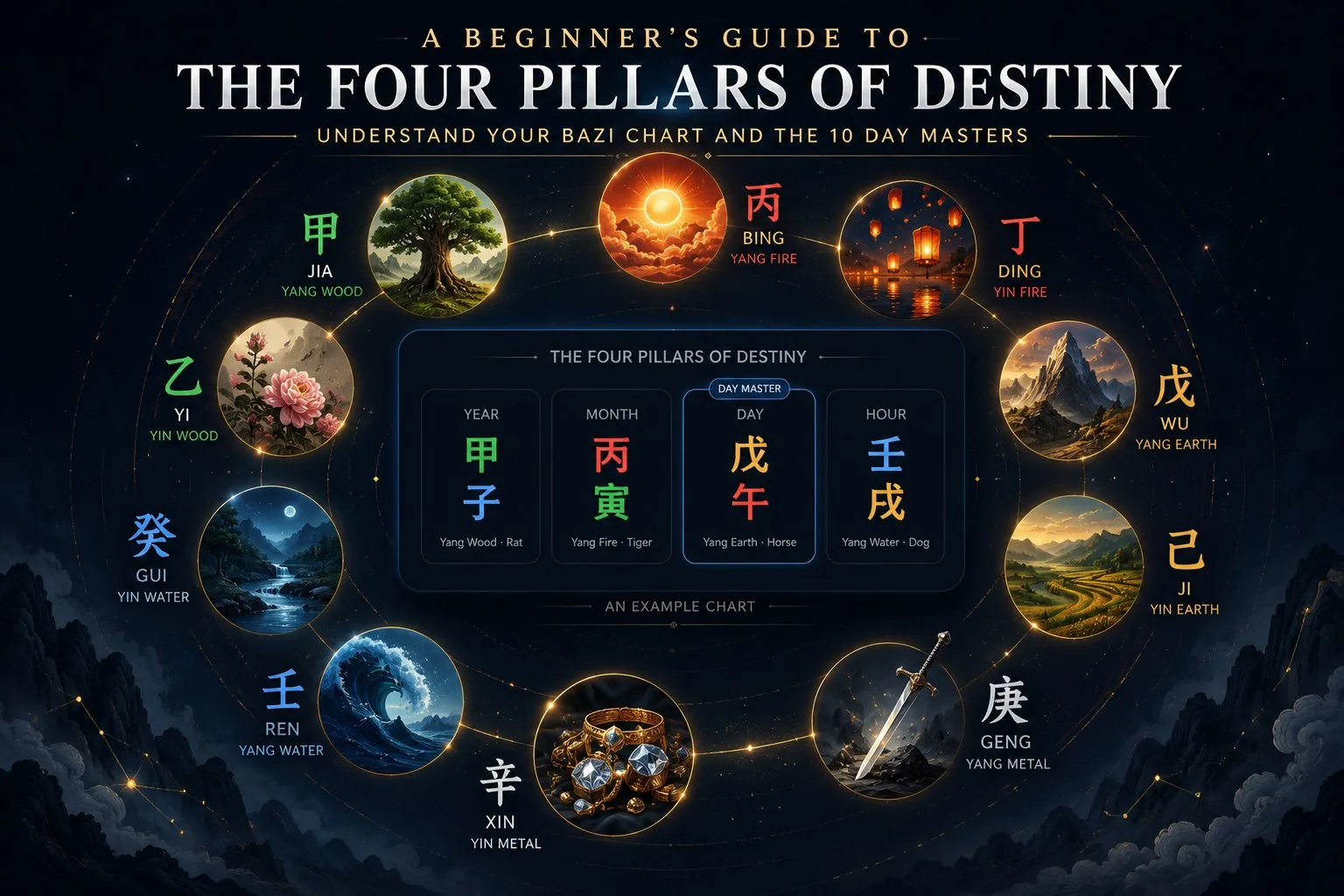
Your BaZi chart has four pillars — Year, Month, Day, and Hour. Each pillar has two parts stacked vertically:
- a Heavenly Stem (天干) on top, and
- an Earthly Branch (地支) below.
Four pillars × two parts = eight characters. That's the 八字.
The chart is calculated from your birth date and time expressed in the classical Chinese solar calendar (the one that starts the year at 立春, "Beginning of Spring," in early February — not January 1). The date determines your Year, Month, and Day pillars. The time determines your Hour pillar.
The ten Heavenly Stems (天干)
There are ten Heavenly Stems. Each one is a specific element in a specific polarity:
| Element | Yang Stem | Yin Stem |
|---|---|---|
| Wood | 甲 (Jiǎ) | 乙 (Yǐ) |
| Fire | 丙 (Bǐng) | 丁 (Dīng) |
| Earth | 戊 (Wù) | 己 (Jǐ) |
| Metal | 庚 (Gēng) | 辛 (Xīn) |
| Water | 壬 (Rén) | 癸 (Guǐ) |
Yang stems (甲丙戊庚壬) embody the outward, expanding, generative face of their element — the sun that announces itself, the axe that cuts through, the ocean that overwhelms. Yin stems (乙丁己辛癸) embody the inward, forming, refining face — the candle that reads by, the field that nourishes, the dew that soaks in. Same element, opposite temperaments.
This distinction matters more than beginners tend to expect. Yang Wood (甲) and Yin Wood (乙) are as different in a chart as an oak tree is from a vine. Never let anyone flatten this to just "Wood." Real BaZi is always read at the stem level, not the element level.
The twelve Earthly Branches (地支)
There are twelve Earthly Branches — the same twelve animals you know from the Chinese zodiac, but here they are anchored to specific seasons and hold hidden stems inside them:
子 (Rat, Water) · 丑 (Ox, Earth) · 寅 (Tiger, Wood) · 卯 (Rabbit, Wood) · 辰 (Dragon, Earth) · 巳 (Snake, Fire) · 午 (Horse, Fire) · 未 (Goat, Earth) · 申 (Monkey, Metal) · 酉 (Rooster, Metal) · 戌 (Dog, Earth) · 亥 (Pig, Water)
Each branch also contains hidden stems — one, two, or three stems tucked inside that come out to play under specific conditions. The Horse (午) hides 丁 Fire and 己 Earth. The Dragon (辰) hides 戊 Earth, 乙 Wood, and 癸 Water. These hidden stems are one of the reasons BaZi is a per-person system, not a per-year animal system. Two Horse-year people can have wildly different fates depending on what the rest of their chart activates inside that Horse.
How the stems and branches marry into pillars
Sixty combinations exist — the jiazi (甲子) cycle — because ten stems and twelve branches only align every sixty years. Your Year pillar is one of those sixty. Your Month pillar is one of the sixty (calculated from the Year stem plus the solar-term month). Your Day pillar is one of the sixty (calculated from the exact date). Your Hour pillar is one of the sixty (calculated from the Day stem plus the two-hour time slot you were born into).
So your chart is essentially four two-character pillars, drawn from a 60×60×60×60 possibility space. That's why "born in the Year of the Rabbit" is a piece of information about you, but not much of one. It's roughly one 4,320,000th of your chart.
What your chart actually says: the Day Master
Of the eight characters in your chart, one matters more than the rest. The Heavenly Stem of your Day pillar is your Day Master (日主), and it represents you. Not "represents you astrologically" in a fuzzy sense. Represents you concretely — your core identity, the axis around which the rest of the chart is read.
Because there are ten stems, there are exactly ten Day Master types. This is not personality-quiz territory. Each Day Master carries a very specific classical archetype:
- 甲 Yang Wood — the tall tree. Upright, ambitious, wants to grow tall. Struggles with flexibility.
- 乙 Yin Wood — the vine, the grass. Adaptable, resilient, artistic. Bends where 甲 breaks.
- 丙 Yang Fire — the sun. Radiant, generous, visible. Cannot hide, and struggles when asked to.
- 丁 Yin Fire — the lamp, the candle. Refined, precise, illuminates in small rooms.
- 戊 Yang Earth — the mountain. Steady, immovable, protective. Slow to change.
- 己 Yin Earth — the field, the garden. Nurturing, receptive, cultivates growth.
- 庚 Yang Metal — the axe, the raw iron. Decisive, unfinished, cutting. Needs refinement.
- 辛 Yin Metal — the jewel, the blade. Precise, discerning, finished. Wounds when misused.
- 壬 Yang Water — the ocean, the river. Vast, moving, ambitious in scale.
- 癸 Yin Water — the rain, the dew. Quiet, penetrating, patient. Wears mountains down.
If you have never heard your Day Master before, that alone is often the first click of recognition — the "oh, that's what I've been doing my whole life." We go much deeper in Your Day Master Explained and in the ten-archetype profiler.
But the Day Master is the lens, not the whole reading. The chart around it is what tells you how the lens is being used.
The five elements, and why "balance" is not the point
BaZi is built on the five elements (五行) — Wood, Fire, Earth, Metal, Water — that generate and control each other in fixed cycles.
Generation cycle: Wood → Fire → Earth → Metal → Water → Wood. Each element gives rise to the next. Wood burns to make Fire. Fire's ash becomes Earth. Earth condenses into Metal. Metal-cold surfaces condense Water. Water grows Wood.
Control cycle: Wood breaks Earth. Earth dams Water. Water quenches Fire. Fire melts Metal. Metal cuts Wood.
Beginners often assume BaZi is about "balancing" the five elements — getting one of each, or an equal share. This is wrong, and it's one of the most common mistakes in pop-BaZi content. Balance is not a virtue in itself. A chart with all five elements evenly distributed can be a directionless chart. A chart with only two elements can be a powerhouse — if those two elements form a supported pattern (格局).
What actually matters is:
- What is your Day Master, and how strong is it?
- What is the chart's dominant pattern, given its month?
- What single element does the chart most need to complete itself? That element is the Useful God (用神).
Everything else follows. We cover the elements in detail in The Five Elements in BaZi.
The Ten Gods: the role each stem plays in your life
Here is the piece that transforms BaZi from a personality snapshot into a life diagnostic. Once your Day Master is set, every other stem in the chart takes on a role relative to it. There are ten possible roles, called the Ten Gods (十神). They are derived cleanly from two questions: does this stem's element generate, control, or match mine? and is its polarity the same as mine or opposite?
The five categories, each split into two flavours by polarity:
Seal (印) — the element that generates your Day Master. 正印 (Proper Seal, opposite polarity) is your mother, your formal teacher, your credential, your protection. 偏印 (Partial Seal, same polarity) is your unconventional mentor, your intuition, your step-parent energy.
Peer (比劫) — the element that matches your Day Master. 比肩 (Parallel, same polarity) is your sibling, your ally, your collaborator. 劫財 (Rob Wealth, opposite polarity) is your competitor, your rival, the peer who takes more than their share.
Output (食傷) — the element your Day Master generates. 食神 (Food God, same polarity) is your gentle creative output, your children, your enjoyment. 傷官 (Hurting Officer, opposite polarity) is your unconventional expression, your talent, your rebellion against authority.
Wealth (財) — the element your Day Master controls. 正財 (Proper Wealth, opposite polarity) is your salary, your spouse (for a male chart, traditionally), your steady earned income. 偏財 (Partial Wealth, same polarity) is your side income, your speculation, your unexpected windfall.
Officer (官殺) — the element that controls your Day Master. 正官 (Direct Officer, opposite polarity) is your legitimate authority, your reputation, your husband (for a female chart, traditionally), your career structure. 七殺 (Seven Killings, same polarity) is your pressure, your rival, your challenge, your capacity to transform under stress.
You don't have to memorise this. Your chart will tell you which of the Ten Gods are prominent, which are missing, and which are being suppressed. Each one is a life domain.
Read this way, your chart is a map of the roles present and absent in your life. A chart with no 正官 and no 七殺 struggles to submit to structure — no boss ever feels quite right. A chart with strong 財 but weak Day Master watches wealth pass by but cannot capture it. A chart with too much 印 gets stuck in "learning mode" — endless courses, no shipping. These are not vague poetic observations. They are structural readings with classical prescriptions.
Deeper dive in The Ten Gods in BaZi.
Is BaZi different from a horoscope?
This is the question every serious beginner asks, and the answer decides whether BaZi is worth your time or not.
A horoscope column is per-birth-year (or per-birth-month, in Western astrology). BaZi is per-person.
A horoscope says "Rabbits in 2026 will experience career changes." That's a claim about roughly one-twelfth of humanity. Even if you are generous and grant that different Rabbit-year decades might read differently, you're still talking about hundreds of millions of people receiving the same forecast.
BaZi reads four pillars — Year, Month, Day, Hour. Sixty possibilities per pillar. That's a possibility space of about 12.9 million distinct chart bodies before you even factor in gender or Luck Pillars. Two people born in the same hour, one day apart, will have different Day pillars and often materially different readings.
The Chinese zodiac animal you know — Rabbit, Tiger, Horse — is one branch of one of your four pillars. In BaZi terms, it's the Year branch. That's it. That's one-eighth of your chart, and not even the most important one-eighth.
If someone reads your BaZi by asking only "what year were you born?" they are giving you a horoscope wearing a BaZi costume. A real reading needs at minimum the year, month, day, and — ideally — the hour.
We go deeper in BaZi vs Western Astrology and in BaZi vs Zi Wei Dou Shu if you want the comparison in detail.
Is BaZi real?
You are going to ask this. Everyone does. Here is the honest answer, in three layers.
Layer one: BaZi is not a science. It doesn't predict specific events with clinical certainty. It has no falsifiable mechanism. Anyone who tells you a BaZi reading will forecast that you will meet a tall stranger on Tuesday is either performing for you or has misunderstood the tradition.
Layer two: BaZi is a coherent symbolic system with real internal logic. It is a thousand-year-old model of temperament, life rhythm, and structural tendencies, calibrated by a scholarly lineage that included the same people who advised emperors on statecraft and physicians on diagnosis. It is closer, in kind, to a diagnostic framework than to prophecy. Given a chart, a competent reader can describe a person's temperament and life patterns with a specificity that regularly startles the person being read.
Layer three: whether BaZi is "true" in some absolute sense is not the useful question. The useful question is: does it produce readings that help me see my life more clearly? For most people who work with it seriously, the answer is yes — with the same caveat you'd give to any diagnostic instrument. It reveals structure. What you do with the structure is up to you.
We handle this at length in Is BaZi Accurate?.
Do I need to believe in it for it to work?
No. BaZi doesn't need your belief to identify that your Day Master is 丙 Yang Fire, that your Wealth stars are unrooted, and that your current Luck Pillar carries 七殺. Those are computable facts about your birth data.
Whether the classical interpretations of those facts land in your life is something you can verify by reading them. A reading that describes you accurately doesn't require faith. A reading that misses is just wrong, and you're allowed to say so.
The tradition itself says the opposite of a faith-based framing. Classical BaZi warns against fatalism repeatedly: knowing the wind doesn't mean surrendering to it; it means learning when to raise the sail and when to reef it. The point of a BaZi reading is to inform choice, not to replace it.
What can BaZi actually tell me about my life?
Here is the honest list. Read it as the ceiling of what a serious BaZi reading offers — not a floor.
BaZi is genuinely good at:
- Describing your temperament with high specificity — the shape of your ambition, the flavour of your rebellions, the pattern of your generosity, the direction of your blind spots. This is often the "how did they know?" moment for first-time readers.
- Naming your career and wealth tendencies. Not "you will be rich" — that's not a claim BaZi makes. But: your chart's Wealth structure is Partial rather than Direct, meaning your income will come more from deal-flow and speculation than from a stable salary, is a claim BaZi does make, and often lands.
- Diagnosing why the same relational pattern keeps repeating. The Spouse Palace (your Day branch) and its interactions with your other pillars usually explain the pattern before you finish describing it.
- Timing. This is where BaZi shines and where horoscope columns can't compete. Your Luck Pillars (大運) — ten-year phases that shift throughout life — tell you which decades of your life are aligned with your chart and which are fighting it. When a supportive Luck Pillar arrives, the same effort produces four times the result. When a hostile one arrives, effort feels like wading through mud. Knowing which one you're in changes everything about strategy.
- Naming what your chart needs. The Useful God (用神) is the classical answer to "what is the one element this chart most needs to be complete?" Once you know it, you know what environments, work, relationships, and even seasons support you — and which drain you. See The Useful God in BaZi.
BaZi is not good at, and does not claim to be good at:
- Predicting specific events with dates.
- Overriding your free will.
- Telling you who to marry (only what shape of partner supports your chart).
- Guaranteeing outcomes.
- Working without your actual birth data.
If a "reading" you're offered claims any of the above, you're being sold something. Real BaZi is more useful and more modest than the pop version.
What if I don't know my birth time?
This is the most common blocker for new readers. Perhaps your parents didn't record it. Perhaps the hospital didn't note it. Perhaps you're adopted. Perhaps the birth certificate says "around noon."
Honest answer: a chart without an hour is still readable, but it's missing a quarter of the data. You still have Year, Month, and Day pillars — six of the eight characters. Your Day Master is still known. Your dominant pattern is still identifiable. Your Ten Gods across those three pillars are still readable. Your Luck Pillars are still calculable from Year and Month.
What you lose without the hour:
- The Hour pillar itself — traditionally read as children, later life, and how the chart concludes.
- The Hour branch's hidden stems, which sometimes carry the missing element that would otherwise complete a pattern.
- Certain branch interactions that only activate when the Hour branch is in play.
If your birth time is truly unknown, there is a classical technique called time-triangulation where a skilled reader compares candidate Hour pillars against known life events and picks the best fit. It's not a magic trick, and it's not a substitute for the real time — but if you never find the record, it's the fallback the tradition offers.
If you have "roughly" the hour (e.g. "sometime between 2 and 4pm"), most of the time that maps cleanly to a single two-hour Hour branch, and you're fine. BaZi's Hour pillars are calibrated in two-hour blocks, not to the minute.
How your chart shifts over time: the Luck Pillars
One more piece before we close, because this is what people miss and it changes everything.
Your natal chart — the eight characters you were born with — never changes. But every ten years, a new pillar of stem-and-branch cycles in as your Luck Pillar (大運). It sits alongside your natal chart and interacts with it. Its stem and branch produce new Ten Gods, activate new hidden stems, and can complete or break patterns that your natal chart could only hint at.
This is why the same person, at the same skill level, has "the decade when everything worked" and "the decade when nothing did." It is not always about effort or discipline. It is often about which Luck Pillar you are in and whether it is feeding your Useful God or fighting it.
Within each Luck Pillar, the annual pillar (the current year's stem-and-branch) modulates further. Within each year, the monthly pillar. Within each month, the daily pillar. The chart is a system of nested clocks, and a serious reading tracks all of them.
If you have never known where you are in your Luck Pillar cycle, learning it is often the single most immediately useful thing a chart gives you. See BaZi Luck Pillars.
How to actually read your chart, step by step
If you're ready to move from "what is BaZi" to "how do I read mine," here's the beginner's order of operations. You don't need to compute the pillars — a calculator does that. What you do need to know is what to look at once you have them.
Step 1 — Find your Day Master. Top character of the Day pillar. That's you. Read the archetype. Feel the click of recognition or the friction of not-quite. Both are data.
Step 2 — Judge Day Master strength (身強 / 身弱). In classical BaZi this is not "count the stems" — it's about rooting in the four branches, seasonal command, and support from Seals and Peers. A strong Day Master (旺) can act on the world; a weak Day Master (弱) needs support before it can. The classical assessment traces every claim to how the stem is rooted across all four branches, not to invented percentages. See Strong vs Weak Day Master.
Step 3 — Identify the pattern (格局). The dominant hidden stem of your Month branch, expressed as a Ten God relative to your Day Master, is your pattern. Most people's charts fall into one of eight or nine classical patterns — Direct Officer (正官格), Wealth (財格), Seal (印格), Food God (食神格), Seven Killings (七殺格), Hurting Officer (傷官格), Yang Blade (陽刃格), Month Companion (建祿月劫). Each has a defined "success" (成格) and "failure" (敗格) condition. Your pattern tells you what the chart is for.
Step 4 — Find the Useful God (用神). Given the Day Master's strength and the pattern, one element is what the chart most needs. That element is your Useful God. Elements that protect and strengthen the Useful God are your favourable elements. Elements that damage the Useful God are your unfavourable ones. This one insight tells you what environments, industries, seasons, and even colours support you. See The Useful God in BaZi.
Step 5 — Read the Ten Gods across the chart. With Day Master and Useful God known, every other stem in your chart is a role: mentor, peer, output, wealth, authority. Note which are present and rooted, which are present but weak, which are missing, and which are hostile to your Useful God. That's the life-domains map.
Step 6 — Layer in Luck Pillars. Find your current Luck Pillar. Is its stem the Useful God? A favourable element? An unfavourable one? The answer tells you the weather of your current decade.
Detailed walkthrough in How to Read a BaZi Chart.
Common misconceptions, listed for the record
"Chinese zodiac and BaZi are the same thing." No. Chinese zodiac is one branch of one pillar of your BaZi chart. See above.
"BaZi tells the future." Not directly. BaZi describes tendencies and timing — the shape of your temperament and the weather of your years. What you do with those is not fated.
"You just need to balance the five elements." No. Balance is not the goal. Serving your Useful God is the goal. A "balanced" chart with no Useful God can be flat; an "unbalanced" chart with a supported Useful God can be powerful.
"Fire is good luck, Water is bad luck." No element is good or bad in itself. Fire supports charts where Fire is the Useful God and stresses charts where Fire is unfavourable. Same for every other element. Anyone who claims "Fire year is a good year for everyone" is doing pop astrology, not BaZi.
"BaZi is fatalistic." The tradition itself pushes hard against fatalism. Every classical reading emphasises what to do — what to strengthen, what to protect, when to move, when to hold. The whole point of naming the pattern is to work with it.
"Shen sha (special stars) decide your fate." They are flavour, not verdict. The pattern and Useful God decide the reading. A "Nobleman" star (貴人) on your chart does not override an unfavourable Useful God. Stars are colour, not architecture.
"A ChatGPT-generated BaZi reading is the same as a real one." It isn't, and it isn't close. Real BaZi requires classical rules applied deterministically to your chart — not vibes. If you want to see why, ChatGPT BaZi vs Real Engine walks through the failure modes.
FAQ
What does BaZi mean in English? "Eight characters." Your birth year, month, day, and hour, each expressed as one Heavenly Stem and one Earthly Branch, gives you eight characters total. Also called the Four Pillars of Destiny (四柱命理).
Do I need my exact birth time to read BaZi? Ideally yes, but not strictly. Without an hour you lose the Hour pillar — a quarter of your data — but the Day Master, pattern, Useful God, and Luck Pillars are all still readable from the other three pillars. A rough hour range (e.g. "afternoon") usually maps cleanly to a specific two-hour Hour branch.
Is BaZi astrology? It is Chinese astrology in the broad sense, but it is not planetary astrology. BaZi reads a calendar system — the classical Chinese solar calendar of Heavenly Stems and Earthly Branches — not the positions of stars or planets. A better label is Chinese metaphysics (命理).
Is BaZi real? It is a real, coherent, thousand-year-old symbolic system with genuine diagnostic power for temperament, patterns, and timing. It is not a science. It doesn't predict specific events. It is closer to a diagnostic framework than to prophecy — and most people who work with it seriously find it startlingly specific about who they are and where they're stuck.
How is BaZi different from a horoscope? Horoscopes are per-birth-year (or per-birth-month). BaZi is per-person. Your chart is drawn from a possibility space of roughly 12.9 million distinct configurations before Luck Pillars — versus twelve zodiac animals. Two people born in the same year can have radically different BaZi charts, and radically different lives.
Do I need to believe in it for it to work? No. Your chart is computed from your birth data whether you believe in it or not. Whether the classical interpretations land is something you verify by reading them, not by believing in them first.
What if I don't know my birth time? A chart without an Hour pillar is still readable — you keep the Day Master, pattern, Useful God, and Luck Pillars. What you lose is the Hour pillar's own reading (children, later life, how the chart concludes) and certain branch interactions that require the Hour branch. If the hour is truly unrecoverable, some readers use time-triangulation against life events; it is imperfect but classical.
What can BaZi tell me about my life? Temperament and archetypal identity (via Day Master). Career and wealth tendencies (via Wealth and Officer structures). Relationship patterns (via Spouse Palace and Ten Gods). Timing across decades (via Luck Pillars) and years (via annual pillars). What your chart most needs to be complete (via Useful God). What it doesn't do: predict specific events on specific dates, or override your free will.
Am I doing something wrong if my life feels stuck? Not necessarily. Sometimes the honest BaZi answer is that you are in a Luck Pillar that is fighting your Useful God, and the same effort that worked in the previous decade isn't working in this one. That is a diagnosable, temporary condition — not a personal failing. Knowing when you're in it changes what strategy makes sense.
Where should I start if I want to read my own chart? Get your chart computed first — with a real engine, not a horoscope column. Then read your Day Master. Then work through the six-step order above: strength, pattern, Useful God, Ten Gods, Luck Pillars. The Ming Map engine will hand you all six on the same screen.
Where to go next
If you've read this far, you're ready to look at your own chart rather than reading generalities about the system. Here are the natural next steps:
- See your own eight characters. Calculate your free BaZi chart on Ming Map → — built on the classical Zi Ping Zhen Quan method, with no invented math and no horoscope shortcuts. Also available on Android.
- Understand your Day Master in depth. Your Day Master Explained and the ten-archetype profiler.
- Learn how to read a full chart. How to Read a BaZi Chart.
- Find your Useful God. The Useful God in BaZi.
- Read your Ten Gods. The Ten Gods in BaZi.
- See how your decades shift. BaZi Luck Pillars.
- Apply it to your life. BaZi for Career, BaZi for Wealth, BaZi for Love and Marriage, BaZi Compatibility.
The system was refined over a thousand years to answer exactly the question you came here with: why do I feel the way I feel, and when does the wind turn? Give it your real birth data — the four numbers you already know — and see what it says.
You may find it already knew.