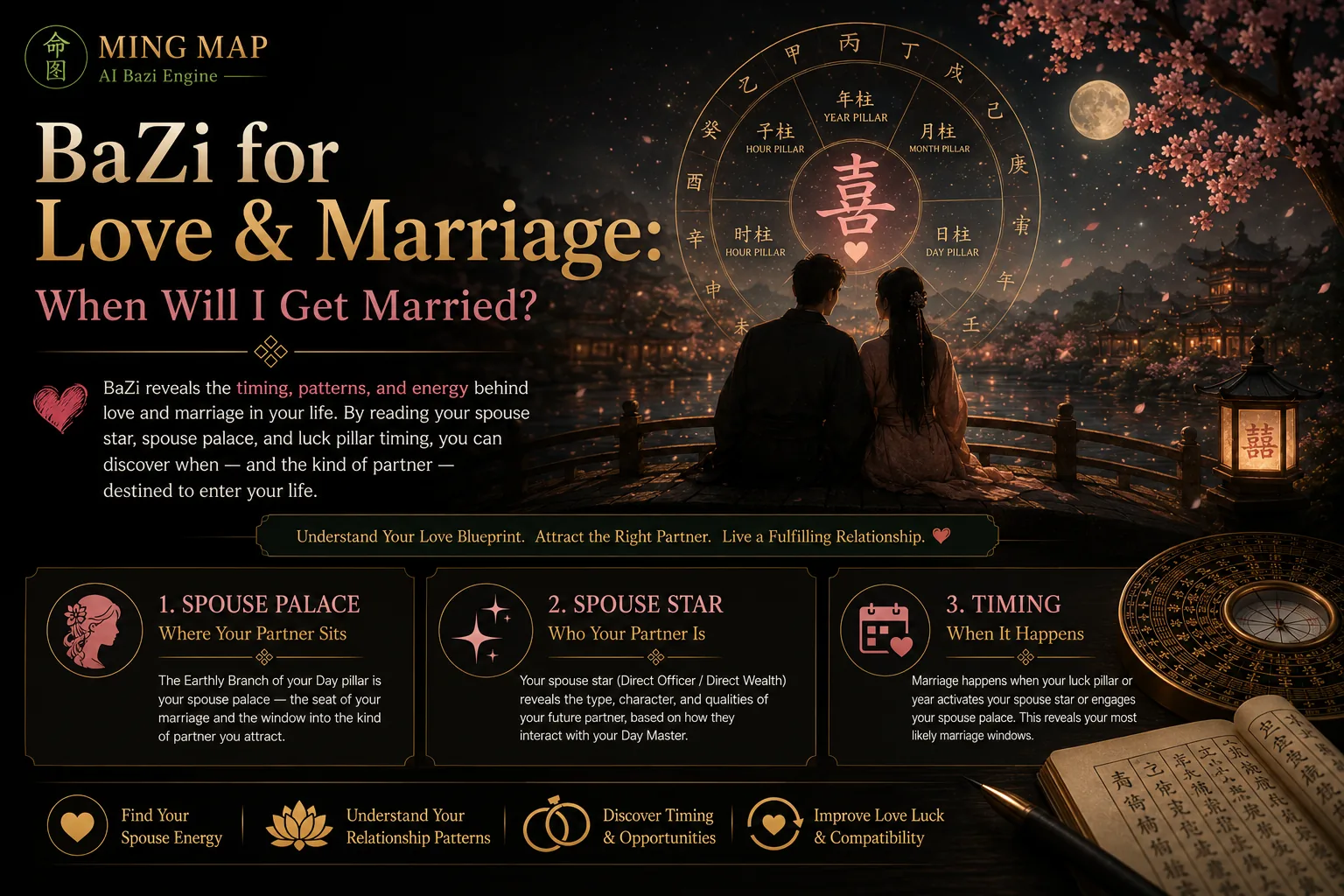
BaZi for Love & Marriage: When Will I Get Married?
If you found your way to this page, chances are you already know why you're here. You're not really asking a technical question about ancient Chinese metaphysics. You're asking a much older question — when will it be my turn?
You've watched people who don't seem to try as hard as you fall into good relationships. You've done the work — the therapy, the apps, the friends-of-friends, the being-your-best-self. You've been patient. You've also, some nights, been furious at how long this is taking. And now you're wondering whether there is something in your chart that is actually holding this up, or whether you were just told a story that isn't true.
This post is going to answer that as honestly as classical BaZi can. Not with fortune-cookie certainty. Not with "your soulmate arrives on March 14th." With the real machinery — the spouse star, the spouse palace, and the luck pillar timing that classical BaZi uses to identify likely marriage windows. And, as much as this matters: what the reading looks like when it seems bleak, and what it actually means in that case, which is almost never what you're afraid it means.
What does my BaZi chart say about marriage?
Your chart talks about marriage in three places at once. Miss any one of them and you'll misread the whole thing.
One — the spouse palace (夫妻宮). The Earthly Branch of your Day pillar is, by classical convention, the seat of your marriage. The Day pillar is you: the Day Stem is your Day Master, the deepest expression of self. The branch directly beneath your Day Master is the closest branch to you in the whole chart — and that's the seat classical BaZi assigns to your spouse. Whoever you end up with, they sit under you, in the position closest to your self. That's not a metaphor the tradition chose lightly.
Two — the spouse star (夫妻星). The spouse palace tells you the seat. The spouse star tells you the person — the specific Ten God that represents your partner. By classical convention:
- For women: the husband is represented by 正官 Direct Officer — the stem that controls your Day Master with opposite polarity.
- For men: the wife is represented by 正財 Direct Wealth — the stem that your Day Master controls with opposite polarity.
The classical tradition names these with binary gender because it was written in a binary-gender society. The mechanism itself — a stem that stands to your Day Master in a specific control-and-polarity relationship — is what matters. In practice most modern readers will look at both control-lines (正官 and 七殺, 正財 and 偏財) regardless of gender, then read the character of what actually shows up in the chart. Same-sex relationships, non-binary relationships, and modern marriages all read through the same machinery — you just look at the actual dynamic in the chart instead of forcing it through a Ming-dynasty template. More on this below.
Three — the timing. Which is the luck pillar and annual year lens. A chart is a natal thing; marriage is an event. Events happen when the flow of time activates something in the natal chart. Specifically, marriages tend to cluster in periods when the luck pillar or year does one of three things: it brings in your spouse star, it engages your spouse palace, or it combines with the branch or stem that already holds your spouse star.
Those three lenses — palace, star, and timing — are the whole framework. Everything else you'll read online is decoration.
Where is my spouse in the chart? The spouse palace (夫妻宮)
Look at your chart. Find the Day pillar. Look at the branch — the one directly under your Day Master. That branch is your spouse palace.
Its element, its hidden stems, its interactions with the rest of your chart — these tell you what kind of partner you are drawn to, and what kind of marriage tends to form for you when it does.
A spouse palace that stands in harmony (六合) with your Month Branch or Year Branch is a chart where marriage tends to feel like it belongs in your life — supported by family, supported by career, sliding into place when its time comes. A spouse palace that stands in combination trinity (三合) with two other branches is a chart where the marriage forms a whole social ecosystem around it — friends, in-laws, community, and career all pulled into orbit.
A spouse palace that stands in clash (六冲) with the Month Branch, or is itself repeatedly clashed by luck pillars, tells a harder story — one we'll get to.
The hidden stems inside the spouse palace matter too. If your spouse star (the Ten God we identified above) is one of the hidden stems inside your Day Branch, that's a strong classical signal: your partner is already seated inside you. You carry them. They tend to feel, when you meet them, like someone you already knew.
The spouse star — the specific stem that represents your partner
Now for the second lens. This is where classical BaZi becomes concrete.
If you are a woman
Your husband star is 正官 Direct Officer — the stem that controls your Day Master with opposite polarity. So:
- 甲 (Yang Wood) Day Master → husband star is 辛 (Yin Metal)
- 乙 (Yin Wood) → 庚 (Yang Metal)
- 丙 (Yang Fire) → 癸 (Yin Water)
- 丁 (Yin Fire) → 壬 (Yang Water)
- 戊 (Yang Earth) → 乙 (Yin Wood)
- 己 (Yin Earth) → 甲 (Yang Wood)
- 庚 (Yang Metal) → 丁 (Yin Fire)
- 辛 (Yin Metal) → 丙 (Yang Fire)
- 壬 (Yang Water) → 己 (Yin Earth)
- 癸 (Yin Water) → 戊 (Yang Earth)
If you also have 七殺 Seven Killings in your chart (the same-polarity control stem), that's the more raw, uncontained version of the same energy. Modern reading often treats both together — you get both a stable-committed thread and a fiery-attractional thread. Whether one dominates or they mix depends on which is transparent (visible in the four heavenly stems) and which is buried.
If you are a man
Your wife star is 正財 Direct Wealth — the stem your Day Master controls with opposite polarity. So:
- 甲 → 己
- 乙 → 戊
- 丙 → 辛
- 丁 → 庚
- 戊 → 癸
- 己 → 壬
- 庚 → 乙
- 辛 → 甲
- 壬 → 丁
- 癸 → 丙
偏財 Indirect Wealth is the same-polarity version — often read as the pursuit-attraction dynamic (or, in the older texts, the girlfriend / second partner / affair archetype, which we'd re-read today as the pull that isn't a settled bond).
Where does your spouse star live?
Once you know your spouse star, find it in your chart. Is it there?
Transparent (透干) — sitting directly in one of the four Heavenly Stems. This is the strongest possible visibility. Your partner-energy is available in your life. You are seen by, and see, partner material.
Hidden inside a branch — the spouse star appears only as a hidden stem inside one of your four branches. Partner energy is present but subterranean; relationships tend to form quietly, from proximity or slow-burn, rather than announcing themselves. If the branch that hides your spouse star is your Day Branch, the partner is seated in you — often felt as recognition when you meet them.
Rooted (有根) — the spouse star has support in the branches beneath it: its own element sits somewhere in the four branches as either the branch's principal qi or a strong hidden stem. Rooted partner-energy is durable. Once formed, the relationship holds.
Rootless (無根) — the spouse star appears as a lone transparent stem with no branch support, or only in a branch that gets clashed or drained. Partner-energy is present but fragile — relationships form but struggle to hold structure.
Combined away (合去) — your spouse star sits in the natal chart but is directly combined by another stem (甲己合化土, 乙庚合化金, 丙辛合化水, 丁壬合化木, 戊癸合化火). This is a particular and painful pattern that classical texts call out. Your partner shows up in the chart but is already taken — meaning, in a natal reading, that you tend to be drawn to people who are unavailable, or to people who "belong" to the situation more than to you. This isn't destiny; it's a pattern that becomes visible so you can stop repeating it.
Will I ever meet the right person? Reading the classical timing
This is the real question you came here for. When does the chart say now?
Classical BaZi answers this through the luck pillars (大運) and the annual pillars (流年). Every ten years you enter a new luck pillar with its own stem and branch. Every year the calendar rotates through the sixty-year cycle. Both interact with your natal chart — and both can activate the spouse star or spouse palace.
The classical marriage-timing signals — the ones actually described in the tradition, not invented — are these:
Signal 1 — The luck pillar or year brings your spouse star. If you're a woman whose Direct Officer is 辛, then a luck pillar or year with 辛 in the stem, or 酉 or 申 in the branch (which root Metal), is bringing your husband star into activation. If you're a man whose Direct Wealth is 己, then 己 stems or 未/戌/丑/辰 branches (Earth roots) do the same. This is the single most-cited timing signal in classical BaZi for marriage: the season when the partner-star finally arrives in the field.
Signal 2 — The luck pillar or year combines with your spouse star. If your spouse star is already sitting somewhere in your natal chart, a period that brings its stem combination partner (甲-己, 乙-庚, 丙-辛, 丁-壬, 戊-癸) tends to activate it. Classical texts read this as the year the partnership forms — two stems find each other and lock. This is why, in traditional practice, many marriages are read from the year that combines with the natal spouse star, not necessarily the year the star first appears.
Signal 3 — The luck pillar or year engages the spouse palace. If the luck-pillar branch or year branch combines with your Day Branch — via 六合 (Six Harmony) or 三合 (Three Combination trinity) — that period stirs the seat itself. Something wants to sit down beside you. Especially strong when the combining branch also brings your spouse star as its principal or hidden qi.
Signal 4 — Your Useful God is in force. This is the quiet one and, honestly, the one most people miss. A marriage that lands during a period when your Useful God is well-supported holds. A marriage that lands during a period when the Useful God is under attack tends to form and then struggle. The tradition is very clear that the quality of a marriage window is a function of the whole chart's balance, not just spouse-star activation. Two people can both have their spouse star activated in the same year and get very different marriages.
Signal 5 — Clashes and punishments to the spouse palace. These are the reverse signal, and they matter as much. A period that clashes (冲) your Day Branch, especially when the clash comes from a luck-pillar or year branch, is a period the classical tradition flags as marriage-destabilising. Existing marriages come under strain. Long-simmering incompatibilities surface. New marriages formed during such a period tend to be forced by circumstance rather than by chosen fit. This is not a rule against marrying during a clash year — many people do — but a rule about knowing what you're walking into.
Put it together and the classical picture of a marriage window looks like this: your spouse star is present or activated, the luck pillar or year is combining with it or bringing its element into force, your spouse palace is being engaged rather than clashed, and your Useful God is holding. When several of these line up, the tradition calls it a marriage year in the plain-language sense.
The most common single pattern, if I had to name one, is: the year the luck-pillar branch or annual branch combines with your Day Branch, while also bringing your spouse star into transparency or root. That configuration is the classical marriage signature.
When will I get married according to BaZi? Reading the windows
So — practically — how do you find your window?
If you want to do this yourself, look at your chart, know your Day Master, identify your spouse star, and then walk through your luck pillars ten years at a time. For each pillar, ask:
- Does the pillar stem carry my spouse star or its combination partner?
- Does the pillar branch harmonise or combine with my Day Branch?
- Does the pillar branch clash my Day Branch or my Year/Month Branch?
- Is this a pillar my Useful God is happy with?
A pillar that answers yes to the first two and no to the third, in a chart with a rooted spouse star, is a marriage decade in the classical reading. Within that decade, the specific annual years that bring the same activations again — usually one to three of them across the ten years — are the actual likely marriage years.
If you're a woman with a 甲 Day Master, your husband star is 辛. A luck pillar containing 辛 or 酉, especially one where the branch also combines with your Day Branch, is a strong marriage decade. Within it, look for years like 辛巳, 辛酉, 辛丑 for stem activation, or years whose branch six-harmonies your Day Branch, as the specific candidate years.
If you're a man with a 丙 Day Master, your wife star is 辛 (Yin Metal). A luck pillar with 辛 or 酉/申, especially with 丙辛合 in play — meaning the natal chart already contains something that will lock with the arriving 辛 — is the marriage decade.
This is not fortune-telling. It's a description of when your chart is most set up to attract, hold, and structure a partnership. You still have to show up. But if you're wondering why the last five years have felt like nothing was landing while your friends all married — check whether their spouse-star windows were open and yours simply wasn't yet. That is often what the "why is it taking so long" feeling is actually reading.
What if I have no spouse star in my chart?
This is the question that quietly haunts a lot of readings, so let's take it seriously.
If your spouse star (Direct Officer for women, Direct Wealth for men) does not appear anywhere in your four Heavenly Stems and does not appear as a hidden stem in any of your four branches — you have what the tradition calls a 無官 or 無財 chart, depending on gender. On the surface, this looks like a chart with no marriage-signal at all.
Here is what the classical tradition actually says about this, in the order it says it.
First: check whether the star is truly absent, or just hidden. Hidden stems inside branches are still counted. A woman with 甲 Day Master whose Direct Officer is 辛 doesn't need 辛 transparent — if she has 酉 in any branch, or 申 or 巳 or 丑 (each of which stores Metal as a hidden stem), she has a rooted husband star. Roots without transparency mean quiet partner-energy — the person shows up, but not with a lot of noise. Many people with hidden-stem spouse stars only see the person clearly when the luck pillar makes the hidden stem transparent — that is the classical mechanism for late marriage.
Second: check the seven-killings channel. For women, if 正官 (Direct Officer) is absent but 七殺 (Seven Killings) is present, that is still husband-energy — just the raw, uncontained flavor. It reads as a partner who is more intense, more demanding, more of a force in your life; it does not read as "no partner." For men, if 正財 is absent but 偏財 is present, that is still partner-energy — read as a partner who arrives with less predictability, often meeting through unusual channels, often outside conventional dating scripts.
Third: even a chart with no spouse star at all still marries. This is critical and often missed. The chart does not have to contain the spouse star for marriage to happen. The luck pillars supply what the natal chart lacks. Someone born with no Direct Officer whatsoever can enter, in her thirties, a ten-year luck pillar that brings 辛 in the stem and 酉 in the branch — and that decade is her marriage decade. The natal absence just means marriage tends to happen later, when the luck-pillar cycle delivers the missing piece. Classical texts call this the star arrives on the road (行運見夫星).
Look at your luck pillars. If any of them contain your spouse star or its combining stem, that decade is when your marriage window opens. You are not chart-less. You are on a slower schedule than the person born with a stem-transparent spouse star. That is a different problem than being "meant to be alone."
Fourth: pay attention to the spouse palace even more than the star. In no-spouse-star charts, the classical readers looked hardest at the Day Branch. A Day Branch that combines or harmonises with the arriving luck-pillar branch is a marriage engagement whether or not the star arrives transparently. Many marriages in no-spouse-star charts happen through palace activation alone — the person appears through the seat, quietly, and stays.
Am I fated to be single?
Let me be direct: classical BaZi does not say anyone is fated to be single. It cannot, structurally, say that. The system has too many layers — natal star, natal palace, luck pillars, annual years, hidden stems, combinations — for any single missing indicator to close the door.
What classical BaZi does say is that some charts marry earlier and some later. Some marry conventionally and some through unusual channels. Some marry once and some more than once. Some marry someone whose energy is stable, and some marry someone whose energy is complicated. These are all patterns of the marriage, not verdicts on whether one occurs.
If you have been told, or you have concluded from a bad reading somewhere, that your chart says you will never marry — that reading was wrong. The tradition doesn't make that claim. What it might correctly say is marriage happens for you in a later window than average, or marriage in your chart tends to form only when a specific luck pillar arrives, or your chart benefits from a marriage where you take a less conventional role. None of these is a doorless outcome. They are descriptions of the shape of the door.
The one thing to hold honestly is this: if all your late luck pillars run counter to your spouse-star elements, and your spouse palace is clashed repeatedly across your life cycle, the reading may be that your partnership arrives through non-traditional forms — long partnerships without marriage, chosen family, deep friendship, later-in-life pairings — rather than through the conventional marriage-in-your-thirties template. This is not the same as being alone. It is a chart in which the form of love is different from the mainstream form. There is a long tradition of respectful reading of these charts and none of it says isolation.
What if my spouse palace is clashed?
A clashed Day Branch is one of the most common questions readers bring — and it deserves a careful answer, because it's often over-read into despair when it means something more specific.
Natal clash of the Day Branch by another chart branch. If the Month Branch or Hour Branch clashes your Day Branch (e.g., 子 in the Month clashing 午 in the Day), the tradition reads this as baseline instability in the marriage seat. Not doom — instability. It means the seat rattles. Marriages formed in a chart with a natally clashed Day Branch tend to face early friction, take longer to settle, and often require the partners to actively build the structure that the natal chart does not automatically provide.
Two things can meaningfully change this reading. One: if there is a third branch present that combines with one of the clashing branches, the clash is resolved (解沖). A 子-午 Day-Month clash resolves if 未 is present, because 午未 six-harmonise and pull the clashing 午 into stability. This is the classical rescue mechanism. Two: if the Day Master is strong and the Useful God is well-supported, a rattled seat matters less — the person is stable enough to hold what the seat cannot.
Luck-pillar clash of the Day Branch. A luck pillar whose branch clashes your Day Branch is, classically, a marriage-strain decade. Existing marriages come under real pressure. New marriages formed during this period should be entered with attention, not blind hope. This is not a decade of doom either — it is a decade of testing. Marriages that survive this decade tend to be markedly stronger afterward, because whatever was going to break was going to break, and something already tested is durable in a way the untested is not.
Annual clash of the Day Branch. Milder than luck-pillar clash. Read as a year of pressure rather than a structural break. Many stable marriages have annual clash years; they read as arguments, restless seasons, brief crises, not endings.
If your spouse palace is clashed and you are not yet married — the tradition would say: pay closer attention to who you choose, and pay attention especially to your compatibility with a chart whose Day Branch combines with yours (that six-harmony partner). A well-chosen partner can pre-resolve the seat's instability. This is not superstition; it's the direct application of the harmony-rescues-clash rule.
What if I have too many spouse stars?
The other side of the "no spouse star" question. Some charts have their spouse star showing up in three or four places at once — transparent in the stems and rooted in multiple branches.
This reads two ways depending on the whole configuration.
Reading one — abundance of partner energy. Charts with heavy spouse-star energy tend to be attractive, in the direct sense. You draw partners. You always have someone interested. Marriage happens easily, sometimes multiple times, and often young.
Reading two — dispersion. If the spouse star is heavy but unmanaged by the rest of the chart, the classical warning is spouse-star scatter (夫星分散 / 財星紛雜) — partner energy spreading across too many people, or across the same person across too many years. This reads as many relationships without one that settles, or a settled relationship shadowed by others.
For women, the specific pattern 官殺混雜 (Officer-Killings mixed) — both 正官 and 七殺 present without one being clearly primary — is called out in the classical texts as a signal of relationship complications. Not doom, but a chart that has to choose — a chart that will find itself pulled between the stable partner and the exciting one, or between the settled path and the passionate one, and where the mature move is to name which line it's actually on.
For men, heavy 財 with 比劫 (Parallel/Rob Wealth) present is the specific warning — the classical texts call this competition-for-wealth (群劫爭財), which reads in the marriage domain as rivals for the same partner, or repeated love triangles. Again — not fate. A pattern to see and stop repeating.
The move for both patterns is the same: identify the cleaner line in your chart. If you have both 正官 and 七殺, treat the one that is rooted, transparent, and unclashed as your primary and consciously honour it in your choices. If you have scattered 財, note which 財 sits in your Day Branch or six-harmonies it — that is the one the chart actually seats. The others are noise.
Am I doing something wrong?
You are almost certainly not.
I want to say this plainly because I know it's the sub-question under all the other questions. When you've been alone longer than you wanted to be, the mind reaches for an explanation, and the honest ones — my luck pillar hasn't opened yet, my spouse star is a hidden stem waiting for transparency — feel almost worse than "you're doing something wrong," because at least wrong implies fixable.
Classical BaZi does not read singleness as personal failure. It reads it as a natal-plus-luck configuration whose marriage window has a specific shape. If your window is 28-38, you meet someone. If your window is 42-52, you meet someone. If your window is 55-65, you meet someone. If the window is short, the meeting is compressed but real. If the window is late, the wait is real, but so is the meeting.
The mistake most readers make with their own charts is looking at the natal chart for the marriage and not the luck pillars. The natal chart tells you what kind of partner and what kind of marriage; the luck pillars tell you when. Nobody's whole life is legible from the natal chart alone. That's the tradition's clearest teaching about time.
If you want the diagnostic version of "am I doing something wrong," here it is: check whether your current luck pillar has your spouse star anywhere in its stem or branch, or a combination partner for your natal spouse star, or a six-harmony for your Day Branch. If it has none of these, you are not doing anything wrong; your window is not currently open. Wait it out, or move to the more solvable form of the question — what is the shape of the window when it does open, and what am I building in the meantime?
Reading two charts together — compatibility
Once you meet someone, BaZi doesn't stop being useful. Two charts read together — BaZi compatibility — checks several things at once:
- Day Master interaction. Do your two Day Masters generate each other, control each other, harmonise as a pair, or clash?
- Day Branch interaction. Do your two Day Branches six-harmonise (the traditional strong-marriage signal), form a trinity, clash, or punish?
- Spouse star match. Does your partner carry your spouse star? A woman with 甲 Day Master (husband star 辛) whose partner has 辛 as their Day Master, or as a strong transparent stem, is meeting someone the chart recognises.
- Useful God complement. Do your partner's dominant elements strengthen your Useful God, or drain it?
A strong compatibility read is not about romantic destiny. It's about whether two people's charts hold each other up over decades — whether their strengths cover each other's weaknesses, or whether they aggravate each other's aggravations.
You can love someone with a difficult compatibility and build a good marriage; you can drift out of a marriage with an excellent compatibility. But the ease-versus-friction baseline is real, and it matters for the decision about who to choose — which is, ultimately, the decision the chart cannot make for you.
FAQ
Can BaZi actually predict my marriage year? Not to a specific date, no. Classical BaZi identifies marriage windows — decades and years when your chart is most set up for partnership to arrive, form, or stabilise. Within those windows, several possible years usually qualify. The narrower the question, the less honest the answer.
What if I have no spouse star and no marriage-friendly luck pillars? Look again. Hidden stems inside branches count as spouse-star presence. Luck pillars extend across your entire life. It is extremely rare, in the classical machinery, for a chart to have zero marriage indicators across all pillars — usually a closer look finds them. If nothing appears even after that, the reading tilts toward late-life or non-conventional partnership form, not toward "will not happen."
Why does the tradition use gendered spouse stars? Because it was codified in a gendered society. The mechanism — a stem in a specific control-and-polarity relationship to your Day Master — is what actually works. Modern readers apply it regardless of gender orientation, reading both control-lines and letting the actual chart configuration speak. The system is more flexible than its Ming-dynasty vocabulary suggests.
I keep dating people who aren't available. Is that in my chart? Sometimes. The specific classical pattern is a combined-away spouse star (合去) — your partner-star exists in the natal chart but is directly locked by a stem combination with someone else. This tends to show up as a repeated pattern of being drawn to people who are already partnered, geographically distant, or otherwise structurally unavailable. Seeing the pattern is most of the work of breaking it.
Is a clashed spouse palace a divorce sentence? No. A clashed spouse palace is a marriage-instability signal — a seat that rattles. Many stable marriages exist in charts with clashed Day Branches. The classical rescues include a third branch that harmonises with one of the clashing branches, a strong Day Master, and a partner whose chart combines with your spouse palace to steady the seat.
Should I marry during a clash year? Classical tradition would say: prefer not to, if you have a choice. Clash-year marriages carry structural pressure from year one. But if the relationship is right and the timing is right for other reasons, do not superstitiously delay — a marriage of two well-chosen people can absorb an unfavourable year.
What's the single best year in a decade to marry? The year whose annual branch six-harmonises your Day Branch and whose stem combines with your natal spouse star. That is the classical double-activation year. Look for it in your luck pillar decade and mark it.
I'm in my late thirties and I've never had a serious relationship. Does BaZi say why? Usually one of three things: your spouse star is hidden inside a branch and hasn't been made transparent by a luck pillar yet; your natal spouse palace is clashed and needs a harmony-partner to stabilise; or your first three luck pillars simply didn't carry the elements your marriage needs. The fourth luck pillar for many people is the one that finally opens the door. This is more common than you'd think.
Can I make my marriage window arrive faster? The window is what it is. What you can do is be in the right shape when it opens — meaning: know your own Useful God, live in the environments and elements that support it, build the strong Day Master version of yourself so that when the door opens you walk through it whole rather than depleted. That is the real preparation the chart supports.
Is the Peach Blossom (桃花) a marriage signal? No. Peach Blossom is a symbolic star associated with charm and attraction — it colours the social side of the love story, not the structural marriage question. It brings dates; it doesn't decide weddings. In the classical priority, stars are flavour, not verdict.
Every claim in this post maps to something computable in your chart: your Day Master and its polarity, the Ten God relationships that name your spouse star, the hidden stems in your Day Branch and the branch interactions across your four pillars, your Useful God, and the ten-year luck pillar sequence that opens and closes your marriage windows. Enter your birth date on Ming Map to see your specific spouse star, your spouse palace, your luck-pillar marriage windows, and a compatibility read against any second chart — the same classical rules, applied to yours.