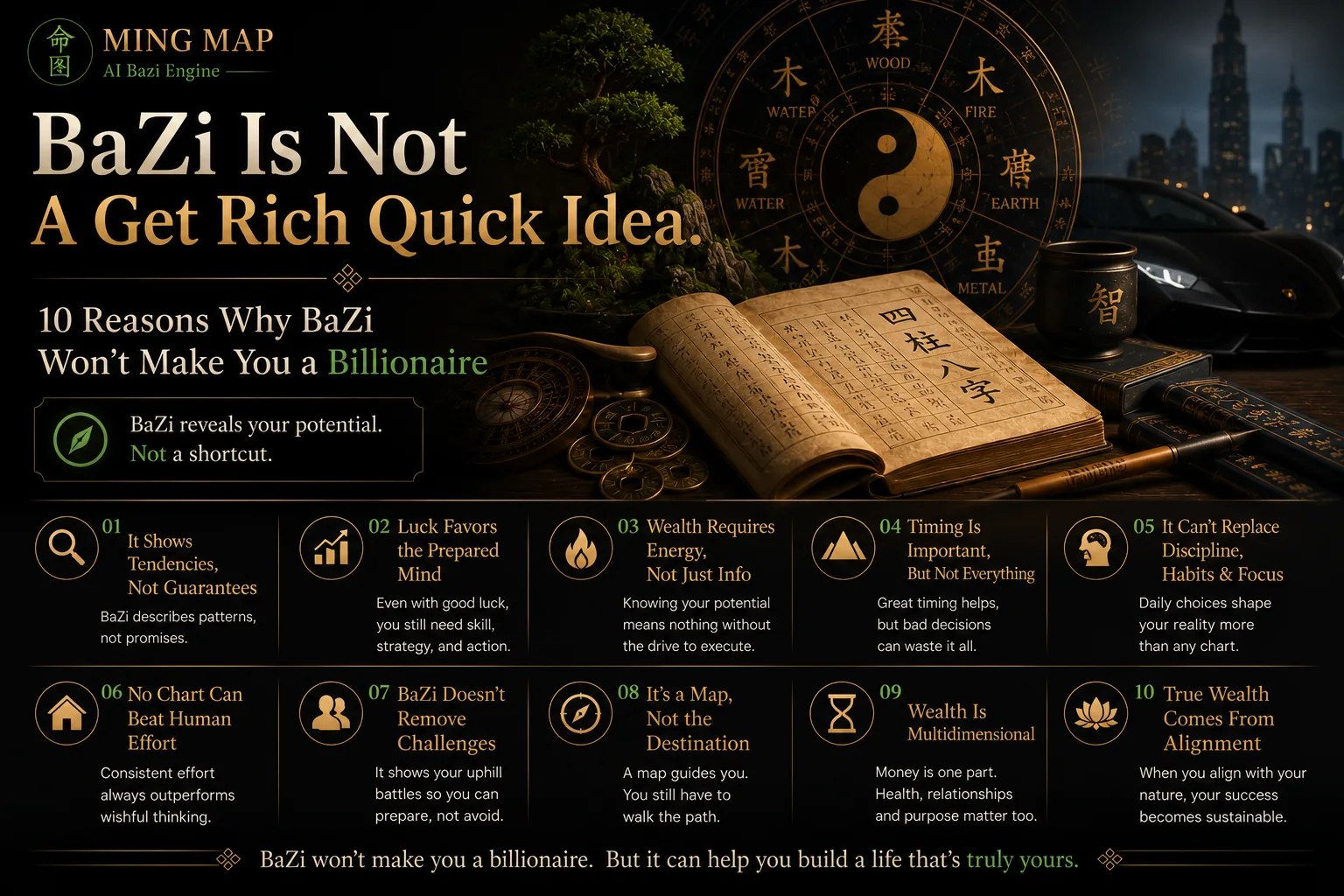
10 Reasons BaZi Is Not a Get-Rich-Quick Scheme (And What It Actually Does)
Let's be honest about why you're here. Somewhere between the ads promising "wealth codes hidden in your birthday" and the videos claiming a certain chart "guarantees millions," a quiet question formed: does BaZi make you rich? And underneath it, a more anxious one — if I just get the right reading, will money finally sort itself out?
Here's the answer nobody selling a course wants to give you: no. BaZi is not a get-rich-quick scheme, and anyone telling you it is has either misunderstood the system or is counting on you to. But — and this is the part worth staying for — that doesn't mean your chart has nothing to say about money. It says a great deal. It just says it the way an honest advisor would, not the way a lottery ticket does.
This post is the honest version. Ten reasons BaZi will never make you rich overnight, each grounded in how the classical system actually works — and, at the end, what it genuinely can do for your relationship with money. If you've been wondering whether BaZi is a scam, or whether you're missing some secret wealth formula, read this first. It will save you money and disappointment.
First, the question everyone's really asking
"Can BaZi predict wealth?" Partly — it can describe your relationship with money: how you tend to earn, whether you hold or leak, when the conditions favour building, what kind of wealth suits your structure. "Will BaZi tell me exactly when I'll be rich?" No. It describes energy quality and timing windows, not dated events with guaranteed payouts. The difference between those two sentences is the entire difference between a real reading and a scam. Keep it in mind as you go through the ten.
1. BaZi describes tendencies and timing — not guaranteed outcomes
The foundational misunderstanding behind every "get rich with your chart" pitch is treating BaZi like a fortune machine that spits out events. It isn't. Classical BaZi reads energy quality — the character of the forces active in your life and when they shift — not a schedule of things that will happen to you.
Your chart might show that a certain period strongly favours building wealth. That is a real, useful reading. But it is a description of conditions, the way a sailor reads that the wind is finally at his back. The wind doesn't sail the boat. If you're anchored in the harbour, a perfect wind changes nothing. BaZi tells you about the wind. You still have to raise the sail.
Anyone who converts "the conditions favour wealth" into "you will receive money on this date" has crossed from reading a chart into selling a fantasy.
2. Having wealth stars doesn't mean you can hold the money
This is the single most misunderstood thing about money in a BaZi chart, and it's where the "rich chart" myth falls apart fastest.
In classical BaZi, money is represented by the Wealth element (財星) — split into Direct Wealth (正財, steady earned income) and Indirect Wealth (偏財, deals, windfalls, opportunistic gains). Naïve readers count wealth stars: "You have three! You'll be rich!" But the classical system asks a second, decisive question: can your Day Master actually hold that wealth?
A weak Day Master surrounded by strong Wealth is one of the most classic — and most painful — pictures in the whole tradition: money that walks past you but never stays. Big earners who die broke. People who make fortunes and lose them. Their charts are full of wealth stars. That was never the problem. The problem was structure: no strength to carry what the wealth demanded. Star-counting misses this completely, which is exactly why star-counting is how scams read charts.
We go deep on this in BaZi for Wealth and on the strength question in Strong vs Weak Day Master.
3. Luck moves in ten-year pillars — this is decade-scale, not overnight
BaZi's timing layer is the Luck Pillar (大運) — the ten-year cycles that roll over the natal chart and change which forces are amplified. Wealth timing, in classical reading, is a Luck-Pillar-and-year phenomenon. It unfolds across decades.
Sit with what that means. When a reading says your wealth conditions strengthen, it is often pointing at a window that opens over a ten-year stretch — not a weekend, not a "manifest it by Friday" promise. The classical view of prosperity is agricultural, not electric: seasons, planting, patience, harvest. A get-rich-quick pitch is selling you lightning. BaZi is describing farming.
If you want to understand your own cycles, BaZi Luck Pillars walks through how to find and read your current ten-year period.
4. The Use God is a discipline, not a lottery ticket
The most important concept in your chart is the Use God (用神) — the single element your chart is built to protect, the thing everything else should support. People hear "the most important element" and imagine a cheat code: strengthen this one thing and win.
But the Use God isn't a jackpot. It's a discipline. It tells you what to lean toward across your whole life — the environments, directions, habits, and relationships that keep your chart in balance. Leaning into your Use God tends to make things go better over time, in the compounding, barely-noticeable way that good habits do. It is the opposite of a windfall. It's the quiet daily choice that, made a thousand times, changes the shape of a life.
What Is the Useful God? explains how it's identified and how to actually use it.
5. Favourable timing still requires you to act
Here is a sentence the whole tradition agrees on and no scam will tell you: a good window that you don't walk through produces nothing.
The classical texts are emphatic that fate describes the terrain, but the person still has to walk it. A period that favours wealth is an opportunity, and an opportunity is only ever a door — it does not carry you through itself. Two people can share nearly the same favourable timing; one builds something and one watches it pass, and the difference is not in the chart. It's in what they did while the door was open.
This is why "just get the reading and wait" is such a trap. The reading tells you when the door is open. Standing in front of an open door is not the same as walking through it.
6. Wealth with no structure to channel it just leaks
Even a chart genuinely rich in Wealth stars needs a structure to hold and direct that wealth. In classical terms, wealth interacts with the whole cast of forces — the Officer (官) that gives it order and protection, the Output (食傷) that generates it, the Resource (印) and Peers (比劫) that either steady or compete for it. A chart can have money everywhere and no framework to keep it, and that money behaves like water on a table: technically present, impossible to hold.
This is why the classical system reads the whole pattern, never one element in isolation. "You have a lot of Wealth" is not a reading. "Your Wealth is protected by an Officer and generated by healthy Output, so it tends to build and stay" — that is a reading. The scam version stops at the first sentence because the first sentence is the one that sells.
7. A "wealthy chart" can still be a broken chart
The classical tradition has an explicit concept of pattern success (成格) and pattern failure (敗格) — a chart's structure can be formed and intact, or it can be broken by a clash, a competing force, or a missing protector. And here is the uncomfortable truth for the star-counters: a chart loaded with wealth stars can be a broken pattern, and a chart with modest wealth can be a beautifully formed one.
Structure beats inventory. A well-formed pattern with a clear Use God and its protector intact will, in the classical reading, tend to do better with money than a chart stuffed with Wealth stars whose pattern is broken. If someone reads your chart by counting money symbols and never mentions whether your pattern is formed or broken, they are not reading it the way the tradition actually works.
8. Lucky stars (shen sha) are flavour — they never decide fortune
Every scam wealth reading leans hard on shen sha (神煞) — the "special stars" with evocative names like Nobleman, Peach Blossom, Sky Horse. They make for great screenshots. "You have the Wealth Nobleman star — riches are coming!"
The classical position is unambiguous and worth memorising: shen sha are colour, not cause. They flavour a reading; they never determine fortune. Fortune quality comes from the pattern and the Use God — the structural analysis in reasons 6 and 7 — not from the presence of a nicely-named star. A reading that hangs your wealth on a lucky star has inverted the entire system: it has taken the garnish and served it as the meal. If a "master" is dazzling you with star names and never mentions your pattern or Day Master strength, that's your signal.
9. BaZi rewards long-term alignment, which compounds slowly
Strip away the mysticism and here is what BaZi practically does for money: it points you toward alignment — work that fits your structure, environments that feed your Use God, timing you move with instead of against, relationships that support rather than drain. None of those pay out on Tuesday. All of them compound.
Choosing a career that fits your chart's Output or Wealth structure doesn't make you rich next month; it makes the next twenty years less of a fight against yourself (see BaZi for Career). Leaning into your favourable elements is a rounding error on any single day and a different life across a decade. This is genuinely valuable — arguably the most valuable thing BaZi offers about money — and it is the exact opposite of quick. Compounding is quiet, boring, and unbelievably powerful, which is precisely why it never trends.
10. The classical tradition itself warns against this exact thinking
Perhaps the most telling reason: the serious classical BaZi tradition explicitly rejects fatalism and lottery thinking. The refined literature is full of warnings against reading charts mechanically, against promising outcomes, against treating a person's fate as a fixed prize to be unlocked. The masters who built this system understood it as a tool for self-knowledge and better decisions — knowing your terrain so you walk it well — not as a wealth-prediction engine.
So when someone uses "ancient Chinese wisdom" to sell you a get-rich-quick reading, they are not just misusing a tool. They are contradicting the very tradition they're invoking. The classical view is closer to "know your weather, sail accordingly, and put in the work" than "your birthday guarantees a fortune." The wisdom was never the shortcut. The wisdom was that there isn't one.
So what does BaZi actually do for money?
If you've read this far, you deserve the honest upside, because there is a real one:
- It tells you your money style — whether you're built for steady earned income (Direct Wealth) or deals and opportunity flow (Indirect Wealth) — so you stop forcing the wrong path.
- It shows whether you tend to hold or leak, and what your chart needs (strength, structure, a protector) to keep what you earn.
- It maps your timing — the ten-year Luck Pillars and years when conditions favour building versus consolidating — so you push when the door is open and protect when it isn't.
- It names your Use God — the discipline that, leaned into daily, tends to make everything go a little better over a lifetime.
- It points you toward alignment — the career, environment, and relationships that fit your structure and compound in your favour.
That's a genuinely powerful toolkit. It's just a toolkit for building wealth wisely over time, not receiving it quickly. The people who get real value from BaZi are the ones who wanted the honest version all along.
Frequently asked questions
Does BaZi make you rich? No. BaZi doesn't make anything happen — it describes your tendencies with money, your timing, and what to lean toward. Wealth still comes from aligned action over time. What BaZi can do is help you stop working against your own structure.
Can BaZi predict when I'll be rich? It can point to periods (ten-year Luck Pillars and specific years) when conditions favour building wealth. It cannot give you a guaranteed date or amount. A window is an opportunity, not a payout.
Is BaZi a scam? The system isn't — it's a coherent, centuries-refined tradition. But get-rich-quick BaZi readings are a scam, because they misrepresent how the system works: counting wealth stars, hanging fortunes on lucky stars, and promising dated outcomes the classical method never claims. Judge the reader, not the tradition. For more, see Is BaZi Accurate?.
I have lots of wealth stars — doesn't that mean I'll be rich? Not by itself. The decisive question is whether your Day Master is strong enough to hold that wealth, and whether your overall pattern is formed or broken. Wealth stars with a weak Day Master or a broken pattern often means money that passes through you, not to you.
If BaZi isn't a shortcut, why use it for money at all? Because alignment compounds. Knowing your money style, your holding-vs-leaking tendency, your favourable timing, and your Use God lets you make better decisions consistently — and consistent better decisions over a decade genuinely change outcomes. It's slow, real leverage instead of a fast, fake one.
Which BaZi wealth concept should I learn first? Start with whether your Day Master is strong or weak — it determines everything about how you hold wealth. Then read your Wealth stars in that light, then your Use God, then your Luck Pillars for timing. The guides linked throughout this post walk each one.
The honest invitation
If you came here hoping BaZi would be the shortcut, I hope you're leaving a little relieved instead of disappointed — because the honest version is actually better than the fantasy. A fantasy can't be worked with. Your real structure can.
Run your own chart and read it the honest way: what's your money style, do you hold or leak, when do your building windows open, what's your Use God asking you to lean into? That reading won't make you rich by Friday. But it might change what you do with the next ten years — and that's the only kind of wealth reading that was ever real.
Generate your free BaZi chart and see what your Four Pillars actually say about money — the honest way, grounded in the classical method, with no invented "wealth codes."