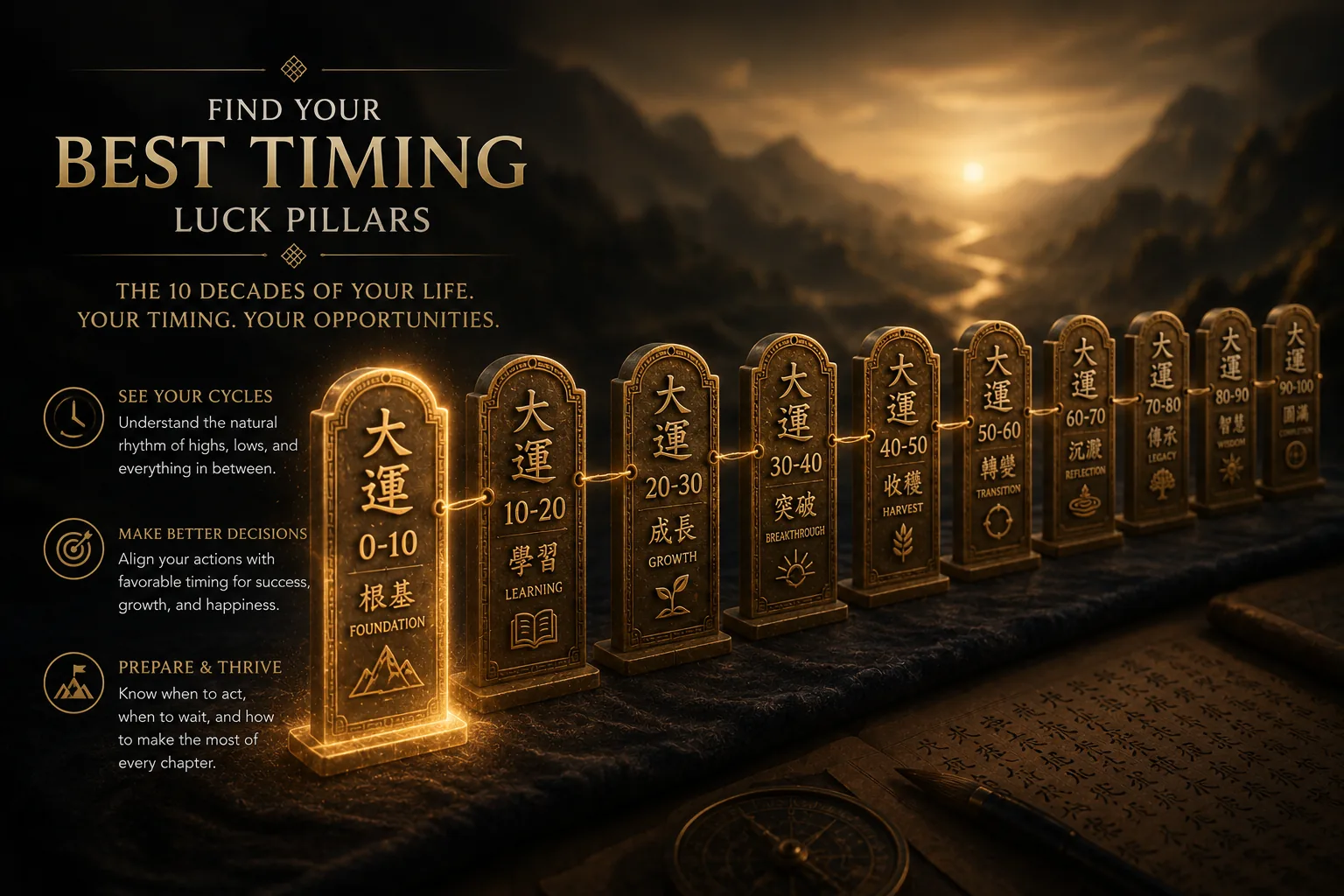
BaZi Luck Pillars (Da Yun 大運): How Your Fortune Actually Shifts Every 10 Years
You have found this page because something in your life is not lining up with who you know yourself to be. Ten years ago, work came easily. Now every door feels heavier. Or the opposite — you spent years pushing rope, and suddenly, for reasons you cannot name, the rope is pushing back. You have heard, from a friend or a video or a search box that led you here, that BaZi has an answer for this. Something called a luck pillar (大運, dà yùn). Something that changes every ten years. Something that might explain why this decade feels like the one you were built for — or the one that keeps costing you.
This guide is going to answer every real question you have about it. Not with mystery, not with vibes — with the classical machinery, laid out plainly. What a luck pillar is. How to find yours. Whether yours is good or bad. When yours changes. And, most importantly, what you are supposed to do with the one you are in.
Your natal chart — your Four Pillars — is fixed at birth. It does not move. Your Day Master is the same today as it was the day you took your first breath. What moves is everything around the chart. And the biggest, slowest, most consequential thing that moves is your luck pillar.
What is a luck pillar in BaZi?
A luck pillar is a 10-year window of elemental energy that overlays your natal chart. One stem on top, one branch below — the same two-line structure as any pillar in your birth chart. But this pillar is not fixed. It rolls. Every ten years, a new stem and a new branch step in and become the "surrounding weather" of your life.
Your natal chart is the terrain. Your luck pillar is the weather that moves across it.
Classically it is written 大運 and pronounced dà yùn — literally "great fortune" or "great movement." Movement is the word to hold onto. Nothing about you changes when a new luck pillar arrives; what changes is what the world is putting around you. The same tree in a wet decade grows fast and green. The same tree in a drought decade drops leaves and doubles down on its roots. The tree is the tree. The weather decided which chapter of the tree's life you would witness.
In classical terms, the luck pillar's stem interacts with the four stems of your natal chart, and the luck pillar's branch interacts with the four natal branches. Every 10 years you get a new stem-branch pairing to layer on top. Over an 80-year life, you will pass through roughly eight luck pillars. Each one activates different Ten Gods, amplifies or drains different natal elements, opens some doors and quietly closes others.
Reading a luck pillar is the most practical use of BaZi. It is the part of the system that answers when, not just who.
Why the same chart can feel like two different lives
You have probably noticed this in your own life or in someone else's. A friend who was invisible through their twenties suddenly hits their stride at 34, and by 40 they are unrecognisable. A cousin who was king of the room in high school peaks early and then spends a decade in a fog they cannot name. A parent who was struggling all through your childhood finds their feet in their fifties and becomes the person you always sensed they were.
None of these people got a new personality. They walked into a new luck pillar.
The classical way of putting it: your natal chart names the pattern, your luck pillar tells that pattern what season it is in. A pattern that needs rain will feel supported in rainy decades. A pattern that needs heat will feel stuck when the weather turns cold. Same chart. Different chapter.
If you are wondering am I doing something wrong — this is often the honest answer. Nothing wrong with the tree. The weather turned, and nobody handed you the almanac.
How do I find my current luck pillar?
There are two things to figure out: your starting age — the age at which your first luck pillar begins — and the direction in which the pillars roll forward from there.
Direction: forward or reverse
The direction is set by two things about you: the polarity of your birth year's stem (Yang 陽 or Yin 陰) and your gender at birth.
- Yang-year men and Yin-year women roll their luck pillars forward through the sixty-cycle order. If your Month Pillar is 甲寅, your first luck pillar is 乙卯, then 丙辰, then 丁巳, and so on.
- Yin-year men and Yang-year women roll their luck pillars in reverse. From 甲寅 your first luck pillar would be 癸丑, then 壬子, then 辛亥, and so on.
The Month Pillar is the starting point either way. The luck pillars are simply the sixty-cycle order stepping outward from it — forward or backward.
Starting age
Your first luck pillar begins at a specific age determined by the number of days between your birth and the closest solar term (節氣) — forward to the next one if you roll forward, backward to the last one if you roll in reverse. The classical rule is three days equals one year. So if you were born four days before the next solar term and you roll forward, your first luck pillar starts a little over one year of age. If you were born twenty-seven days after the previous solar term and you roll in reverse, your first luck pillar starts at nine.
Nobody calculates this by hand anymore. Every serious BaZi tool — including Ming Map — will lay your luck pillars out on a timeline the moment you enter your birth details. What is worth understanding is that the starting age is not arbitrary and not the same for everyone. Some people have their first luck pillar arrive at age 2, others at 9. From there they all roll every ten years.
Reading which one is current
Once you have the timeline, finding your current luck pillar is trivial: look at your age today, look at which 10-year block covers it, and read off the stem and branch. That two-character pillar is the atmosphere your life is being run through right now.
If you are 34 and the pillar covering age 32–41 is 己卯, your current luck pillar is Yin Earth Rabbit (己卯). If you are 51 and the pillar covering 45–54 is 壬申, your current luck pillar is Yang Water Monkey (壬申). That pillar — those two characters — is the single most important overlay on your life for as long as the window lasts.
What does my current 10-year luck period mean?
Once you know which pillar you are in, four things matter. Read them in order — each depends on the one before it.
1. What Ten Gods does the luck pillar's stem create relative to your Day Master?
The stem sitting on top of your luck pillar is an element — but more importantly, it is a role. Its relationship to your Day Master gives it a name in the classical Ten Gods system: Direct Officer (正官), Seven Killings (七殺), Direct Wealth (正財), Indirect Wealth (偏財), Direct Resource (正印), Indirect Resource (偏印), Eating God (食神), Hurting Officer (傷官), Friend (比肩), or Rob Wealth (劫財).
That role tells you what the decade is about. A Direct Officer decade is about structure, responsibility, formal roles, being visible to institutions. An Indirect Wealth decade is about opportunity flow, side income, deal-making, unpredictable money. A Direct Resource decade is about learning, mentorship, credentials, protection. A Hurting Officer decade is about creative output, unconventional expression, and — classically — friction with authority.
If you feel like your entire twenties were about being seen and evaluated, and your entire thirties have been about producing and creating — that is not you having a mid-life realisation. That is your luck pillar's Ten God changing from Officer-flavoured to Output-flavoured. Two different chapters of the same book.
2. Is the incoming stem your friend or your problem?
The Ten God tells you the theme. Your Useful God tells you the verdict. This is where the classical machinery gets specific.
Your Useful God (用神) is the single element your chart most needs to work well. It was identified from your natal chart the moment you were born — pulled from the Month Branch, tuned against your Day Master's strength, and configured to make the pattern operate.
The rule for luck pillars is categorical:
- A pillar that reinforces or generates your Useful God is favourable (喜運).
- A pillar that attacks, drains, or combines away your Useful God is unfavourable (忌運).
- A pillar that removes a natal harmful element (an enemy of your Useful God) is favourable, even if it looks neutral at first.
- A pillar that empowers something already excessive in your chart is unfavourable, even if the incoming element looks flattering.
There are no percentages here, no thresholds, no scoring. It is what the element does to your Useful God. That is the whole method.
3. What does the luck pillar's branch do to your natal branches?
The stem is only half the pillar. The branch does its own work — on a different level.
Where stems interact through generation, control, and stem combinations (甲己合化土 and so on), branches interact through clashes (六沖), combinations (三合 and 六合), punishments (三刑), and harm relationships (相害). These interactions play out at the branch level, on the roots of the chart, and they are often quieter, slower, and more physical than what stems do.
A luck pillar branch that clashes your natal Month Branch is disturbing the foundation of your pattern — early domain, career direction, the family-of-origin layer. A luck pillar branch that completes a Three Harmony (三合) with two of your natal branches is unlocking a whole element as if it had always been there. A luck pillar branch that punishes your Day Branch is putting friction into your marriage and self-concept for the decade.
The classical warning is that the same element behaves differently as a stem versus as a branch. A Fire stem in your luck pillar generates a Wood Day Master. But a Fire branch might clash a critical Water branch in your natal chart at the same time. Same element. Two effects. This is why the tradition insists you evaluate them separately.
4. Which hidden elements does the luck pillar activate?
Here is the piece most casual readers miss.
Every branch in your natal chart contains hidden stems (藏干) — dormant elements packed inside. Your natal 寅 contains hidden 甲, 丙, and 戊. Your natal 辰 contains hidden 戊, 乙, and 癸. Your natal 未 contains hidden 己, 丁, and 乙. These hidden stems are latent — partially in effect, but not fully active.
When a luck pillar brings in a stem that matches a hidden stem in one of your natal branches, that hidden element becomes transparent (透清). It comes alive. What was quietly sitting inside your natal chart is now visibly operating.
This is why a luck pillar sometimes activates something in a person's life that seemed to come out of nowhere. It didn't come out of nowhere. It was inside your natal chart the whole time, dormant, waiting for a matching stem to walk past. The luck pillar brought the key.
If you have hidden Wealth in your natal Month Branch — dormant, unactivated — and a Wealth-stem luck pillar arrives in your late thirties, this is often when money that was always going to be yours actually starts arriving. Not new destiny. Old destiny, finally lit up.
Is my luck pillar good or bad?
This is the question everyone types into Google. The honest classical answer is: no luck pillar is universally good or universally bad. It is good or bad for this chart.
That said, there is a real, non-vague way to tell. Here is the checklist.
A favourable luck pillar (喜運) tends to do at least one of these:
- Bring your Useful God as its stem, or generate the Useful God's element.
- Bring the Useful God's supporter — the element the pattern depends on to work.
- Introduce a branch that combines with a natal branch to strengthen the Useful God's root.
- Remove or control an element in your natal chart that was attacking your Useful God.
- Activate a hidden favourable stem in your natal branches by making it transparent.
An unfavourable luck pillar (忌運) tends to do at least one of these:
- Bring an element that directly clashes with, drains, or combines away your Useful God.
- Empower an element that was already excessive in your natal chart, throwing balance off further.
- Clash the natal branch that holds your Useful God's root — undermining the foundation of the pattern.
- Activate a hidden harmful stem via transparency — making a dormant problem manifest.
- Break a working natal pattern (變格/破格) by transforming your Useful God into a different element.
The subtle move — the one that separates real readings from bad ones — is that favourable-looking pillars can secretly harm, and unfavourable-looking pillars can secretly help. Classical texts have specific names for these: 似喜而實忌 ("looks favourable but is actually unfavourable") and 似忌而實喜 ("looks unfavourable but is actually favourable").
A pillar that brings more of your Useful God's element into an already-overloaded chart is not helping — it is tipping you into excess. A pillar that brings your Useful God's enemy into a chart that already has that enemy's controller is not harming — the controller neutralises the intruder, and everyone leaves peacefully.
This is why a computer that just checks "is Fire your favourable element? Yes / No" cannot read a luck pillar properly. The correct read is always contextual: what does this specific pillar do to the specific pattern in this specific chart?
When does my luck change?
Your luck pillar changes every ten years, on your birthday of the correct age. If your pillars roll at 3, 13, 23, 33, 43, 53, and so on, then age 33 is a transition. Age 43 is a transition. Age 53 is a transition.
But two more things are worth knowing about when.
The half-and-half rule
A single luck pillar has two halves. The first five years are dominated by the stem (the top character). The second five years are dominated by the branch (the bottom character).
So a luck pillar of 己卯 splits into:
- Years 1–5: the influence of 己 (Yin Earth) is dominant.
- Years 6–10: the influence of 卯 (Yin Wood Rabbit) is dominant.
If your stem is favourable but your branch is not, your decade will feel like it starts warm and ends heavier. If the stem is difficult but the branch is friendly, you will grind through the first half and be rewarded in the second.
This is why some people report a luck pillar that started brutal and ended blessed, or vice versa. Same 10-year window. Two halves. Two verdicts.
The transition years
The years immediately before and after a luck pillar changes — the year you turn the starting age, and the year before — tend to feel unusually charged. The old atmosphere is thinning. The new one is arriving. Life often re-arranges itself around a luck pillar change: relationships shift, jobs change, people move house, quiet decisions get made that reshape the next decade.
If you are within a year of a luck pillar change and something feels like it wants to end or begin, take it seriously. The pressure has a source.
Layered timing: annual pillars
On top of the 10-year luck pillar, each year has its own pillar (流年). Then each month, then each day, then each hour. The full timing stack looks like this, from slowest to fastest:
- Natal chart (fixed)
- Luck pillar (10 years)
- Annual pillar (1 year)
- Monthly pillar (about 30 days, boundaries set by solar terms)
- Daily pillar (1 day)
A hard annual pillar inside a supportive luck pillar is a bump inside a good decade. A soft annual pillar inside a difficult luck pillar is a breath inside a hard decade. The luck pillar wins over years; the annual pillar wins over months. For the practical reader, the 2026 Yang Fire Horse is the annual layer sitting on top of whatever luck pillar you are currently in. Its meaning for you depends entirely on how it interacts with your natal chart and your current 大運.
Reading two luck pillars end to end
Let us make this concrete with two composite examples. Neither of these is a real person — they are typical shapes to show you the machinery in motion.
Example A: a 甲 Day Master rolling into a 庚申 luck pillar
Take a Yang Wood (甲) Day Master, born in a Wood-strong month with plenty of Water support. This chart is Day-Master-strong. Classical Useful God analysis for a strong Yang Wood pattern often lands on Metal — the element that controls Wood, refines it into something usable, and gives the tree a shape.
Now at age 32, this person rolls into a 庚申 luck pillar — Yang Metal Yang Metal Monkey. Metal on the stem, Metal on the branch. Ten God is Seven Killings (七殺) on the stem, Seven Killings on the branch root.
The classical read: this is a favourable luck pillar for this chart — if handled correctly. Metal is the Useful God's element. The Killing is what a strong tree needs to be refined. Career pressure, competitive environments, high-responsibility roles will all show up now, and they will produce the kind of person the chart was built to be. Ten years earlier, this same person might not have been ready. Now the pillar has arrived, and there is a job to do.
But there is a subtlety. If this person's chart also had a natal 寅 (Tiger, hidden 甲/丙/戊), the incoming 庚申 branch triggers 寅申冲 — a direct clash. That clash sits on top of the favourable pillar and creates friction — travel, sudden career pivots, physical relocations. Not doom, but the pillar's blessing arrives with a shake-up. This is what the classical texts mean when they say two things are true at once: the pillar is favourable in element and disruptive in branch. You would live through both.
Example B: a 丁 Day Master rolling into a 丙午 luck pillar
Take a Yin Fire (丁) Day Master, born in a Fire-heavy month, with little Water and lots of Wood support. Day-Master-strong on Fire. The classical Useful God for a Fire-overloaded chart is usually Water — the element that cools the excess. Metal is a secondary supporter (Metal generates Water).
Now this person rolls into a 丙午 luck pillar — Yang Fire Fire Horse. More Fire, on both levels. Ten God is Rob Wealth (劫財) on the stem, Friend (比肩) via the branch. Same-element energy stacked on top of an already Fire-heavy chart.
The classical read: this is an unfavourable luck pillar for this chart. Not because Fire is "bad" — Fire is not bad, Fire is this person's own element — but because the pattern was already Fire-full, and more Fire pushes it into excess. Ten Gods active are peer-related: competition, business partners moving on your territory, resource conflicts, siblings, professional rivals. Emotional volatility. Burnout risk. Money running through the fingers.
The response, classically, is not to fight the decade but to behave in a way that regulates it. Introduce structure the pillar does not bring on its own. Deliberately manage the peer field. Cool climates. Water elements in the environment. Long-term projects rather than reactive ones. A decade like this is not "cursed" — it is a decade that punishes overreach and rewards discipline. Same chart, ten years earlier, was probably a much easier ride.
The point of both examples is the same: the pillar's verdict is not the pillar's stem. It is the interaction between the pillar and your chart's Useful God.
What to actually do in a favourable luck pillar
If your current luck pillar is confirmed favourable — supplying your Useful God, protecting your pattern, activating a helpful hidden stem — the classical guidance is unglamorous but real.
- Move. Whatever big move you have been sitting on — the launch, the pivot, the marriage, the move, the study — this is the decade to make it. Favourable pillars do not last forever. Ten years feels like a long time until you look up at year seven and realise you have not used the window.
- Choose scale, not just speed. A tailwind decade is when the compound structures you build actually last. Anything you set up now — a company, a book, a marriage, a house, a body of knowledge — is more likely to hold through the next pillars.
- Do not overextend into things your chart does not want. A favourable pillar amplifies your Useful God, but it does not change what you are. A 丁 Day Master in a supportive Water pillar is still 丁 — still the refined, precise lamp, not the Sun. Play your actual position at higher volume, not somebody else's position at any volume.
- Save for later. A favourable pillar creates the reserves — financial, relational, physical — that a future unfavourable pillar will draw down. This is not a modern reframe of the tradition; it is exactly what classical texts advise. The wise use of a tailwind decade is preparing for the headwind that will follow.
What to actually do in an unfavourable luck pillar
If your current luck pillar is confirmed unfavourable — attacking your Useful God, empowering something excessive, clashing a critical root — the response is not despair. It is strategy.
- Consolidate, don't expand. A headwind decade rewards depth over breadth. Fewer projects, better executed. Fewer relationships, more real. Fewer bets, more considered.
- Do not diagnose yourself as broken. The most damaging thing an unfavourable pillar does to intelligent people is convince them that they are the problem. You are not the problem. The weather is not the tree.
- Introduce what the pillar does not bring. If the pillar brings excess Fire, introduce Water in your environment, your climate, your daily rhythms. If the pillar brings crushing Metal, introduce Earth — mentorship, structure, protection, rest. This is not superstition. It is the classical practice of arranging your life to compensate for what the season is not providing.
- Wait for the branch half if the stem is bad. Remember the half-and-half rule. If years 1–5 of your pillar are difficult because of the stem, the branch may be gentler. Do not sign a 10-year contract with the first two years' evidence.
- Do the internal work. Classical texts observe that unfavourable pillars often become periods of deep character development — precisely because they are the periods where external expansion is not available. The person you become in a hard pillar is the person who cashes in during the next good one. Nothing wasted.
What if my luck pillar looks mixed?
Very often — probably most of the time — a luck pillar is not clean. The stem helps, the branch clashes. Or the stem attacks your Useful God, but the branch activates a favourable hidden stem in your natal Month Branch. Or the pillar completes a Three Harmony that transforms your pattern into something different for ten years.
Mixed pillars are normal. The classical response is to read them in their two halves and honestly.
- Stem helpful + Branch helpful = strongly favourable pillar. Move.
- Stem helpful + Branch harmful = supportive early, harder late. Front-load your big moves.
- Stem harmful + Branch helpful = grind early, lift late. Endure the first five years; the second five will pay.
- Stem harmful + Branch harmful = unfavourable pillar. Consolidate. Do not expand. Play the long game.
Most of what people call "unpredictable luck" in their lives is a mixed pillar being lived one half at a time. If you had known the shape of the ten years in advance, the first five would have been much easier to tolerate.
FAQ
Am I meant to be alone forever, or is my luck pillar the reason? If you have gone through a long romantic quiet period, look at what the last two luck pillars have been. A pillar heavy in Friend or Rob Wealth (比劫) energy often correlates with prolonged single life or difficult partnerships — same-element pillars amplify self-focus and peer competition, not partnership. A pillar bringing Officer (for women) or Wealth (for men) as the classical spouse-role often coincides with relationships forming. This is not fate. It is the elemental weather your life has been running in. If your current pillar is quiet on partnership Ten Gods, the pillar after this one may bring different weather. Real answer, real timing.
Why can't I hold onto money in this decade, when I could before? Look at what the Wealth Ten Gods are doing in your current luck pillar. If your Useful God is Wealth and this pillar is draining or clashing it, you are watching money that used to stick, stop sticking — that is the pillar, not your discipline. If this pillar brings Rob Wealth (劫財) as its Ten God, that is the classical signature of money leaving through partners, siblings, competitors, or split ventures. Neither means you are bad with money. It means the decade is not built for accumulation. Change the timeline, change the read.
How do I find my current luck pillar without doing the calculation myself? Enter your birth date, time, and location into any serious BaZi calculator — Ming Map will lay out all eight or so luck pillars on a timeline, colour the current one, and show you the exact stem, branch, and Ten God active right now. The math (starting age, direction, sixty-cycle order from the Month Pillar) is done for you. You do not need to learn to calculate it by hand to read yours honestly.
When does my luck change next? Your current luck pillar's start age and end age are shown on any calculated chart. Subtract the current age from the pillar's end age — that is how many years remain in the current chapter. On the birthday you cross into the next pillar, the whole overlay shifts. Not gradually. In practice, the transition often feels gradual across the year on either side, but the actual pillar boundary is a specific age.
Is a "bad" luck pillar dangerous? Not in the doom sense — the classical tradition explicitly rejects reading pillars as verdicts. An unfavourable luck pillar is information about the season, not a curse. The specific risks it raises depend on which Ten God is unfavourable, which branch is clashing, and what natal element is being weakened. What is fair to say is that unfavourable pillars reward consolidation, patience, and inner work — and punish overreach, big public bets, and living as if the tailwind is still there.
Can my Useful God change during a luck pillar? Not usually — your Useful God is set by your natal chart and does not shift with the weather. But a luck pillar's branches can occasionally combine with your natal branches to transform the natal pattern into a different one for the duration of the pillar. Classical texts call this 變格 (pattern change). This is unusual and requires a specific combination — for example, a natal 丁 chart in 亥 month rolling into a pillar that brings 卯 and 未, completing a 亥卯未 Wood Three Harmony that turns the pattern into something Wood-dominant. When it happens, the Useful God analysis needs redoing for the pillar. Most pillars leave the natal pattern intact and simply overlay atmosphere.
Does everyone get eight luck pillars in a lifetime? Depending on starting age, most people who reach old age pass through seven or eight luck pillars. Some pass through nine. The exact number depends on when your first pillar started. It is common for classical readings to focus on the pillars covering ages roughly 20 through 70 — the outer edges (very early childhood, very old age) are read more lightly and often reflect the parent chart or the closing chapter more than the individual decade.
Do luck pillars matter for children under their starting age? Under the classical view, a child before their first luck pillar is read primarily through the parents' charts (Month Pillar and Year Pillar domains). Once the first luck pillar arrives, the child begins to have their own weather. That is one reason the classical texts pay close attention to which age the first pillar arrives at — the child's independent life, in a real sense, begins there.
Should I make my big decisions based on my current luck pillar? Yes and no. The luck pillar tells you the seasonal wisdom of the next ten years — what kinds of moves the elemental environment will support. Big decisions should be aware of it but not enslaved to it. A favourable pillar for expansion still requires you to have something real to expand. An unfavourable pillar for consolidation does not mean you cannot start anything; it means the shape of what you start should match the season. BaZi is a tool for aligning your life with time. It is not a permission slip and it is not a prohibition.
What if my luck pillar is favourable but I still feel stuck? Two possibilities. First — check that your current annual pillar is not overriding the decade with a harder year. A supportive luck pillar can host a difficult annual pillar, and the year layer sometimes wins in the short term. Second — a favourable pillar creates opportunity, not automatic success. If you are not moving on the weather, the weather is still weather. A tailwind decade with an unmoving sail is just a decade.
Your Day Master is fixed. Your natal pattern is fixed. Your Useful God is fixed. But the atmosphere your life is running through — that has been moving in ten-year steps for as long as you have been alive, and it will keep moving until the end. Learning which pillar you are in, and which one is next, is the closest thing this system offers to knowing the shape of your own weather in advance.
If you have not yet seen your own luck pillars laid out on a timeline — with the current one highlighted, the next one visible, and the Ten Gods and Useful God interactions worked out against your natal chart — that is where to start. Ming Map will do it in under a minute, without guesswork, without invented math, using the classical rules exactly as they are meant to be applied. You will see which decade you are in, why it feels the way it feels, and what shape the next one wants to take.
You are not doing something wrong. You are living inside a specific chapter of a specific book. The chapter has a name, a length, and rules. Once you know them, the whole thing starts to make sense.