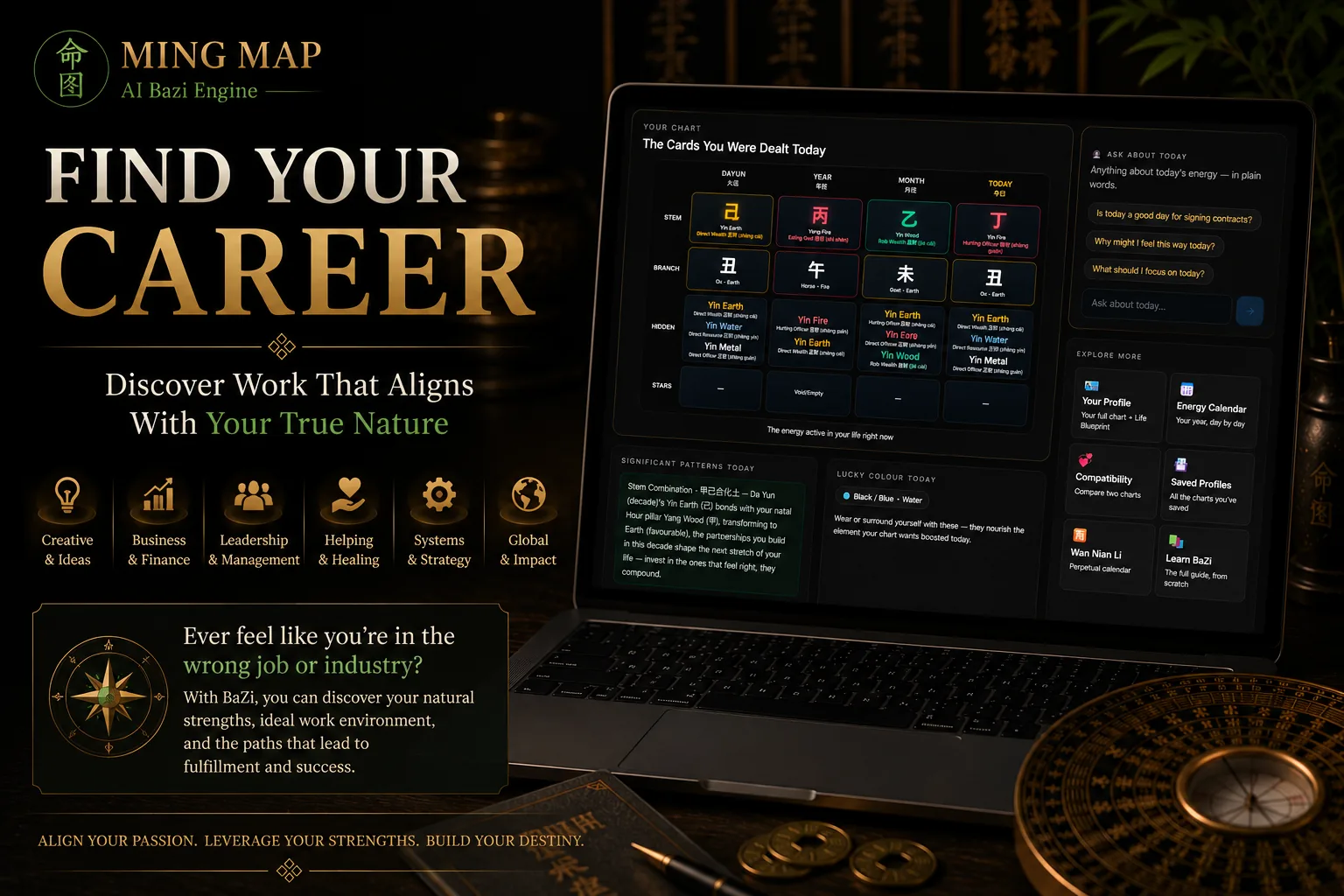
BaZi for Career: Find Work That Fits Your Chart
If you're reading this, you probably didn't type "bazi for career" out of intellectual curiosity. You typed it because something is wrong. The job doesn't fit. The Sunday-night feeling won't go away. You've been asking, quietly, for months or years now: what am I meant to do with my life? And the usual answers — passion tests, salary calculators, "follow your bliss," "just be grateful" — have all failed you.
Classical BaZi answers this question differently. It doesn't tell you what job title to pursue. It tells you the kind of energy your chart was built to run on, the motivation type you actually respond to, the natural talent carried in the month you were born, and the shape of success written into your pattern. Job titles come and go; those four things are the same at fifty as they were at fifteen. When your work matches them, you feel like yourself. When it doesn't, you feel like you're grinding metal against wood — loud, wasteful, exhausting, and no one is impressed with the result.
This is a long guide because you deserve a long answer. We'll walk through what career is right for me according to BaZi, layer by layer: Day Master, dominant Ten God, month branch, pattern, Useful God, and timing. By the end you should be able to sit down with your own chart on Ming Map and read a real career direction out of it — not a horoscope column, an actual reading.
Why do I feel stuck in my career?
Before we get to the machinery, let's name the thing you're feeling.
Career stuckness, in classical terms, almost always comes from one of three mismatches:
You're in the wrong element family. Your chart's Useful God — the one element that makes your chart work — is Water, and you've spent a decade in a Fire industry. The whole environment is running against your grain. You do fine, but nothing feels like yours.
You're in the wrong motivation type. Your chart is dominantly Officer-driven (正官) — you need structure, clear authority, an org chart, a badge, a rung. Or it's dominantly Output-driven (食神 / 傷官) — you need to make things and be seen for what you make. Or it's Wealth-driven (財) — you need to build assets, close deals, own something. When the motivation type of your job doesn't match your chart's dominant Ten God, no promotion fixes it.
You're in the right work at the wrong time. Your natal chart says architect clearly. But your current Luck Pillar — the ten-year decade you're actually living inside — is running against your Useful God, so everything feels like slog right now. This one is important because the answer is not to quit; the answer is to hold on.
Most career-lost people are dealing with a mix of all three. The chart tells you which mix you're dealing with.
What career is right for me according to BaZi? — the four layers
Classical BaZi reads career on four layers. Each one narrows the field. Read them in order.
- Layer 1 — Day Master: the element you are. This gives your baseline temperament and the industries that feel native.
- Layer 2 — Dominant Ten God: how you're motivated. Structure, building, creating, teaching, collaborating — this is the emotional engine of your work.
- Layer 3 — Month Branch: what you're naturally good at. The month you were born carries a specific talent set — often the clearest single career signal in the whole chart.
- Layer 4 — Pattern and Useful God: the shape of success. This is where classical BaZi gets specific. The pattern says what kind of career arc succeeds for you and what breaks it.
We'll take them one at a time.
Layer 1 — Day Master: the raw material
Your Day Master is the heavenly stem sitting in your day pillar. It's the one character everything else in the chart revolves around. There are ten of them — 甲 乙 丙 丁 戊 己 庚 辛 壬 癸 — and each one has a native career direction that classical texts have observed for centuries.
Note this doesn't lock you into an industry. It tells you which environments your nervous system was built for.
甲 Yang Wood — the Tall Tree
You are meant to grow tall and be seen. Industries that reward vertical growth, long timelines, and visible upward trajectory: construction, forestry, publishing, education, leadership tracks, executive coaching, senior professional service, ministry. You do poorly in flat, lateral, egoless environments where no one is meant to stand out. Say yes to work with a clear ladder.
乙 Yin Wood — the Grass, the Vine, the Flower
You are meant to spread horizontally, adapt, and beautify. Design, hospitality, writing, healing arts, floristry, fashion, education (especially early years), community organising, wellness, quiet luxury. You thrive on relationship networks, not org charts. You do poorly in rigid hierarchies where charm and taste are treated as decoration rather than product.
丙 Yang Fire — the Sun
You are meant to shine on many. Public-facing roles, media, entertainment, sales, leadership, teaching, coaching, energy sector, luxury goods, aviation, anything where visibility is the currency. You do poorly in back-office work where no one sees your effect. Being seen is not vanity for you — it's how your work compounds.
丁 Yin Fire — the Lamp, the Candle, the Refined Flame
You are meant to illuminate the specific, not the crowd. Precision work, editing, curation, jewellery, dentistry, surgery, watchmaking, boutique advisory, private education, deep research. Your value is depth, not volume. You do poorly in mass-market, high-throughput roles that flatten your judgement.
戊 Yang Earth — the Mountain
You are meant to hold ground. Real estate, construction, agriculture, banking, insurance, institutional leadership, executive coaching, education administration, infrastructure. You do poorly in fast-pivot startup culture that penalises stability. Your gift is that people trust you to still be there in five years.
己 Yin Earth — the Field, the Garden
You are meant to nourish. Teaching, hospitality, nutrition, primary care medicine, community leadership, small-plot agriculture, non-profit, foundational services, therapy, parenting-adjacent work. You do poorly where warmth is treated as unprofessional. Your work reaches people through relationship, one at a time.
庚 Yang Metal — the Axe, the Sword
You are meant to cut cleanly. Military, law enforcement, surgery, heavy industry, competitive sport, high-stakes finance, executive leadership under pressure, professional judging. You do poorly where indecision is normalised. Your gift is that you say the true thing without flinching.
辛 Yin Metal — the Blade, the Jewel
You are meant to refine. Law, accounting, precision manufacturing, gemology, dentistry, aesthetic medicine, corporate governance, judiciary, luxury craftsmanship. You do poorly in rough-and-ready environments where finish doesn't matter. Your value is the last 10% of polish that most people don't bother with.
壬 Yang Water — the Ocean, the River
You are meant to move at scale. Finance, trading, deal-making, hospitality, travel, logistics, shipping, entertainment, media distribution. You do poorly in stationary desk jobs with no flow of people or capital. Your gift is that you can hold many currents in your head at once.
癸 Yin Water — the Rain, the Dew
You are meant to penetrate quietly. Private wealth management, academic research, writing, quiet luxury, health services, therapy, deep work, forensic analysis. You do poorly in loud, high-throughput environments that dilute your attention. Your gift is that you notice what everyone else missed.
If none of these feel like you, you're probably reading from a Day Master that isn't your own, or you're in the middle of a Luck Pillar that's masking your baseline. Run your actual chart.
Layer 2 — Dominant Ten God: the motivation type
This is the part most modern career advice completely misses. Two people with the same Day Master and the same skills can burn out at exactly the same job — because they have different motivation types. Classical BaZi calls these the Ten Gods, and the one that dominates your chart is the emotional engine your career actually runs on.
There are broadly five families to think about for career:
Officer-motivated (正官 / 七殺) — the Structure and Authority family
If Officer or Seven Killings dominates your chart, you are wired to succeed inside a system. You want a title, a rank, a rulebook, a chain of command, a clear standard to be measured against. You don't hate rules — you thrive on them, because rules are what let you demonstrate competence.
- 正官 Direct Officer: legitimate authority, corporate ladders, government, law, established professions, board seats, institutional leadership. You want the sanctioned role.
- 七殺 Seven Killings: high-pressure, high-stakes command — entrepreneurship, military, surgery, elite sport, turnaround leadership, crisis roles. You want the hard problem, and you sharpen under pressure.
The trap: if you're Officer-motivated and stuck in a job with no clear hierarchy, no promotion path, no external standard — you feel formless and unseen no matter how good the pay is. You need the frame.
If you don't know what to do with your life and this is your dominant motivation, the answer is almost never "start your own thing from scratch." The answer is: find a bigger institution and become someone real inside it.
Building-motivated (正財 / 偏財) — the Wealth family
If Direct or Partial Wealth dominates your chart, you are wired to build assets and close deals. You want tangible outputs — revenue, ownership, real property, portfolios, deals that close, businesses that survive.
- 正財 Direct Wealth: steady, earned, compounding — salaried professional roles that build equity, savings-oriented finance, long-term investing, ownership of stable businesses.
- 偏財 Partial Wealth: windfalls, deal flow, entrepreneurship, real estate, side income streams, sales, brokering, speculation.
The trap: Wealth-motivated people in salaried roles with no ownership, no bonus tied to output, no upside — feel ghostly. The work happens but nothing accumulates. You need to see the pile growing.
If you're career-lost and Wealth is dominant, the question is not "what do I want to do all day" — it's "what am I willing to spend fifteen years building?"
Creating-motivated (食神 / 傷官) — the Output family
If Food God or Hurting Officer dominates your chart, you are wired to make things and be seen for what you make. This is the family of creative output.
- 食神 Food God: gentler, warmer creative expression — cooking, teaching, wellness, hospitality, design, gentle content, the arts, family-facing craft. You create for others' enjoyment and enjoy the process yourself.
- 傷官 Hurting Officer: brilliant, non-conforming, boundary-pushing expression — media, entertainment, performance, sales, innovation, entrepreneurship, tech, journalism, anything where being unusual is the value.
The trap: Output-motivated people in roles where nothing they make is visible to the outside world waste away. Middle-management coordination, back-office processing, roles that produce reports no one reads. You need the byline, the credit, the stage, the shipped product.
If you're Output-dominant and stuck, the answer usually involves showing your work in public in a way you're not currently doing. Classical texts warn that 傷官 unregulated offends authority — if you're a Hurting Officer type wondering why every boss eventually clashes with you, that's the pattern. The move isn't to become quieter; it's to find work where being loud and unusual is the job.
Teaching-motivated (正印 / 偏印) — the Resource family
If Direct or Partial Seal dominates, you are wired to know and to nourish. Career fit lives in education, research, healthcare, advisory, ministry, therapy, deep expertise, guardianship of knowledge.
- 正印 Direct Seal: formal knowledge — academia, credentialled advisory, licensed professions, official teaching, established medicine, orthodox religion.
- 偏印 Partial Seal: unconventional wisdom — unusual mentors, non-degree expertise, occult knowledge, alternative healing, independent research, niche craft.
The trap: Resource-motivated people are the most likely to over-learn and under-ship. You accumulate credentials without deploying them. If this is you and you feel stuck, the honest answer is probably: you know enough already; you're avoiding the exposure of using it.
Collaboration-motivated (比肩 / 劫財) — the Peer family
If Parallel or Rob Wealth dominates, you are wired for lateral relationships — partnerships, teams, guilds, coalitions, joint ventures, siblings-in-arms. You do poorly working alone and you do poorly under a single boss you can't push back against.
The trap: Peer-dominant people in solo careers (freelance, solo practice, sole trader) get lonely and lose direction. And Peer-dominant people in hierarchies get in trouble with authority. The right fit is partnership — co-founder, business partner, guild member, senior peer in a firm of equals.
How to tell which family dominates you
The dominant Ten God is usually the one that appears transparently in your natal stems (heavenly stems in year, month, day, hour) and has a strong root in the branches. If you have Officer or Killing transparent with a solid branch behind it, you're Officer-motivated. If Wealth is transparent with a strong root, you're Wealth-motivated. And so on. On Ming Map this is called out directly on your chart page.
Most people have one clearly dominant family and one secondary. The dominant one is the engine. The secondary one is the flavour. A Wealth-dominant chart with strong Output secondary makes a creative entrepreneur. An Officer-dominant chart with strong Resource secondary makes a scholar-official — the classical civil servant. Officer with Wealth secondary makes a corporate executive. Output with Resource secondary makes a teaching artist or a thoughtful writer. Read your combination and the direction usually becomes obvious.
Layer 3 — Month Branch: the natural talent
Now for the layer classical practitioners give the most weight to. The month branch (月令) is the single strongest signal in the whole chart. It's the "root" of your Useful God, the fulcrum of your Day Master strength, and — for our purposes — the clearest fingerprint of your native talent.
Very briefly: the month branch you were born in carries a dominant hidden stem, and the Ten God relationship between that hidden stem and your Day Master is the natal pattern's starting point. The month branch is also the season, which imprints a set of native capacities. Here's the shape of it by month branch:
- 寅 Tiger month (early spring): initiative, launching, pioneering. First-mover roles, R&D, entrepreneurship, teaching new subjects.
- 卯 Rabbit month (mid spring): refinement of growth, curation, cultivation, arts. Editorial, design, horticulture, hospitality.
- 辰 Dragon month (late spring, a tomb branch 墓庫): storage, gathering, the keeper of resources. Wealth management, archives, estate planning, foundations, family office work.
- 巳 Snake month (early summer): strategic vision, insight-into-motion. Consulting, strategy, communications, negotiation, high-end professional service.
- 午 Horse month (mid summer): performance, visibility, the stage. Media, entertainment, sales, teaching, coaching, executive leadership.
- 未 Goat month (late summer, a tomb branch 墓庫): harvest, integration, care. Hospitality, family services, nutrition, therapy, gentle luxury.
- 申 Monkey month (early autumn): analysis, tool-making, engineering. Tech, mechanics, precision manufacturing, quantitative work.
- 酉 Rooster month (mid autumn): discernment, judgement, quality control. Law, editing, judiciary, curation, gemology, aesthetic medicine.
- 戌 Dog month (late autumn, a tomb branch 墓庫): guarding, security, structural integrity. Security, defence, real estate, banking, structural engineering.
- 亥 Pig month (early winter): deep intelligence, wisdom-under-pressure, travel. Research, writing, logistics, philosophy, deep science.
- 子 Rat month (mid winter): flow, adaptability, secret knowledge. Trading, deal-making, intelligence work, therapy, private banking.
- 丑 Ox month (late winter, a tomb branch 墓庫): patience, endurance, accumulation. Long-term investing, farming, endurance sport, deep craft, institutional service.
Notice the four tomb branches — 辰戌丑未. If you were born in one of these months, you have a native capacity for holding and storing — this shows up as careers where the value is in the accumulation, not the flow. Fund management, archives, foundations, estates, deep specialisation, museum work, long-form scholarship. Tomb-month people often feel career-lost in their twenties because the world rewards flow and they only really come into themselves by their forties. That's not a defect. That's the shape of the season.
If your Day Master is 甲 Yang Wood and you were born in the Horse month (午), for example, the reading is direct: you are a tall tree born at the height of visible summer — public-facing creative or leadership work is your native lane. If you're a 甲 born in Rooster (酉), Yin Metal cuts Wood at its peak — a much sharper, more institutional path suits you: law, professional service, corporate leadership under a strong system.
The month branch is not a job title. But it is the closest thing to one that the chart offers.
Layer 4 — Pattern and Useful God: the shape of success
Now we get to the part that most casual BaZi content ducks. The pattern (格局) is the specific structure your chart forms — Direct Officer pattern (正官格), Wealth pattern (財格), Seal pattern (印格), Food God pattern (食神格), Seven Killings pattern (七殺格), Hurting Officer pattern (傷官格), Yang Blade pattern (陽刃格), and so on. Each pattern has a specific career shape it succeeds inside and a specific way it fails.
The Useful God is the single element your chart most needs to make that pattern work. Alignment with the Useful God is what makes work feel right.
Here's the career shape of each of the main patterns.
Direct Officer pattern (正官格) — the institutional career
Classical formation: Officer dominant in the month branch, transparent, clean, supported. Success shape: the sanctioned professional. This chart succeeds in institutional careers — law, government, corporate leadership, established professions, board directorship, senior civil service. The classical structure "Officer generates Seal generates Day Master" (官印相生) is the most prestigious career configuration in the whole system — it produces people who rise legibly inside a hierarchy and end up trusted with authority.
How this chart fails at work: the classical warning is Hurting Officer attacks Direct Officer (傷官見官) — meaning if this chart takes on too much unconventional expression, or clashes publicly with authority, the career suffers. If you have this pattern, the career move is not to become an edgy independent voice. It's to become deeply excellent inside a system that has room for you to rise.
Career-lost 正官格 people usually got told at some point that "real success means being your own boss" and tried to build a solo business against their pattern. It rarely works. Go back inside.
Wealth pattern (財格) — the builder's career
Formation: Wealth dominant in the month, Day Master strong enough to command it, ideally an Output source feeding the Wealth. Success shape: the builder. Business ownership, real estate, deal-making, professional services with equity, portfolio careers. The classical configuration "Wealth strong generates Officer" (財旺生官) is the wealth-to-status pathway — you build the pile, and the status follows.
How this chart fails: heavy Rob Wealth or Parallel peers compete the Wealth away — meaning in career terms, this chart cannot survive environments with lots of rivals for the same pot. Zero-sum sales floors with peer competition, partnerships without clear equity splits, family businesses with too many claimants. Also: heavy Seal breaks the supply chain from Output to Wealth — for this chart, over-studying and under-shipping is career-ending.
If you have a Wealth pattern and you're career-lost, the answer is almost always to stop optimising for salary and start optimising for ownership.
Seal pattern (印格) — the scholar's career
Formation: Seal dominant in the month, ideally with an Officer or Killing generating it. Success shape: the trusted expert. Academia, research, healthcare, licensed advisory, ministry, orthodox teaching, senior counsel. This chart succeeds by being the one who knows, whom others come to consult.
How it fails: classical warning is Wealth destroys Seal (財壞印) — meaning if this chart chases money by abandoning depth, expertise, or ethical structure, the career collapses. Also: excessive Seal makes the Day Master disconnected and arrogant — the eternal grad student who never ships. If you're Seal-pattern and stuck, you probably know enough. The problem is exposure, not learning.
Food God pattern (食神格) — the productive creator
Formation: Food God dominant, Day Master strong enough to generate it, ideally feeding into Wealth (食神生財) or controlling Seven Killings (食神制殺). Success shape: the joyful producer. Craft-based work, teaching, gentle creative output, hospitality, food, wellness, design, product-building. Warm, sustainable, generative careers.
How it fails: Partial Seal steals the food (梟神奪食) — Partial Seal appearing in the chart cuts off the creative output. In career terms, this shows up as unusual mentors or teachers who inadvertently shut down your own voice, or theoretical frameworks that block you from making things. Food God pattern people often need to gently outgrow the mentor who first taught them, so they can produce in their own voice.
Seven Killings pattern (七殺格) — the disciplined warrior
Formation: Seven Killings dominant, controlled by either Food God (食神制殺) or channelled through Seal (殺印相生). Success shape: the person who does the hard thing. Military, surgery, elite sport, entrepreneurship, turnaround executive, crisis leadership, high-pressure finance. This chart is made for the difficult problem.
Uncontrolled, this pattern is dangerous — classical texts warn about health, conflict, and burnout. The whole career strategy is find your controller. If you have Food God controlling the Killing, your career shape is a disciplined operator — surgeon, elite performer, competitive executive. If you have Seal channelling the Killing, your shape is a strategic leader — military strategist, senior executive, high-level advisor.
If you have this pattern and you're stuck in low-stakes work, you're miserable. This chart doesn't come alive until the stakes are real.
Hurting Officer pattern (傷官格) — the brilliant nonconformist
Formation: Hurting Officer dominant, ideally with Wealth to channel it (傷官生財), or Seal to temper it (傷官佩印). Success shape: the visible unconventional voice. Media, performance, entertainment, sales, innovation, journalism, tech, art, entrepreneurship. This chart succeeds where being unusual is the value.
Classical warning: Hurting Officer sees Officer (傷官見官) is destructive — meaning this chart clashes with institutional authority. If you're Hurting Officer pattern and you keep ending up in fights with bosses, that's not a personality flaw. That's the pattern. The move is not to become obedient. The move is to build a career where you have no boss above you, or where your unusualness is the product.
Also: the specific 金水傷官 configuration (Metal Day Master with Water Hurting Officer) is the classical "refined and clear" configuration — this one can work inside institutions, as an eloquent, analytical, high-authority voice.
Yang Blade pattern (陽刃格) — the concentrated force
Only Yang Day Masters can have this — 甲 with 卯, 丙 or 戊 with 午, 庚 with 酉, 壬 with 子. Extreme concentration of the Day Master's own element, requiring a controller. Success shape when controlled: formidable achievement. Extreme athletes, generals, top surgeons, high-office executives, competitive founders. This is the classical "warrior with a sharp sword" chart.
Uncontrolled: severe classical warnings about self-destruction, accidents, extremism. If you have this pattern, career fit means finding the structure that channels the intensity. Yang Blade people are miserable in gentle jobs and dangerous in unstructured ones. Real hierarchy, real stakes, real controllers — that's where they thrive.
The Jian Lu / Month Companion condition (建祿月劫)
If your month branch is your Day Master's own element, classically this is not a pattern — it's a condition. The Day Master is naturally strong and self-sufficient. The Useful God has to be found in the other pillars, from whatever else is transparent — Officer, Wealth, Food God, or Killing. Career direction follows that Useful God, not the month.
The trap for Jian Lu people is scattered potential. You have plenty of raw energy but no obvious pattern-based direction. You have to find the thing outside yourself that gives you a shape — a mission, an institution, a product, a partner, a market. Without it, the chart runs and runs and produces nothing durable.
How do I find my calling using BaZi?
If you've been reading this hoping for a single sentence that names your calling — I understand why, and I have to disappoint you honestly. Classical BaZi does not name jobs. What it does, done well, is give you a four-part filter:
- My Day Master says my baseline temperament is X — so I filter out industries that fight it.
- My dominant Ten God says my motivation type is Y — so I only take roles that engage that motivation.
- My month branch says my native talent is Z — so I lean into that talent rather than compensating around it.
- My pattern says my success shape is W — so I structure my career around what makes that pattern succeed and avoid what makes it fail.
Run those four filters against every option in front of you and most of the noise falls away.
Your calling isn't a job title. It's the intersection of those four things, expressed through whatever the world currently offers in that intersection. Fifty years ago your intersection might have been "regional bank manager." Today it might be "risk lead at a fintech." In fifty years it'll be something none of us have named. The intersection is stable; the label isn't.
Should I quit my job based on my chart?
Almost never on the chart alone. Almost never right now. Here's the honest classical answer, and it has two parts.
Part one: is the mismatch structural, or is it timing?
If your current work fights your Day Master, opposes your dominant Ten God, ignores your month branch talent, and runs against your pattern — that is a structural mismatch. Yes, you should plan an exit. Not this week. But you should stop pretending it will fix itself.
If your current work fits most of the four layers but the Luck Pillar you're in is running against your Useful God, that is a timing problem. The move is not to quit. The move is to survive the pillar and re-emerge when the wind changes. Classical texts are very clear about this: the same chart in different luck pillars produces different outcomes. Quitting during a bad pillar often means giving up right before the pillar turns.
Ming Map shows your current Luck Pillar on your chart page. If it brings your Useful God, the year is for you and your career discomfort is probably about the specific role, not the direction. If it brings your unfavourable element, you are in a genuinely hard chapter and the classical advice is: reduce ambition, protect health, cultivate skills, wait for the pivot.
Part two: what does the year say?
Classical career timing looks at whether the current period supplies or attacks your Useful God, and whether it activates favourable Ten Gods (Officer, Wealth, Output, Resource, depending on your pattern) or unfavourable ones. A period that brings your favourable Ten God active is a supportive window for career moves. A period that clashes your Day pillar branch or brings a Six Clash (六冲) against your career-carrying pillar tends to force change whether you want it or not.
If both your natal chart and your current window support a move, and you've thought about it for more than a season, and you have a next step lined up — then yes, the timing supports it. If the natal chart supports it but the window doesn't, prepare quietly; move later. If neither supports it, sit tight and read this article again in six months.
What am I meant to do with my life?
You are meant to use what you were built for. That is the whole answer.
Classical BaZi's underlying philosophy is that a well-lived life expresses the chart. Not fights it, not overcomes it, not transcends it — expresses it. Your Day Master, your motivation type, your natal talent, your pattern, your Useful God — those are not obstacles to your true self. They are your true self, written in a notation that predates you by three thousand years.
The reason you feel lost is almost certainly that some accident of upbringing, culture, geography, or fear has pointed you at a life that expresses somebody else's chart. Not maliciously — it's just what happened. Your job is to walk it back to yours. That doesn't require quitting everything and moving to Bali. It requires directional honesty — a series of small choices, over several years, each one moving you a little closer to work that fits the four layers.
If you can only afford to change one thing in the next year, change the motivation type of your work. Get inside the Ten God family your chart is actually built for. Everything else — industry, title, seniority — can adjust from there.
Timing your career moves — the Luck Pillar layer
A short but important word on timing. Classical texts read Luck Pillars — ten-year decades that layer on top of your natal chart — with three questions:
- Does the pillar's stem and branch supply my Useful God? If yes, the decade is for your work. Big moves land. Investments compound. Effort translates into results.
- Does the pillar activate my pattern's favourable Ten God? For a Direct Officer pattern, that's a Wealth or Seal decade. For a Wealth pattern, that's an Output or Officer decade. For a Food God pattern, a Wealth decade. For a Seven Killings pattern, a Food God or Seal decade. Read your pattern; know your favourable pillar type.
- Does the pillar cause a Six Clash (六冲) or combination with your Day pillar? If yes, expect forced change — the pillar makes you move whether or not you were planning to.
The general rule: big career moves in supportive pillars, consolidation in neutral pillars, protection in unsupportive pillars. When you're in a good decade you should be bold, not merely comfortable. And when you're in a hard decade you should not be ambitious past your bandwidth — you should be durable.
You can't always tell which one you're in by feel. The chart tells you. Run it.
Frequently asked questions
Can BaZi tell me my exact job title? No, and be suspicious of anyone who claims otherwise. BaZi tells you the four things above — temperament, motivation, talent, success shape. Modern job titles are a thin, changing surface on top of those. Match the deep layers and the surface takes care of itself.
Am I doing something wrong if my work doesn't feel like a calling? Not necessarily. Most people spend their twenties trying on other people's charts before they find their own. If you're in your twenties and lost, you're on schedule. If you're older and lost, the chart is a shortcut — it can save you another decade of blind trial.
What if my Day Master is the "wrong" element for my industry? Read one layer up. Sometimes an industry looks like the "wrong" element on the surface but engages your Useful God underneath. A 甲 Yang Wood person working in finance (nominally a Metal industry) can thrive if their specific role is building portfolios of growth companies — Wood work inside a Metal building. It's often not the industry, it's the sub-role within it.
I have no dominant Ten God — everything is spread evenly. What do I do? Then your career shape is defined by your pattern and your Useful God, not by a dominant Ten God. Read Layer 4 more carefully. Even distributions often produce generalists — chief-of-staff types, general management, teaching, hospitality — where the work is the integration itself, not a specialist output.
Why can't I hold onto money in my career? Classically this reads as a Wealth-pattern problem: heavy Rob Wealth or Parallel peers competing away the Wealth, or Seal blocking the supply chain from Output to Wealth. Sometimes it's the pillar — a Rob Wealth pillar drains money by design. The move is usually to close — fewer partners, cleaner equity, less exposure to peer rivals, more solo ownership.
Am I meant to be alone in my career? If your chart is heavily Peer-dominant (比肩 / 劫財), no — collaboration is your engine, and solo work exhausts you. If your chart is heavily Seal-dominant, the answer may be a solo-but-mentored path — quiet expertise with occasional partnership. Read your Peer versus Resource balance to know which one you are.
Should I follow my passion? Follow your pattern, not your passion. Passion is a feeling from this week. The pattern is stable across your whole life. When the two align, wonderful. When they don't, the pattern is more predictive of long-term satisfaction than the passion is.
What about the classical career direction of my favourable element? Isn't that enough? It's a starting filter, not the answer. Element families point at broad industries — Wood for growth and education, Fire for visibility and media, Earth for property and stability, Metal for precision and structure, Water for flow and communication. But two people with the same favourable element can need completely different careers if their motivation types differ. Layer 2 matters as much as element family.
When should I actually make the change? When your natal chart says this direction fits, and your current Luck Pillar says this window supports movement, and you have a next step lined up. Two out of three is usually not enough. All three is a green light.
What if I'm too old to change careers? Classical BaZi has an unusually calm answer here. Careers unfold across the whole life; the tomb-branch and Seal-heavy charts specifically tend to bloom later. Some of the most fitted careers in classical case studies begin in the second half of life. You are almost certainly not too late. You may be too tired — those are different problems.
If you're serious about answering "what career is right for me according to BaZi," run your chart on Ming Map and look at four things: your Day Master, your dominant Ten God, your month branch, and your Useful God. Each one is called out explicitly on your chart page, and each one narrows the field. A single visit is often enough to move you from "lost" to "I see the direction now." That direction is worth a lot. The specific next step is yours — but you shouldn't have to guess at the direction.
Nothing above is a horoscope column. Every claim maps to a computable rule in your chart. Enter your birth date and see what your specific chart says.