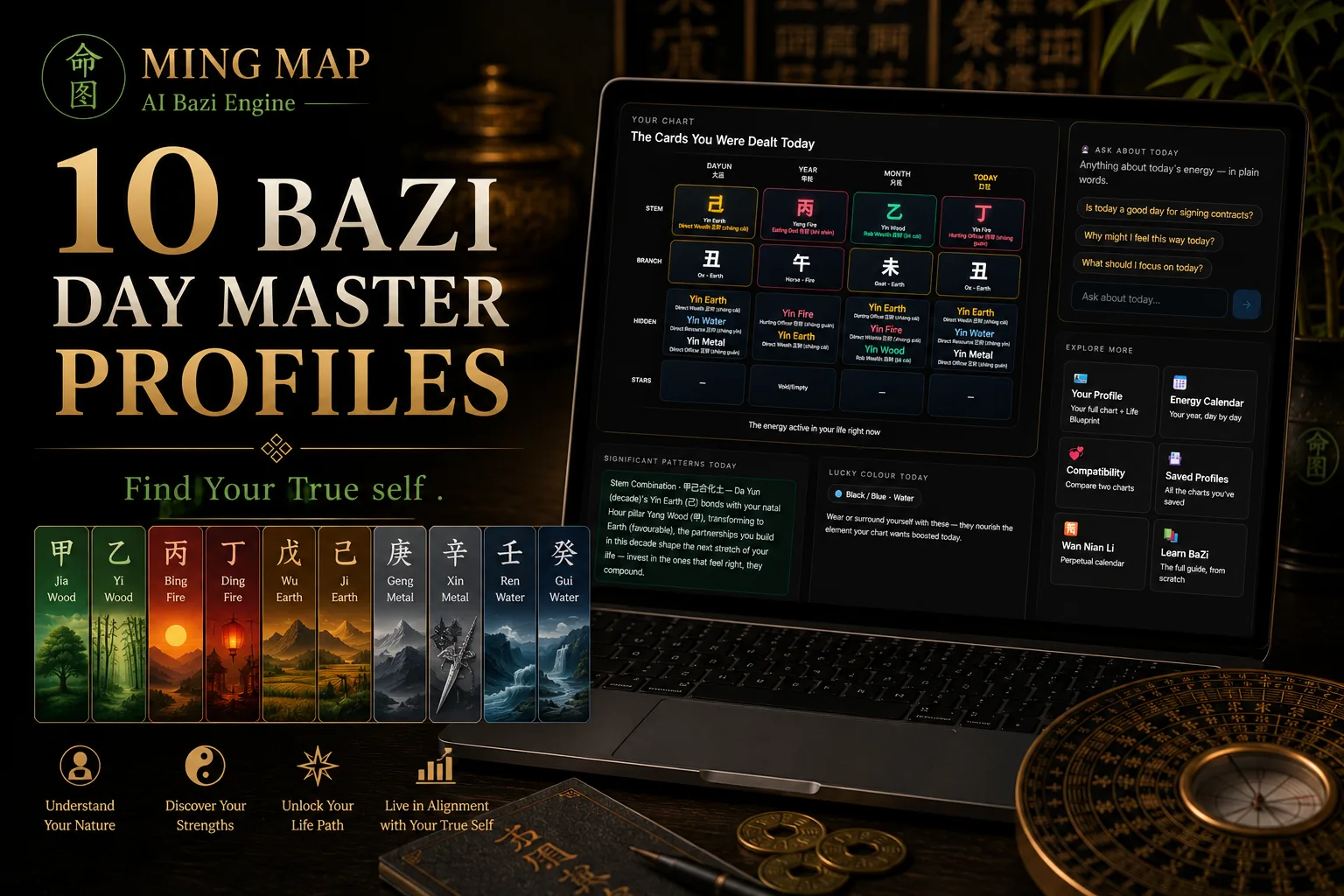
BaZi Profiling: The 10 Day Master Profiles Explained
If you have landed here, you probably typed something into Google like "which day master am I" or "what does my Chinese birth chart say about my personality?" — and you are hoping for something more specific than another zodiac column that lumps a billion people into twelve boxes.
BaZi profiling is that more specific answer. It reads you not by the year animal you were born in, but by the single Heavenly Stem sitting on the day of your birth — your Day Master (日主, rì zhǔ). There are ten of them, one for each combination of the five elements and Yin or Yang polarity, and classical BaZi treats them as ten distinct temperaments, each with a canonical image: a great tree, a lamp flame, a mountain, a dew drop.
This guide walks all ten in the depth they deserve. For each you get an archetype, a working style, a love style, a money style, health tendencies, the shadow that emerges under stress, and the growth edge — the specific move that stretches you into the next version of yourself. Read the one that is yours, then read the two on either side of you in the cycle. That is often where the rest of your family lives.
Which Day Master am I?
Your Day Master is the top character of your day pillar (日柱) — the stem, not the branch. It comes from your birth date once it is converted into the Chinese solar-lunar calendar. You cannot guess it from your Western birthday alone; a small correction is required for the day-boundary time (Chinese days pivot at 23:00, not midnight) and for the sexagenary cycle. The fastest way is to enter your birth details into Ming Map and read the top of your day pillar. It will be one of: 甲, 乙, 丙, 丁, 戊, 己, 庚, 辛, 壬, or 癸.
That single character is the seat of you. The rest of the chart — year pillar, month pillar, hour pillar — tells us about the family, the environment, the timing, the tools you were handed. But the day stem is the person holding those tools.
Why ten profiles and not five
A lot of pop BaZi content stops at "five elements" — Wood, Fire, Earth, Metal, Water. That is half the picture and it hides the most useful half.
Every element in classical BaZi appears in two polarities: Yang (阳, the outward, active, expansive expression) and Yin (阴, the inward, refined, adaptive expression). Yang Wood (甲) and Yin Wood (乙) are both Wood, but they live differently — one is a tall pine, the other is a climbing vine. Yang Earth (戊) and Yin Earth (己) are both Earth, but one is a mountain and one is a garden bed. The polarity flip changes the personality more than most people expect.
Classical BaZi is strict about this. In the ten-god system that assigns roles to every stem around your Day Master, the same element becomes a different god depending on whether its polarity matches yours or not. Same polarity = a "partial" (偏) relationship — competitive, unconventional, more intense. Opposite polarity = a "proper" (正) relationship — steadier, more socially legible. That is why we always work at the level of the specific stem, never the element alone.
Which is a long way of saying: if a profiling test only asked whether you are Wood or Fire, throw it away. You need to know which of the ten stems you are.
甲 Yang Wood — the Great Tree
Archetype. 甲 (jiǎ) is the tall pine, the oak, the load-bearing timber. In classical imagery, Yang Wood grows upward. It does not creep sideways, it does not compromise its trunk to fit around obstacles — it drives straight up toward light, and it prefers to stand alone at the top of the canopy. You are the person in the room who instinctively takes a principled stance and holds it, even when that costs you politically. You have a spine. Others feel it before they can name it.
Working style. You lead by example. Vision, direction, long horizon. You are terrible at politics that require chameleon-ing yourself; you are excellent at building something from a first principle and holding a team to it. Institutional roles, entrepreneurship, publishing, architecture, education, forestry, construction — anything where a structure has to be built and someone has to be its trunk. When you work under a boss who respects the truth, you thrive. When you work under a boss who wants a mirror, you rot.
Love style. You commit. Slowly, and rarely, but once you do, you plant. You are looking for someone who can lean on your trunk without wanting to prune you, and who has their own root system so you are not being asked to grow tall enough to shade them from every weather. You struggle with partners who need frequent reassurance — not because you don't love them, but because the tree does not send its leaves to check on the grass. Learn to say the thing out loud.
Money style. Slow, structural, real. You build wealth by accumulating things that keep growing — property, businesses with defensible moats, senior positions, equity. You are unlikely to make a fortune from speculation and equally unlikely to lose one gambling. Cash flow is your weak spot in youth (all resources go into growth), and it is your quiet superpower in middle age (the tree finally bears fruit).
Health tendencies. Wood governs the liver and gallbladder in Chinese medicine's overlap with BaZi. When Yang Wood is stressed you feel it as pent-up frustration, headaches, tight neck and shoulders, digestive irritation. If your chart is Fire-heavy or Metal-heavy without cooling Water, the tree gets scorched or hacked — take rest seriously and drink actual water.
Shadow when stressed. Rigidity. Righteous stubbornness. Cutting people off because they broke a principle you never told them about. When 甲 goes into shadow it becomes the tree that refuses to bend in the storm and snaps at the base. The story you tell yourself is "they betrayed the standard"; the truth is often "you never spoke the standard out loud."
Growth edge. Learn to bend without collapsing. Study Yin Wood (乙) — the vine that reaches the same sun by wrapping the trellis. Learn to say difficult things kindly. Learn to accept help. The classical rule that saves you: a great tree needs Water at the root and Metal to prune the excess branches — resource (印) to sustain you, and honest structure (官) to shape you. Do not try to be your own axe.
乙 Yin Wood — the Vine
Archetype. 乙 (yǐ) is the flowering vine, the climbing bamboo, the wildflower in the meadow — soft-looking, deceptively tough. Where 甲 climbs by trunk, 乙 climbs by relationship: it wraps around whatever will hold it and reaches astonishing heights that way. Vines outlive many of the trees they grew on. Do not mistake gentleness for weakness.
Working style. Diplomacy, taste, timing, network. You navigate. You read the room. You know exactly which person is the actual decision-maker even when the org chart says otherwise. Design, writing, hospitality, PR, negotiation, education, medicine, wellness, curation — anywhere that how you do something matters as much as what you do. You are wasted in blunt-force environments; you shine wherever finesse compounds.
Love style. You bond deeply and adaptively. You are unusually good at fitting yourself around a partner's shape — which is a gift and, unmanaged, a slow disappearance. You want a partner with an actual trellis: their own values, their own life, their own competence. You wilt when someone leans on you the way a tired person leans on a wall.
Money style. Money flows to you through people. Your networks are worth more than your salary. You do not need to be the loudest earner in the room to be the wealthiest one at 55. You are strong at recurring income, hospitality, retail with taste, small luxury businesses, professional services. Where you get hurt is in ventures that require pure aggression — you are the wrong tool for that job, and you will out-source aggression to a partner who mishandles it.
Health tendencies. Same Wood-organ vulnerability as 甲 but expressed as anxiety, allergies, skin flare-ups, sleep disturbance, immune quirks. You are more sensitive to environment — bad air, bad food, bad company, bad workplaces — than most Day Masters. Believe your body when it tells you something is off before your mind can name it.
Love-style follow-up: Am I meant to be alone? No. But your version of "together" is not everyone's version. You need a partner who does not require you to be a project. Solitude is genuinely nourishing to you — do not confuse your need for space with not being a partnership person. Many long-married 乙 charts guard their solitary rituals fiercely; it is what keeps them in the relationship.
Shadow when stressed. Passive resentment, martyrdom, tangled loyalties, difficulty exiting bad situations because you have wrapped yourself around them. Vines are hard to unwind. When 乙 goes into shadow the story sounds like "I gave and gave and they took" — which is often true but only half true; the other half is the vine's own reluctance to name what it needed early.
Growth edge. Learn to say the ask, cleanly, before you resent the answer. Learn to prune your own connections — some trellises are not worth climbing. Study Yang Wood (甲): the trunk that stands on its own. You do not need to become a tree, but you need a version of yourself that can stand for a week without needing external support.
丙 Yang Fire — the Sun
Archetype. 丙 (bǐng) is not a candle. It is not a bonfire. It is the Sun. Classical texts are emphatic: Yang Fire is the great luminary, radiant, warm, generous, and impossible to hide. If you are 丙 you have known this since you were small. You walk into rooms and rooms react. You emit warmth even when you are tired. People remember meeting you.
Working style. Leadership, visibility, sales, media, education, energy, entertainment, luxury goods. You are wasted behind a desk making spreadsheets for someone else; you are magnetic when you are the face of the thing. You inspire; you burn out others when you demand they burn as hot as you do.
What is the Yang Fire personality like — the fuller answer. Big-hearted, quick to warmth, quick to anger, quick to move on. Generous without keeping score. Genuinely bad at hiding your feelings — your face and voice give you away, and this reads as honesty by strangers and exhaustion by close family. You need attention the way plants need light — this is not vanity, it is metabolism. In love you are demonstrative and dramatic; in work you are the room's energy source; in solitude you shrivel slightly and need to notice that early.
Love style. Passionate, expressive, generous, jealous, sudden. You need reciprocation visibly — a partner who is emotionally hidden feels like a cave you cannot warm. You do best with a Water-flavoured partner who can regulate you (Yin Water is the classical pairing that cools without extinguishing) or a well-rooted Earth partner who receives your warmth without demanding you give more.
Money style. Big earner in surges, big spender in surges. Cash flow does not scare you; discipline does. Wealth building for 丙 is a boring subject you must learn to love. Find one advisor you trust, automate half of everything, and stop asking whether you feel like saving this month.
Health tendencies. Cardiovascular, blood pressure, inflammation, insomnia, adrenal burnout. The Sun does not turn off — you have to. Sleep is not optional. Alcohol turns you volatile faster than most Day Masters.
Shadow when stressed. Grandiosity, temper, dramatic exits, burning bridges you would like back next month. The Sun in shadow is a scorching noon — everything under it wilts. When 丙 stops being warm and starts being hot, the people around you cannot tell you, because you have made yourself frightening.
Growth edge. Learn to let the light be available rather than broadcast — you do not have to be on for every room. Study Yin Fire (丁): the lamp that illuminates one thing precisely. The classical rule that steadies you: Water (官殺) as real structure, real deadlines, real accountability, and Wood (印) as substance you feed on — reading, mentors, quiet study. Without both, you burn out the fuel and become an angry ember.
丁 Yin Fire — the Lamp
Archetype. 丁 (dīng) is the lamp flame, the candle, the refined fire that reads books late at night. Where 丙 lights a stadium, 丁 lights a manuscript. You are quieter than the Sun, warmer than most people realise, and precise in a way that few Day Masters are.
Working style. Precision work, deep expertise, mentorship, editing, research, dentistry, surgery, watchmaking, quiet leadership, spiritual work, therapy, small-team craft. You are the person people go to when they want the right answer, not the loud one. In group settings you can look invisible; in a one-on-one conversation you can change someone's decade.
What is the Yin Fire personality like — the fuller answer. Reflective, discerning, unusually kind but not soft. You read people well and are protective about who you spend energy on. You are romantic in a private way, spiritual in a private way, and often creative in a way that only becomes visible after decades of quiet work. Do not mistake your quietness for smallness — the lamp is the reason people can read after dark.
Love style. Slow, careful, deeply loyal once chosen. You are looking for depth over sparkle. You are wounded by partners who cannot see you and heal remarkably fast around partners who can. You need a partner who protects your quiet — a very loud person will drain you even if you love them.
Money style. Steady rather than spectacular. Craft businesses, professional services, expertise-for-hire, small luxury, teaching, publishing, IP. You are unlikely to build a giant company; you are very capable of building a durable, respected one. You do well investing in your own skill and in things you can inspect (property, small businesses, real assets).
Health tendencies. Eyes (long screen hours), sleep, nervous exhaustion, digestive sensitivity. You feel emotions in your body more than most; treat that as data.
Shadow when stressed. Withdrawal, quiet resentment, over-editing yourself out of the room. The lamp in shadow just goes dim — no one notices until it goes out. When 丁 stops speaking, the people who need your light do not know to ask.
Growth edge. Learn to show up before you feel invited. Learn to finish the thing you have been polishing for three years and let the world see it imperfect. Study Yang Fire (丙): unashamed visibility. You do not need to become the Sun, but you need a version of yourself that puts your work under it.
戊 Yang Earth — the Mountain
Archetype. 戊 (wù) is the mountain, the massive plateau, the fortress ground. Immovable, protective, patient, deep. Where others react, you stand. Storms pass over you; the shape of you does not change. That is your gift and, in the wrong context, your problem.
Working style. Long-term custodianship of important things. Real estate, banking, insurance, institutional leadership, government, agriculture, construction, executive coaching, family-office management. You are the one who inherits or builds the thing that will outlive you. You are excellent at holding a line; you are terrible at rapid pivots.
Love style. Loyal, protective, unshowy. You are not the partner who writes poems; you are the partner who is there through the years poems get written about. You want to be trusted more than admired. You do best with a partner who values reliability over performance and who can gently thaw the parts of you that go cold under prolonged pressure.
Money style. Steady accumulation. Real estate is often literally your friend. You are patient enough for compound interest to actually work on you. You are vulnerable to stagnation — hoarding without deploying — and to being talked into ventures by more energetic personalities who use you as their foundation without giving you the upside.
Health tendencies. Digestion, weight regulation, blood sugar, joints, back. Earth's organ correlates in Chinese medicine — stomach and spleen — are the classic 戊 vulnerabilities. You need movement; the mountain that does not walk becomes a tomb.
Shadow when stressed. Stubbornness, immobility, grudges that last for decades, inability to say "I was wrong." When 戊 goes into shadow it becomes the ground that refuses to shift even after the geology has changed underneath it. The people who love you are still asking for a small adjustment that you framed as an assault on your identity.
Growth edge. Learn to deploy what you accumulate. Learn to move before you are forced to. Study Yang Wood (甲) — a good partner and mentor archetype for you — the tree that pushes upward from your soil and shows you where the light is. The classical rule for you: your role is stewardship, not accumulation for its own sake. Give things away on purpose sometimes.
己 Yin Earth — the Field
Archetype. 己 (jǐ) is the garden bed, the cultivated field, the fertile plot. Not the mountain — the soil. You nourish. Things grow in you that could not have grown elsewhere. Children, students, patients, employees, plants, friendships — you are the reason they became what they became, and you are unusually happy to let them take the credit.
Working style. Teaching, care work, nutrition, community leadership, primary healthcare, human resources, non-profit, hospitality, small agriculture, family business. You are excellent at building environments where other people flourish. You are underrated at every one of these jobs because your contribution is invisible until you leave.
Love style. Nurturing, patient, quietly devoted. You bond by feeding — food, care, attention, small acts that add up. You are vulnerable to partners who accept your care as their entitlement and never ask what you need. Learn to name your own needs; the field also requires rain.
Money style. Steady, service-based, compounding. You are less likely than any other Day Master to have a spectacular exit and more likely than most to be the quietly wealthy person no one expected. You are strong at recurring revenue businesses, savings, credentials that let you charge more per hour. You are vulnerable to over-giving discounts.
Health tendencies. Digestive, immune, blood sugar, exhaustion from over-serving. You are the Day Master most likely to schedule everyone else's medical appointments and skip your own.
Shadow when stressed. Codependence, martyrdom, silent resentment, quiet worry that eats the soil from underneath. When 己 goes into shadow it looks like ceaseless service that no one appreciates and that you cannot stop performing. The story is "they take me for granted"; the deeper truth is often "I have stopped asking to be seen."
Growth edge. Take a room's attention for a while and see that it does not kill you. Study Yin Wood (乙): the vine that reaches up out of the soil. You are allowed to grow from your field; you do not have to remain only the substrate.
庚 Yang Metal — the Blade
Archetype. 庚 (gēng) is raw iron, the axe, the unrefined sword, the ore. Hard, direct, decisive, useful — a weapon or a tool depending on who sharpens it and to what. You cut through. You are the person others call when a difficult conversation has to happen or a hard decision has to be made and no one else has the stomach for it.
Working style. Military, law enforcement, surgery, competitive sport, heavy industry, executive leadership under pressure, high-stakes finance, engineering, sales that involves closing. You do your best work when you are needed — pressure and stakes bring out your best. Low-stakes environments make you restless, and restless 庚 will pick fights just to feel alive.
Love style. Loyal, protective, direct. You do not do subtle. You do not do coded messages. You do not do "if you loved me you would just know." You want a partner who can say the thing out loud, take a plain answer, and not require you to be a mind reader. Your love shows as action — not many words. Partners who need frequent verbal reassurance can misread you for cold; you are not cold, you are just built to protect rather than perform.
Money style. Aggressive earner. You are willing to take real risks and you handle real losses. You do well in commission, deal-making, business ownership, cyclical investing. You are vulnerable to over-leverage and to a kind of macho refusal to ask for help before the situation is critical.
Health tendencies. Cardiovascular, lungs, respiratory, joints, injuries. The metal organs in Chinese medicine are the lungs and large intestine — respiratory quirks and grief-related somatic stuff show up in 庚 charts. Also: injuries. You take risks with your body.
Shadow when stressed. Aggression, rigidity, controlling behaviour, cutting off people you love in the name of a principle you invented that afternoon. When 庚 goes into shadow it becomes the blade that keeps swinging after the fight is over. Family members feel it as fear.
Growth edge. Learn to soften without going soft. Learn to receive care. Learn that not every problem is a nail. The classical rule that shapes you: raw iron becomes a useful tool only after it is refined by fire — controlled pressure, real challenge, mentorship from someone who has done the work. Choose your fire; do not become someone else's slag.
辛 Yin Metal — the Jewel
Archetype. 辛 (xīn) is refined metal — the jewel, the polished blade, the surgical instrument, the fine ornament. Where 庚 is raw ore, 辛 is what it becomes after skill and pressure. Elegant, precise, image-conscious, discerning. You care about how things are done. You would rather have one exquisite object than five acceptable ones.
Working style. Law, accounting, precision manufacturing, gemology, aesthetic medicine, dentistry, corporate governance, judiciary, luxury retail, editing, critique. You are the person people trust with the final call. You are wasted in environments that reward volume over quality.
Love style. Selective, romantic, aesthetic. You care what your partner is and also how they show up — how they dress, how they speak, how they carry themselves. This is not shallow; you experience love partly through form. You want to be admired for who you already are, not for who you are becoming. You are vulnerable to partners who use your image-consciousness against you (belittling, comparing, criticising your appearance) — hold your ground and leave earlier than you think you should.
Money style. Quality over quantity. You spend well on the things that matter and are strangely thrifty on the things that don't. You do well in premium services, professional practice, high-end goods, expertise-for-hire, IP, licensing. You are vulnerable to lifestyle inflation that outpaces your actual security.
Health tendencies. Respiratory, skin, allergies, refined sensitivities generally. You feel small chemical and environmental things more than most Day Masters. This is data, not weakness.
Shadow when stressed. Perfectionism, hyper-criticism (of yourself first, others second), vanity, brittleness, inability to accept a rough draft of anything. When 辛 goes into shadow, nothing is ever quite right, including you. The people around you start editing themselves before speaking, and eventually go quiet.
Growth edge. Learn to publish the imperfect thing. Learn to receive rough affection. Study Yin Earth (己): the field that accepts what falls into it. You do not need to become the field, but you need a corner of your life where standards loosen — a friend group where the food is bad and the conversation is honest, a hobby you are objectively mediocre at, a body you allow to look human.
壬 Yang Water — the Ocean
Archetype. 壬 (rén) is the great water — the ocean, the wide river, the flood. Vast, mobile, curious, impossible to fully contain. Where 甲 rises, 壬 travels. You are the Day Master most naturally at home with change, with distance, with scale. You can move to a new country and be functional in a week. Your mind is genuinely wide.
Working style. Finance, trading, hospitality, travel, logistics, shipping, entertainment, deal-making, journalism, diplomacy, tech at scale. You are excellent at flow — of money, of people, of information, of ideas. You are less excellent at sitting still and drilling into one thing for a decade. Choose careers with movement.
Love style. Passionate, curious, easily bored, unusually generous. You want a partner who is a world, not a room — someone with their own currents and depth. You are vulnerable to the "grass is greener" pattern and to using travel as an emotional exit. Long love for a 壬 requires deliberate anchoring: shared rituals, a home base you actually inhabit, a friend group you do not abandon every three years. Otherwise the ocean just keeps moving.
Money style. This is often the Day Master with the most dramatic wealth cycles — big up, big down, big up again. You are strong at deals, opportunistic income, multi-stream businesses, and the kind of wealth that flows in when many currents converge. You are vulnerable to spreading across too many bets and to not holding wealth (classical BaZi says water needs the shore — Earth — to be contained). Discipline is your friend.
Health tendencies. Kidneys, bladder, hormones, sleep-cycle disruption, addictions. Water Day Masters need cyclical restoration. You cannot run on empty for long without expensive consequences.
Shadow when stressed. Restlessness, avoidance, impulsive exits, seductive charm used as escape, secret compartments in your life. When 壬 goes into shadow, the ocean pulls back from shore and leaves everyone standing in wet sand wondering what they did wrong. Often they did nothing; you just ebbed without warning.
Growth edge. Learn to stay. Learn to build a shore. Study Yang Earth (戊): the mountain that does not move. You do not need to become the mountain, but you need a mountain in your life — a stable relationship, a home you own, a career trunk you commit to, a discipline you practice every day for years — that the ocean of you can rush around.
癸 Yin Water — the Dew
Archetype. 癸 (guǐ) is soft water — dew, mist, rain, spring water. Where 壬 is the ocean, 癸 is the drop — small, gentle, absurdly pervasive. Dew reaches places no ocean can. You are more perceptive than you let people see, more spiritual than you may admit publicly, and quieter about your influence than any other Day Master. People underestimate you and you often let them.
Working style. Research, writing, therapy, private wealth management, academic work, quiet luxury, health services, deep expertise, spiritual work, editing, curatorial roles, high-end personal services. You are the thinker Day Master. You do your best work in solitude and share it selectively.
Love style. Intuitive, gentle, deeply loyal, occasionally elusive. You bond by knowing — you understand your partner in ways that feel unnerving to them at first and comforting later. You want to be known back, and you are shy about the asking. Your partner has to seek you a little; that is how you feel valued.
Money style. Compound, quiet, patient. The 癸 who ignores the pressure to have a splashy career and instead saves aggressively, invests boringly, and builds one expertise deeply for thirty years is often, at 55, the quietly wealthiest person at the family dinner. You are vulnerable to under-charging for your work and to hiding your competence out of a misguided modesty.
Health tendencies. Kidneys, bladder, hormones, immune, sleep, emotional exhaustion from absorbing other people's states. You are permeable. Set boundaries earlier than you feel entitled to.
Shadow when stressed. Withdrawal, self-erasure, martyrdom-lite, silent resentment, evaporation. When 癸 goes into shadow, the dew simply dries and no one notices until the field is bare. You must speak up while there is still moisture.
Growth edge. Learn to land. Learn to be visible on your own terms. Study Yang Water (壬): the wide river that goes where it wants and is not shy about the going. You do not need to become the ocean, but you need at least one channel in your life where you are the current.
Which Day Masters are most compatible with mine?
The honest answer: compatibility in classical BaZi is not a Day-Master-to-Day-Master lookup. It is a whole-chart question — how your two charts nourish each other's Useful Gods (用神), how your Day branches interact (harmony 六合, trinity 三合, clash 六冲, harm 相害, punishment 三刑), how the ten-god exchange around your two day stems plays out. Two 甲 people can be a great marriage or a terrible one depending on all of that.
That said, there are general tendencies worth naming, so you know where to look:
- Same element, opposite polarity (甲 with 乙, 丙 with 丁, etc.) — sibling-like, familial, often best as friends and business partners; can lack the productive tension a marriage needs unless the rest of the chart supplies it.
- Same element, same polarity (甲 with 甲, 丙 with 丙) — mirror energy; either fantastically aligned or competitively deadlocked. Classical BaZi calls same-polarity same-element "parallel" (比肩) — a peer, not a partner.
- Combining pairs (天干合) — the five classical stem combinations: 甲己 (Wood + Earth → Earth), 乙庚 (Wood + Metal → Metal), 丙辛 (Fire + Metal → Water), 丁壬 (Fire + Water → Wood), 戊癸 (Earth + Water → Fire). These have a specific magnetic quality in classical texts — chemistry, mutual transformation, sometimes fusion. They are not automatically "good" (the transformed element may or may not suit either chart), but they show up as unusually intense relationships.
- Control pairs (your controller or someone you control) — often show up as impactful relationships: a boss, a mentor, a spouse who challenges you, a rival who forges you. They are not "bad" pairings; they are formative ones.
For a real compatibility read, you and your partner both need your Useful God identified — then we ask does their chart supply your Useful God, or drain it? That is the classical method. Read the Useful God guide if you want the mechanics.
Can I change my Day Master personality?
Your Day Master itself does not change — it is the stem you were born on, fixed for life. But the expression of it changes enormously across your years, because the surrounding conditions change.
Three things in particular reshape how your Day Master shows up:
- The rest of your natal chart. A 甲 born in the depth of winter (Water-heavy) lives very differently from a 甲 born at midsummer noon (Fire-heavy). Same Day Master, radically different strength posture and needs.
- Your ten-year luck pillars. These are the decade-long conditions that either supply your Useful God or drain it. A tough decade can make a 丙 look like a shy 丁; a supportive decade can make a 丁 look like a radiant 丙. The Day Master did not change — the weather did.
- Your own deliberate practice. BaZi is descriptive, not deterministic. Knowing your Yang Wood tendency toward rigidity is the thing that lets you practise flexibility on purpose. Personality is not a prison; the chart is a map that shows you which gates you keep bumping into.
The correct question is not "can I become a different Day Master." It is "can I become the mature version of my Day Master rather than the immature one?" That answer is a resounding yes, and it is basically the whole point of studying your chart.
FAQ
Which Day Master is the "best" one? None. Each has strengths, shadows, and vocational fits. Classical BaZi does not rank Day Masters against each other — it evaluates each chart by whether its own Useful God is well-supplied. A weak 丙 can be a miserable life; a well-supported 癸 can be a magnificent one. Ranking Day Masters is a marketing move, not a classical position.
Am I doing something wrong if my life doesn't match my profile? Almost certainly not. Your Day Master is your base temperament; your actual life is shaped by chart strength, Useful God, luck-pillar decade, and choices. A stressed 丙 can look like a withdrawn 丁; a wounded 甲 can look like a scattered 乙. Read the profile as your material, not your fate. If nothing resonates, double-check that your chart calculation is correct (birth time, day-boundary rule, time zone).
Why can't I hold onto money — is it my Day Master? Sometimes, but rarely purely. Wealth-holding in classical BaZi is a whole-chart question. It depends on whether your Wealth god (財) is present and stable, whether your Day Master is strong enough to carry wealth (weak Day Masters see wealth walk past), whether you have peer support (比劫) to protect it, and whether your current luck pillar is a wealth-active decade. That is a real reading, not a Day Master column.
How is BaZi profiling different from the popular MBTI-style tests? Both cluster people into types. MBTI clusters by self-reported behavioural preference; BaZi clusters by the cosmic signature of your birth moment and derives temperament from elemental logic. BaZi also embeds a timing system (your luck pillars) that most personality tests lack — it explains not just who you are but when different sides of you come forward.
Does the Day Master interact with the year animal (Chinese zodiac)? Yes — your zodiac animal is your year branch. The Day Master is a stem. Together with the month and hour pillars they form the "Eight Characters" (八字) of BaZi. Your zodiac alone is a very rough profile; your Day Master alone is a good profile; your full chart is the real reading. The how-to-read-a-BaZi-chart guide walks the full picture.
Is BaZi profiling the same as the "Joey Yap" 10 profiles? The classical stem-based profiling system predates any modern populariser by many centuries. Contemporary teachers (Joey Yap included) have added marketing language and packaging, but the core ten profiles — 甲 through 癸, with their canonical imagery — are drawn straight from classical BaZi.
My child's Day Master is very different from mine. Are we compatible? Different Day Masters between parent and child is normal and often complementary. A 戊 (mountain) parent gives a 甲 (tree) child something to root in; a 丙 (sun) parent gives a 己 (field) child warmth to grow under. Problems more often arise from matched intensities without a cooling factor (e.g. two aggressive Day Masters and no water in either chart) than from differences.
Can two people with the same Day Master marry? Yes, and many do. Two 甲s can be a great forest or a stubborn deadlock; two 壬s can be a matched adventure or two ships that never dock. Same-stem pairings are not forbidden — they simply require deliberate difference-making elsewhere (different life focuses, different rhythms) to avoid mirror-fatigue.
Does my Day Master decide my career? It tilts your career. It is not a prison. A 庚 can be a florist and a 乙 can be a soldier — it just costs them more to be effective in a role that fights their nature. Alignment with your Day Master's grain makes work feel like drafting downstream; fighting it feels like paddling all day. Both are possible; only one is sustainable at scale.
Where do I go from here? Pull your full chart. Read your Day Master's profile above, then read your strength assessment, your Useful God, and your current luck pillar. Those four together are what classical BaZi means by "reading a chart" — and it is worth the hour it takes to sit with them.
Every profile in this guide maps to a computable structure — your Heavenly Stem, its polarity, its natural seasonal peak, its life-stage against every branch in your chart, and the ten-god relationships it forms with the rest of your pillars. Enter your birth details on Ming Map to see your Day Master profile against your actual chart — the ten profiles here are the cover of the book; your chart is the story.