How to Read a BaZi Chart: A Step-by-Step Worked Example
You have your chart in front of you. Eight Chinese characters in a grid, some colored labels, maybe a scroll of Luck Pillars underneath. You have no idea what to do with it.
That is fair. A BaZi chart is a diagnostic instrument, not a horoscope. It is meant to be read — in a specific order, with a specific method, using rules that are almost a thousand years old. The good news: the order is fixed, the method is teachable, and once you have walked through one chart end to end, every other chart is the same steps in the same sequence.
This guide walks you through one real chart, character by character, in the classical order. No abstract theory. You will finish it knowing exactly what to look at first, second, third — and why.
New to BaZi entirely? Start with What Is BaZi? first, then come back here. This guide assumes you already know your chart shows four pillars (Year, Month, Day, Hour), each with a Heavenly Stem on top and an Earthly Branch below.
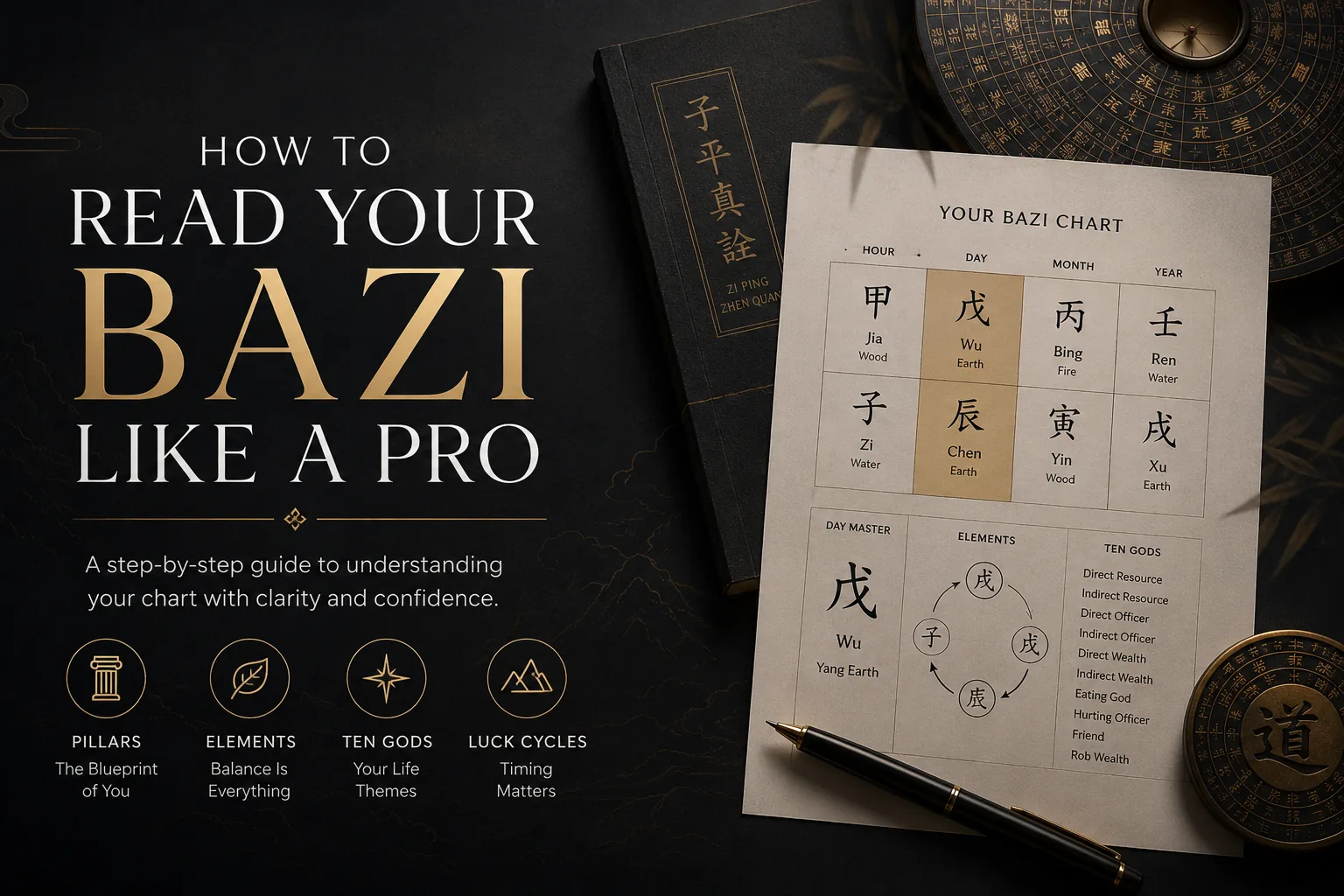
Here is the chart we will read the whole way through:
How do I read my own BaZi chart? Start with the order of operations
The single most common mistake people make with their chart is trying to read everything at once. They look at all eight characters, spot a "clash" or a scary-looking star, and panic. That is not how the classical system works.
What order do I read a BaZi chart in? Always the same seven steps:
- Identify the Day Master — which of the ten stems is you.
- Judge its strength — is your Day Master well-supported by the rest of the chart, or drained by it?
- Find the Useful God (用神) — the one element your chart most needs for balance, derived from the classical pattern system.
- Map the Ten Gods across all four pillars — what role does every other character play relative to you.
- Note the key interactions — clashes (六冲), harmonies (六合/三合), punishments (三刑) between branches.
- Map each pillar to a life domain — Year to ancestry, Month to parents/career, Day to self and marriage, Hour to children and late life.
- Layer in the Luck Pillars (大運) — the ten-year periods that tell you when your favorable elements activate.
That is the whole method. What am I supposed to look at first? The Day Master. Always. If you do not know which of the ten Heavenly Stems is your Day Master, you do not yet have a reading — you have a page of characters.
Let us walk each step on the chart above.
Step 1 — Identify the Day Master (日主)
How do I know which element is my Day Master? It is fixed by position, not by choice. The Heavenly Stem sitting on top of the Day pillar — the third column from the left in almost every chart layout — is your Day Master. That single character is you.
On our sample chart, the Day pillar stem is 戊 — Yang Earth. That means the entire reading below is spoken from the perspective of a Yang Earth "self."
Every stem carries two pieces of information you must read together:
- Element — Wood, Fire, Earth, Metal, or Water. This is the raw material of your nature.
- Polarity — Yang (expansive, outward, structural) or Yin (contained, refined, adaptive). Same element, different polarity, different life.
The ten possible Day Masters are:
| Stem | Element | Polarity | Classical image |
|---|---|---|---|
| 甲 | Wood | Yang | The tall tree |
| 乙 | Wood | Yin | The vine, the grass, the flower |
| 丙 | Fire | Yang | The sun |
| 丁 | Fire | Yin | The lamp, the candle |
| 戊 | Earth | Yang | The mountain |
| 己 | Earth | Yin | The field, the garden |
| 庚 | Metal | Yang | The axe, the raw iron |
| 辛 | Metal | Yin | The blade, the jewel |
| 壬 | Water | Yang | The ocean, the river |
| 癸 | Water | Yin | The rain, the dew |
Our Yang Earth (戊) Day Master is the mountain: solid, grounding, patient, resistant to being moved. That is the baseline personality. But personality alone does not tell you what to do with the chart — for that you need strength.
If you are still unsure how to identify yours or what it means, read the deeper walkthrough at Your Day Master Explained.
Step 2 — Is the Day Master strong or weak?
This is the step most beginners skip, and it is the step that decides everything downstream. The question is not "are you a strong person" — it is how much backing does your Day Master have across the rest of the chart?
Classically this is judged by roots (根) in the four Earthly Branches, the season (which month you were born in), and the balance of support versus drain across all eight characters. There is no threshold number and no percentage — the assessment is categorical, based on where your Day Master's element shows up as roots and what else in the chart is feeding it or draining it.
Here is our chart again, this time reading it for strength:
- The Day Master: 戊 Yang Earth.
- Roots in the branches. Earth appears as the main hidden stem of the Hour branch 戌 (a solid tomb root — a stored, accessible reserve of Earth qi). Earth also appears inside the Day branch 午 as its secondary hidden stem (己 Earth). Two rooted positions is meaningful — a Day Master with real branch roots is difficult to call weak.
- The season. The Month branch is 寅 (Yang Wood Tiger). Wood controls Earth, so on season alone Yang Earth is technically not "in season." That would push toward weakness — except our roots and support push the other way, hard.
- Resource (support). The Month stem is 丙 (Yang Fire), and Fire generates Earth — direct fuel for the Day Master. On top of that, the branches 寅 · 午 · 戌 (Tiger–Horse–Dog) form the classical Fire trinity (寅午戌三合火). That is a full three-way combination pouring Fire into Earth. Enormous resource support.
- The drain. The Year stem 甲 (Yang Wood) is Wood, which controls Earth — a drain on the Day Master. That is one significant pressure.
- Peer support. No transparent Earth stems elsewhere in the chart, so there is no stem-level 比肩 (Parallel) reinforcement. Rooted branches carry the weight.
Put it together categorically: rooted in tomb Earth (戌), supported inside 午, fed by transparent Fire (丙) that is itself amplified by a full Fire trinity in the branches, against a single Wood drain in the Year stem. Roots + heavy Resource clearly outweigh one drain.
Verdict: the Day Master is Strong (身強).
That single word flips everything about how the rest of the chart reads. A strong Day Master does not want more support — it wants an outlet. Something to burn its excess into. A weak Day Master would want the opposite — nourishment and protection. Same characters on the page, opposite prescription.
For the full method — including how to assess borderline charts — see Strong vs Weak Day Master.
Step 3 — Find the Useful God (用神)
This is the heart of a real reading. The Useful God (用神) is the one element your chart most needs to be in balance. It is not "your favorite element" and it is not "your zodiac element." It is derived from the pattern (格局) of your chart, and the pattern lives in the Month branch.
The pattern lives in the Month branch
The Month branch is the seasonal command post of the chart. Whatever qi commands it commands the whole reading. On our chart, the Month branch is 寅 (Yang Wood Tiger). Its dominant hidden stem is 甲 (Yang Wood) — and here is the crucial detail — 甲 also appears transparently in the Year stem. That transparency matters. When the Month branch's commanding stem is also visible on the surface of the chart, its pattern is confirmed with high confidence.
To a Yang Earth Day Master (戊), Yang Wood (甲) is:
- Same polarity as the Day Master (both Yang) → matched polarity
- Wood controls Earth → the controlling element
Same polarity + controlling relationship = Seven Killings (七殺). So this chart is a Seven Killings pattern — 七殺格.
Pattern + strength = Useful God
The classical rule for Seven Killings is straightforward: because Seven Killings is one of the "unfavorable gods" (the raw, aggressive form of authority), you counter it (逆用) rather than use it directly. The two classical countermeasures are:
- 食神制殺 — let the Food God (Output element) tame the Killing.
- 殺印相生 — let the Killing generate the Seal (Resource), so pressure feeds nourishment.
Which countermeasure applies to this chart? Look at the Day Master. Our Yang Earth Day Master is Strong, with abundant Resource (Fire) already. Adding more Seal would be pouring fuel on a chart that is already well-fed. What this chart needs is an outlet — something for the strong Earth to do.
That points cleanly to the first countermeasure: 食神制殺 — the Eating God tames the Killing. For a Yang Earth Day Master, the Output element is Metal (Earth generates Metal). Metal controls Wood — so Metal simultaneously gives the strong Earth an outlet AND tames the Seven Killings by controlling the Wood.
Useful God: Metal (庚 Yang Metal specifically — matched polarity to control the Yang Wood Killing).
From that Useful God, the rest of the balance sheet falls out:
- Favorable elements: Metal and Water. Metal is the Useful God itself. Water is Wealth for this chart — it drains excess Earth strength and it feeds Metal (Metal generates Water in the productive cycle, but Water also protects Metal from Fire attack). Both are on the "yes" list.
- Unfavorable elements: Fire and Wood. More Fire would over-nourish the already-strong Earth and melt away the Metal tool this chart depends on. More Wood would reinforce the Seven Killings — the very pressure Metal is trying to tame.
Now notice something crucial: this chart has almost no Metal in it. Only the tertiary hidden stem in 戌 (辛 Yin Metal) carries any Metal at all. The one element the chart needs most is barely present in the natal picture. That is not a defect — it is a diagnosis. It tells us that this life will feel meaningfully different depending on whether the environment (Luck Pillars, years, other people) is supplying Metal or withholding it. It is exactly why Step 7 matters so much.
For the full derivation method and every pattern's countermeasure, see What Is the Useful God?.
Step 4 — Map the Ten Gods across all four pillars
Now that you know who you are (Day Master) and what you need (Useful God), you can read every other character on the chart. Each one plays a role relative to you. Those roles are the Ten Gods (十神).
The Ten Gods are not literal deities — they are a labeling system. Every stem in the world falls into one of ten relationships with your Day Master, decided by two things: the elemental relationship (does it generate you, control you, get controlled by you, get generated by you, or match your element?) and the polarity match (same Yin/Yang as your Day Master, or opposite?). Same polarity gives the "partial" (偏) form; opposite polarity gives the "proper" (正) form.
For our Yang Earth (戊) Day Master, here is what each stem on the chart becomes:
- Year stem 甲 — Yang Wood controls Yang Earth, same polarity → Seven Killings (七殺). Raw authority, pressure, the challenge that forges you.
- Month stem 丙 — Yang Fire generates Yang Earth, same polarity → Partial Seal / Indirect Resource (偏印). Unconventional support, non-traditional teachers, unusual learning paths.
- Day stem 戊 — the Day Master itself. Not labeled with a Ten God (it is you).
- Hour stem 壬 — Yang Water is controlled by Yang Earth, same polarity → Indirect Wealth (偏財). Money in motion, opportunity flow, deals rather than salary.
Reading it as a story: this person carries strong authority-pressure energy early (Seven Killings in the Year), Resource support through the Month (Fire fueling the mountain), and Wealth showing up in later life through the Hour stem (壬 as Indirect Wealth). That is the outline. Now you layer in the Useful God verdict:
- Seven Killings (甲) in the Year: unfavorable as raw pressure — but with Metal on the way (Luck Pillars), it becomes the very thing Metal tames productively. Present as a challenge, not a doom.
- Partial Seal (丙) in the Month: normally "good" (Seal supports the Day Master), but for a strong Day Master, more Resource is over-nourishment. This chart has too much of this. Watch for stagnation, over-thinking, learning-without-doing.
- Indirect Wealth (壬) in the Hour: Water is on the favorable list — a genuine asset. Money in motion in late life. Something built, something earned, something that flows.
You do not stop at the stems. Read the hidden stems in each branch the same way and you get an even richer map. In our chart, the Hour branch 戌 hides 辛 (Yin Metal, the Useful God itself, hidden but present), 丁 (Yin Fire, more Resource), and 戊 (Yang Earth, self-reinforcement). That hidden 辛 is quietly holding the chart together — a hairline of the Useful God tucked into the tomb.
This is the core insight most beginners miss: you never read a Ten God as universally "lucky" or "unlucky." You always read it against the Useful God. The same Partial Seal that is a lifeline for a weak chart is a trap for a strong one. The same Wealth that would burn out a fragile Day Master is oxygen for a robust one.
If any of the Ten God names are new, spend fifteen minutes with The Ten Gods in BaZi — it is the vocabulary every other guide assumes you know.
Step 5 — Note the key branch interactions
The stems are half the chart. The other half lives in the branches — and branches interact with each other in specific classical ways that either amplify, protect, or destabilize what the stems are doing.
On our chart the four branches are 寅 · 寅 · 午 · 戌 (a Tiger in Year and Month, a Horse in Day, a Dog in Hour).
Here is what to look for, in order of importance:
Three combinations (三合)
寅午戌 三合 → Fire trinity. All three branches are present. This is the classical Fire trinity, one of only four possible three-way combinations. It floods the chart with Fire qi, which pours into our Yang Earth Day Master as Resource. It is the single loudest interaction on the chart, and it is why the Day Master read Strong in Step 2 despite being born in a Wood month.
The trinity is also why the Useful God is Metal rather than something gentler. A trinity is not a subtlety — it is a full-spectrum activation. Countering it takes Metal, not intention.
Six harmonies (六合)
None active on this chart. The six-harmony pairs are 子丑, 寅亥, 卯戌, 辰酉, 巳申, 午未 — none of those pairs are present in our four branches.
Six clashes (六冲)
None active within the natal chart itself. The six-clash pairs are 子午, 丑未, 寅申, 卯酉, 辰戌, 巳亥. Our branches 寅寅午戌 contain no internal clash pairs. That is a sign of structural stability in the natal picture.
But note: the natal chart is only half the picture. When a Luck Pillar or a yearly pillar brings a 子 (Rat), it will clash the Day branch 午 — activating the classical 子午冲, one of the sharpest of the six clashes. When it brings 申 (Monkey), it will clash both Tiger branches — 寅申冲 doubled. When it brings 辰 (Dragon), 辰戌冲 stirs the Hour tomb branch (a "tomb-stir" rather than a destructive clash, releasing hidden stems into use). All of these are useful signals for Step 7.
Punishments (三刑) and self-punishments
Our chart has a doubled 寅寅 — not a formal self-punishment in the classical list (the four self-punishments are 辰辰, 午午, 酉酉, 亥亥), but the doubled Tiger does amplify the Seven Killings pattern. Two Wood branches feeding the same Killing is a heavier version of the pattern than a single Tiger would be. Read that as: the authority-pressure theme is not subtle in this life.
The classical arrogance punishment (寅刑巳, 巳刑申, 申刑寅) is only partially present — 寅 is on the chart but 巳 and 申 are not, so the punishment is dormant. It becomes live only if a Luck Pillar or year brings in 巳 or 申.
The bottom line for branch interactions
A useful summary sentence for our example chart: the branches form a full Fire trinity, no internal clashes, no active harmonies, and a doubled Tiger that intensifies the Seven Killings pattern. That single sentence captures ninety percent of the branch structure and tells you what to watch for when new branches arrive from outside.
Step 6 — What does each pillar mean? Map the life domains
You have now read the chart chemically — as elements and roles. Time to read it biographically. Each of the four pillars maps to a specific life domain and set of relatives.
What does each pillar mean? The classical mapping is fixed:
| Pillar | Palace (宮) | Life domain | Relatives |
|---|---|---|---|
| Year (年柱) | Ancestral Palace | Family background, early childhood, roots and origin | Grandparents, ancestors, social background |
| Month (月柱) | Parents & Career Palace | Parents, siblings, youth, early adulthood, career formation | Parents (father especially for men), siblings, early bosses |
| Day (日柱) | Self & Spouse Palace | Middle life. The stem is you; the branch is your marriage | Self (Day stem), spouse (Day branch) |
| Hour (時柱) | Children & Legacy Palace | Late life, children, subordinates, what you leave behind | Children, descendants, late-life outcomes |
So on our sample chart:
- Year pillar 甲寅 (Seven Killings sitting on Tiger). Early life carried authority-pressure energy. A demanding early environment — a strict parent figure, a formative institution, an ancestral history of hard work under difficult circumstances. Not "bad" — formative.
- Month pillar 丙寅 (Partial Seal sitting on Tiger). Youth and career-formation years were marked by unconventional mentors and teachers — informal support rather than official credentials. Father figure (Fire generating Earth) present but perhaps outside the usual pattern. Career began in a domain that involves either learning or authority (both Fire-Resource and Wood-Killing signals here).
- Day pillar 戊午 (Yang Earth on Horse). The stem is our person — the mountain. The branch 午 is the Spouse Palace. Horse (午) carries Fire and Earth as hidden stems — a spouse who brings warmth, activity, and support. But 午 is also the clash-target of any incoming 子 (Rat), so the marriage domain is sensitive to Rat years and Rat pillars. That is a real thing to know.
- Hour pillar 壬戌 (Indirect Wealth on Dog). Late life carries a Wealth signal — money in motion, opportunity flow, possibly self-directed enterprise. The Dog branch is a tomb, and it hides 辛 Yin Metal — the chart's Useful God, quietly stored for late life. That is a genuinely encouraging late-pillar signal: what the chart needs most is stored where the chart lives longest.
Read as a life sketch: this is someone whose life carries pressure early (Year), learning and formation through youth (Month), a warm and active middle life with a note to watch marriage-domain clashes (Day), and a late life that finally has room for the Wealth and the Useful God the chart has been reaching for.
"Am I meant to be alone?" — a real question people search when their Day branch feels troubled. The Day pillar branch answers this domain. A supported Day branch (harmonized, not clashed, hiding compatible stems) points toward partnership as a natural fit. A repeatedly clashed Day branch, or a Day branch whose hidden stems fight the Useful God, points to a more complex marriage domain. Not "no" — more work.
"Why can't I hold onto money?" — read Wealth (財) placement. Wealth in the Hour stem, supported by the Useful God, and drained cleanly to the Day Master says "flow, land, keep." Wealth surrounded by Rob Wealth (劫財) or Parallel (比肩) stems, or Wealth without root, says "money passes through, doesn't stick." Our example chart has Wealth in the Hour stem without competing peer stems eating it — a favorable signal.
For deeper reading on which pillar shows what, see The Four Pillars in BaZi.
Step 7 — Overlay the Luck Pillars (大運) for timing
Your natal chart is fixed. You were born with those four pillars and they do not change. But you are not living in the natal chart alone — you are living inside a moving weather system called the Luck Pillars (大運).
A Luck Pillar is a ten-year pillar (one stem, one branch) that layers on top of your natal chart. Every ten years, a new one arrives. The direction of the sequence (forward through the sixty-year cycle or backward) is decided by your Day Master's polarity and the polarity of your birth year, and the starting age is calculated from your birth date's proximity to a solar term.
The question a Luck Pillar answers is exactly one thing: does this pillar bring my favorable elements or my unfavorable ones? If it brings the Useful God or its supporters, the decade is a tailwind. If it brings the Useful God's enemies, the decade is a headwind.
On our sample chart, imagine the active ten-year pillar is 庚申 (Yang Metal Monkey). Both halves are pure Metal — the stem is Yang Metal, the branch is Yang Metal. Metal is exactly the Useful God this chart has been waiting for.
- The Metal stem 庚 shows up as 食神 (Food God) for our Yang Earth Day Master — the Output that classically "tames the Killing" (食神制殺). This is the missing tool arriving.
- The Metal branch 申 activates the chart's only Metal branch content and gives our chart a real Metal root for the first time.
- 申 also clashes both natal 寅 branches (寅申冲 doubled). That looks alarming — but for a chart whose Seven Killings pattern is over-armed with doubled Tiger Wood, having the Wood clashed by incoming Metal is the countermeasure landing. This is exactly what "Metal tames the Killing" looks like in practice.
Verdict: a strong tailwind decade. The chart finally has room to convert its excess Earth strength and its intense Seven Killings pressure into productive output. This is the decade to build, to ship, to take responsibility, to convert pressure into product.
Contrast that with a hypothetical 甲午 (Yang Wood Horse) Luck Pillar layered on the same chart:
- The Wood stem 甲 doubles down on Seven Killings. More pressure on a chart that already has too much.
- The Fire branch 午 doubles the natal Horse and joins the Fire trinity even more forcefully — piling still more Resource onto a Day Master that was already too strong.
- No Metal. No Water. Nothing on the favorable list activates.
That decade would read as a headwind: too much pressure, too much heat, too much support without an outlet. Not doom — a season for consolidation, patience, careful health management, and waiting for the next pillar.
Layer the current year on top of the active Luck Pillar for finer timing. A year that brings Metal on top of the 庚申 pillar (say, a 辛酉 year) is a peak-favorable window. A year that brings Fire on top of a 甲午 headwind pillar amplifies the difficulty. This is how BaZi answers when.
For the full method on Luck Pillars — how to derive them, how to read them against the natal chart, and how to layer years — see BaZi Luck Pillars.
The whole chart, read in order — a one-page summary
Here is our sample chart, condensed into a single readable paragraph:
A Yang Earth (戊) Day Master, born in Tiger month, with the Fire trinity 寅午戌 flooding the chart — strong Day Master, well-fed by Fire Resource. The pattern is Seven Killings (七殺格), confirmed by transparent 甲 in the Year, made heavier by the doubled Tiger in the branches. Because the Day Master is strong and already over-Resourced, the countermeasure is Eating God tames the Killing (食神制殺) — Useful God is Metal, supported by Water. The natal chart carries only trace Metal (hidden 辛 in the Hour tomb). Life domains: pressured early years (Year 甲寅), unconventional mentorship in youth (Month 丙寅), warm middle-life partnership sensitive to Rat clashes (Day 戊午), Wealth and stored Useful God in late life (Hour 壬戌). A 庚申 Luck Pillar is a tailwind decade — Metal finally arrives on the stem and in the branch, taming the Killing and giving the strong Day Master its outlet.
That is a complete BaZi reading. Same seven steps, in the same order, on the same chart. Every claim above is grounded in a specific character on the page.
FAQ
How do I read my own BaZi chart if I have never done it before? Start with the Day Master (Step 1) and stop there for the first sitting. Just sit with your Day Master for a day — read about its classical image, notice how it feels. On the second sitting, add strength assessment (Step 2). Only on the third sitting move to the Useful God. Trying to absorb all seven steps in one evening is why most people give up.
What am I supposed to look at first — the stars, the pattern, or my zodiac? The Day Master. Everything else is downstream. The "stars" (神煞 shen sha) are flavor, not fortune — classical texts are clear that stars do not determine outcomes. Your zodiac (year animal) is only one of the twelve branches in your chart, and often not the most important one. Your Day Master is the single character everything else is read against.
How do I know which element is my Day Master if I only know my birthday? Use a proper BaZi calculator (one that respects solar terms — the year flips at 立春, roughly February 4, not January 1). The calculator finds your Day pillar's Heavenly Stem, and that stem is your Day Master. You will see one of 甲乙丙丁戊己庚辛壬癸.
What does each pillar mean in one sentence? Year = origin and ancestry. Month = parents, siblings, and early career. Day = your self (stem) and your marriage domain (branch). Hour = children and late life.
Do I need to memorize Chinese characters? No. A good app or reading labels everything in English with the characters alongside. Understanding the order of operations and the concept behind each Ten God matters far more than being able to write 傷官 by hand. The characters are for precision when it matters; the concepts are for reading your life.
Why do two calculators give me different charts? Almost always one of three things: (1) they disagree on your time zone or true local solar time, (2) your birth is near a solar-term boundary and one calculator uses the wrong side of it, or (3) one is using Gregorian calendar month boundaries instead of the classical solar-term months. Charts near a boundary are genuinely sensitive — cross-check with two independent calculators.
What is the single most important thing in my chart? Your Day Master and its strength. Every other step is read against that verdict. A chart cannot be interpreted without it, and interpretations that skip it are horoscope-column noise dressed up in Chinese characters.
Is the Useful God always already present in my chart? Not necessarily. In our worked example, the Useful God (Metal) is barely present in the natal chart — only a hidden trace in the Hour tomb branch. That is common. It is precisely why certain Luck Pillars and years feel transformative: they are supplying an element your natal picture was reaching for.
Am I doing something wrong if my chart looks "bad"? No chart is bad. A chart is a diagnosis, and every diagnosis has a countermeasure — that is literally what the Useful God is. A chart with heavy Seven Killings and no protection is not a life sentence; it is a chart that needs to know where its Food God is and when Metal arrives. A chart is only "bad" when the reading is wrong.
"Am I meant to be alone?" or "Why can't I find a partner?" — where does that show up? Read the Spouse Palace (the Day pillar branch) together with the Wealth stems (for men) or Officer stems (for women). A clean, harmonized Day branch with a supported spouse-signal element points to partnership as a natural fit. A repeatedly clashed Day branch, or a Spouse Palace whose hidden stems fight the Useful God, points to a more complex marriage domain — not a prohibition, a pattern.
"Why can't I hold onto money?" — is that in my chart? Read the Wealth stems (正財 / 偏財) and check three things: (1) is Wealth on the chart's favorable list given the Useful God? (2) is Wealth surrounded by Rob Wealth (劫財) or Parallel (比肩) stems that would eat it before it lands? (3) is Wealth rooted in a branch, or does it float without support? "Wealth without root" is the classical formula for money that passes through.
Read your own chart the same way
You now have the full method. Seven steps, in the same order, on any chart in the world.
The real difference between reading someone else's chart in a textbook and reading your own chart is that on your own chart, every step points to something you can feel. The pressure the Year pillar describes — you already lived it. The Spouse Palace signals — you know what they mean. The Useful God that is missing from your natal picture — you can feel where you have been reaching for it your whole life.
That is the promise of BaZi as a diagnostic instrument rather than a horoscope: it gives you language for what you already know about your own life, and it tells you when the weather is turning.
See your own chart read this way. Open your free BaZi chart in Ming Map → — it finds your Day Master, judges strength across all four pillars, derives your Useful God by the classical method, maps the Ten Gods, notes the branch interactions, assigns your life domains, and lays your Luck Pillars on a timeline. Available on the web and as a mobile app.