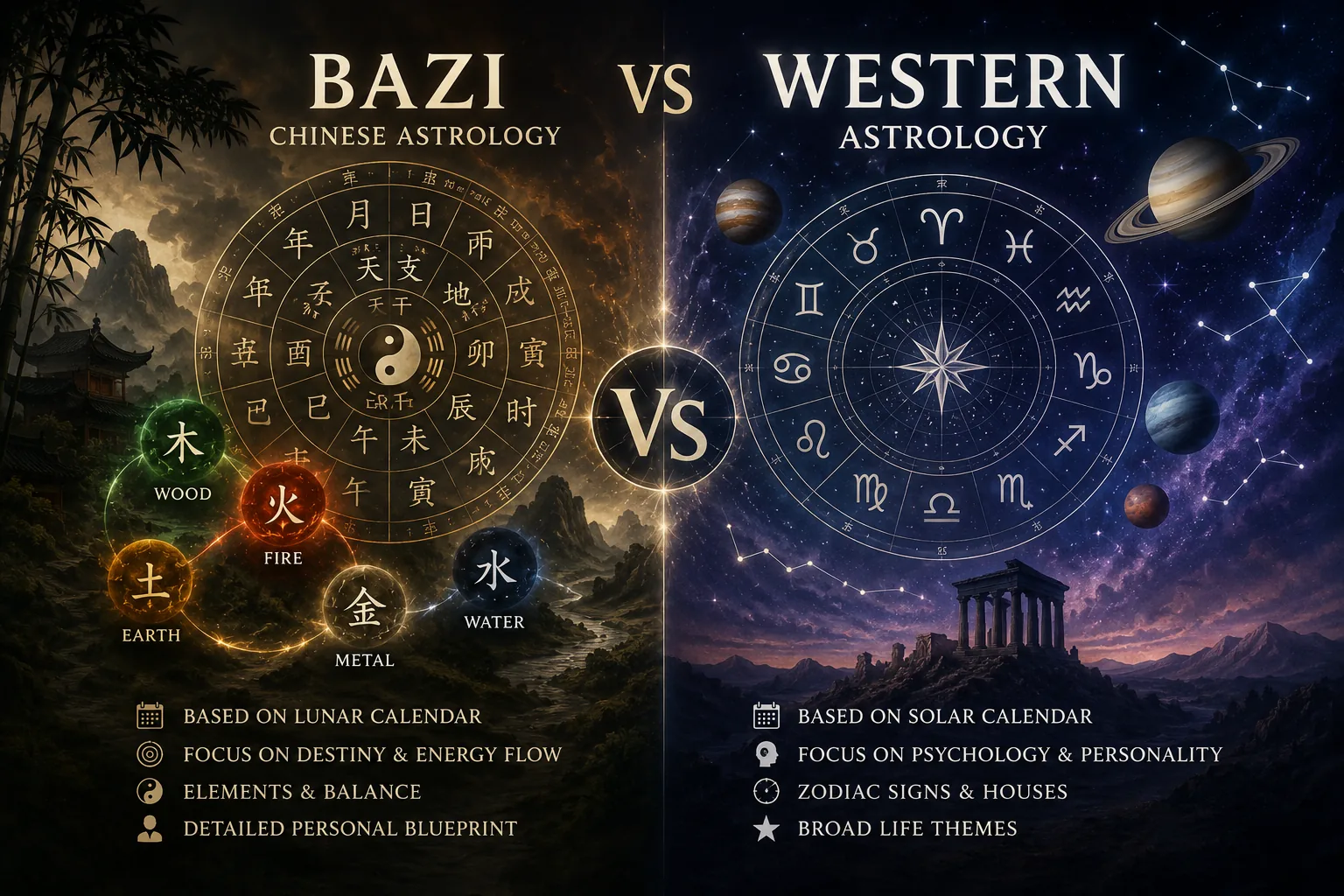
BaZi vs Western Astrology: What's the Difference?
You're here because something is off. Maybe you've read your Western chart, and it sounded like you — the Sun-Moon-rising cocktail was uncanny — but it never quite answered the question you actually walked in with. Why is the money always leaking? Why does every relationship shape the same? Why do you feel like you're doing something wrong even when the astrologer said Venus was well-placed? Then someone mentioned BaZi. Chinese Four Pillars. Different alphabet, different logic, and — the promise goes — sharper on the practical stuff. So now you're comparing systems, trying to figure out which one is "more real," and whether you can trust either.
Here is the honest answer, from someone who has spent years in both: neither system is wrong, and neither is a hoax. They are two different lenses looking at the same person from very different angles. Western astrology reads the sky at the moment you were born — where the planets sat against the zodiac belt. Classical BaZi reads the calendar — your birth converted into stems and branches, anchored to solar terms and grounded in five-element phase logic. Both use birth data. Both have thousands of years of tradition behind them. Both give you a chart. But what that chart does is different, and that difference is the whole point of this article.
If you're stuck and searching for something more structural — something that names what to do, not just what to feel — the argument for BaZi is straightforward. It gives you actionable elements. It gives you per-day granularity. It tells you what to lean into and what to ease off. But we're going to earn that claim honestly, not by trashing Western astrology, which is beautiful in its own domain.
What each system is actually reading
Western astrology reads the sky. At the moment of your birth, the Sun was somewhere in the ecliptic, the Moon was somewhere else, and every planet was positioned against the twelve zodiac signs. Your natal chart is a snapshot of that geometry: Sun sign, Moon sign, rising sign (Ascendant), planets in houses, and the aspects — the angles — between them. The archetypes are old and vivid: Aries the ram, Taurus the bull, Scorpio the depths, Aquarius the outsider. The interpretive engine runs on planetary meaning (Mars = drive, Venus = love, Saturn = discipline) and how those meanings interact with signs and houses.
Classical BaZi reads the calendar. Your birth year, month, day, and hour each get converted into a pillar — a pair of characters. The top character is a heavenly stem (there are ten: 甲乙丙丁戊己庚辛壬癸). The bottom is an earthly branch (there are twelve: 子丑寅卯辰巳午未申酉戌亥). Four pillars, eight characters — that's where the name comes from. 八字, bā zì, literally "eight characters." Your chart is not a snapshot of the sky. It is a compressed reading of the time itself, expressed through the two great cycles that classical Chinese thought used to describe reality: the ten stems and the twelve branches, both of which map to the five elements — Wood, Fire, Earth, Metal, Water — in their Yin and Yang forms.
That's the first difference, and it is philosophical, not cosmetic. Western astrology says: the planets influence you. Classical BaZi says: the moment you were born has a specific elemental signature, and you are made of it. No planets required. The system doesn't track them at all. It tracks the qi of the moment — the phase of Wood or Fire or Water that was ascendant when you drew your first breath.
The mechanics, side by side
Let's put it in a table so you can see the shape.
| Western astrology | Classical BaZi | |
|---|---|---|
| What it reads | Planetary positions against zodiac | Chinese calendar (stems + branches) |
| Core unit | 12 zodiac signs, 10 planets, 12 houses | 10 stems + 12 branches, 5 elements in Yin/Yang forms |
| "You" in the chart | Sun sign, or whole natal chart | The Day Master (日主) — the stem of your day of birth |
| What drives interpretation | Planetary aspects and house placements | Element balance, Ten Gods, and pattern (格局) |
| Timing engine | Transits, progressions, returns | Luck Pillars (大運) — ten-year cycles — plus annual and monthly pillars |
| Granularity | Down to the day (transits) | Down to the day natively, down to the hour if birth time is known |
| Cardinal question | Who are you? | What is your chart made of, and how does time act on it? |
| Flavour | Psychological, archetypal, mythic | Structural, elemental, relational |
| What you get told to do | Understand your patterns | Balance your elements, protect your Useful God |
Both systems will describe your personality, your relationships, your career leanings. Both will point at "hard years" and "easy years." But the machinery underneath is not the same, and the practical output at the end differs sharply.
The Day Master — where BaZi centres itself
In Western astrology, the Sun sign is your identity anchor, and the whole chart is a personality mosaic. In classical BaZi, there is one character above all others: the Day Master. The stem of the day you were born. If you were born on a 甲 day, you are Yang Wood — a tall tree. If you were born on 丙, you are Yang Fire — the sun itself. If you were born on 癸, you are Yin Water — dew, mist, gentle rain. That single stem is you. Every other character in your chart is described in relation to it.
This is not a personality label like "you're a Scorpio, so you're intense." It's a starting reference point for a whole calculus. The classical Ten Gods system takes each of the other stems in your chart and asks: what role does it play relative to the Day Master? Does it feed the Day Master (Resource, 印), match it (Friend/Rob Wealth, 比劫), get controlled by it (Wealth, 財), control it (Officer/Seven Killings, 官殺), or drain it (Output, 食傷)? Every character gets a job title relative to you. That's how classical BaZi reads relationships, career, wealth, and pressure — as a functional map, not a personality survey.
Western astrology has nothing exactly like this. Aspects between planets modify meaning, sure — a Mars-Saturn square is a specific flavour of tension — but the interpretive logic is more mythic and more free-form. BaZi is closer to grammar. Once you know the Day Master, everything else in the chart has a grammatical role. It's a system.
If you want to go deeper on this, our guide on strong vs weak Day Master walks the classical strength assessment, and what your Day Master says about you covers all ten.
Why BaZi and my Western chart say different things
This is the search that brought a lot of people to this page. You are a Libra Sun, Cancer Moon, Scorpio rising — and BaZi says you're Yang Metal (庚) with a Direct Officer pattern and Fire on the unfavourable list. The two readings don't just diverge; they seem to describe different people.
Both can be right. They are measuring different things.
Your Sun sign describes where the actual Sun was in the sky at the moment of your birth. Your Day Master describes what elemental phase the day itself carried in the classical calendar. These are not the same measurement, and they should not be expected to agree. It would be like reading your height and your favourite colour and being surprised they don't match.
The classical BaZi Day Master is also more specific than your Sun sign. It cycles every day. Two people born on the same day of the same month, two years apart, will have the same Day Master. Two people born on consecutive days will have different Day Masters. The system distinguishes between 甲 (Yang Wood) and 乙 (Yin Wood) — same element, different polarity, materially different personalities and life mechanics — where Western astrology would give both people the same Sun sign.
That granularity is one of BaZi's structural advantages. But it also means the "flavour" the two systems point at won't overlap neatly. A "generous, warm Leo" in Western terms could be a 癸 (Yin Water) Day Master in BaZi — quiet, deep, hidden. Not a contradiction. Just two different snapshots of a complex human being.
The elements — five instead of four
Both systems have elements. Western astrology recognises four: Fire, Earth, Air, Water. Signs get grouped by element (Fire = Aries, Leo, Sagittarius; Earth = Taurus, Virgo, Capricorn; and so on). It's a useful shorthand for temperament.
Classical BaZi uses five: Wood (木), Fire (火), Earth (土), Metal (金), Water (水). And the relationships between them are not decorative — they are the whole engine. Wood generates Fire. Fire generates Earth. Earth generates Metal. Metal generates Water. Water generates Wood. That's the sheng (生) cycle, the generating cycle. It's the classical image of nourishment. Then there's the ke (克) cycle, the controlling one: Wood controls Earth. Earth controls Water. Water controls Fire. Fire controls Metal. Metal controls Wood. That's how the system describes limits, pressure, and boundaries.
Every stem and every branch has an elemental identity. So a chart with lots of Wood and no Metal is elementally lopsided — nothing is cutting or shaping the Wood. A chart drowning in Water with no Earth banks lacks containment. The whole diagnostic tradition of BaZi rests on identifying what element is too much and what is missing, then asking which one — added at the right moment — would balance the chart. The classical name for that balancing element is your Useful God (用神, yòng shén). It's the single most actionable concept in the system.
If that phrase is new, our Useful God guide is the deepest treatment we have. It's the reason a real BaZi reading can tell you what colour to wear, what direction to face, what career suits you, which foods support you, which people balance you — not as horoscope filler, but as classical technique. The elements are actionable.
Western astrology's four elements do not carry this operational load. They describe you. They rarely prescribe.
Which is more accurate, BaZi or astrology?
This is the honest question, and it deserves an honest answer.
Neither is science. Neither system has produced controlled, replicated experimental evidence that would satisfy a physicist or a psychologist. If you want proof at that level, neither will give it to you. We tackle this directly in Is BaZi Accurate? — the short version is that both are metaphysics, systems of reflection and interpretation, and the question of "accuracy" needs to be reframed as "usefulness."
So the real question is: useful for what?
Western astrology is often extraordinary at psychological mirror-work. It gives you archetypes — Saturn's discipline, Neptune's dissolution, the shadow work of Pluto in the 8th house — and those archetypes can name emotional experiences you didn't have words for. That's not nothing. It has helped a lot of people understand themselves. If your work is inward, Western astrology is a genuinely powerful language.
Classical BaZi is different. It's not primarily a psychological system. It's a structural and temporal one. It asks: what is your elemental composition, what is the pattern that composition forms, what does the pattern need to succeed, and how do the coming ten years act on it? It doesn't tell you your childhood wound. It tells you which years to launch, which years to hunker down, which career direction fits your chart, which relationships strengthen your Useful God and which combine it away.
If you are lost about what to do — not what to feel — BaZi is usually the sharper tool. If you are trying to understand why you are the way you are, either can work, and many people find Western astrology warmer for that job.
Neither is more accurate. They are optimised for different questions.
Timing: transits vs Luck Pillars
Here is where the difference gets very concrete.
Western astrology handles timing through transits: where are the planets now, and what are they doing to your natal chart? Saturn is transiting your 10th house — career restructuring. Jupiter is squaring your natal Venus — a relationship expansion or overreach. Mercury is retrograde — communication mishaps. Transits are continuous and can shift week to week.
Classical BaZi handles timing through Luck Pillars (大運, dà yùn) — ten-year phases that each carry their own stem and branch. Your first Luck Pillar starts in childhood and every decade a new one begins. Layered on top are annual pillars (each year has a stem and branch — 2026 is 丙午, Yang Fire Horse), monthly pillars, and daily pillars. The reading is not "Mars is squaring your Moon this week." The reading is: "Your current Luck Pillar is a Yin Wood Rabbit decade. That Yin Wood is your Direct Wealth. Wealth is usable if your Day Master is strong. Yours is moderately strong. This decade favours accumulation." Then the year adds: "2026's Yang Fire is your Eating God. Eating God pointed at Wealth is a classical earnings configuration. But watch the month of June — the double Horse triggers self-punishment."
The two timing systems produce forecasts of comparable complexity, but BaZi's granularity is different. Luck Pillars operate in decades. Years operate in twelve-month blocks with specific elemental signatures — you can read our 2026 forecast for a full example of how a single year gets analysed. Months operate at the level of solar terms. Days, too, if you want to go that deep.
Both systems can tell you "watch out for October." BaZi is more likely to tell you why — because October is a Dog month, and if you have Dragon in your chart, that's a 辰戌冲 clash to your foundation pillar. The mechanism is stated, not implied.
Can I use both?
Yes. Truly, honestly, yes. They don't contradict each other because they aren't measuring the same thing. Nothing in classical BaZi asserts that planets don't matter. Nothing in Western astrology asserts that the five elements aren't real. The two systems are looking at you through different windows, and both windows can be open at the same time.
Many practitioners we respect do exactly this. They'll run a natal astrology chart to understand a client's psychological texture, then run the BaZi chart to see the elemental structure and the timing. The two readings complement rather than compete. Western astrology fills in the emotional and archetypal dimensions; BaZi fills in the structural and temporal ones. Together they form a fuller picture than either alone.
Where it can go wrong is when you try to reconcile them character by character. "But my rising sign says I'm reserved, and my Day Master says I'm expressive — which is right?" Neither. Both. You are reserved in one dimension and expressive in another, and the two systems just happen to have flashlights pointed at different rooms. Stop trying to make one system's vocabulary translate perfectly into the other's. They don't. They aren't supposed to.
Is BaZi harder to learn than astrology?
Yes and no.
Western astrology has a gentler on-ramp. Sun signs are famous. Everyone knows their Sun sign. From there, you learn your Moon and rising, then the planets, then houses, then aspects. Each layer builds on a familiar vocabulary. Popular astrology apps and columns keep you close to your chart with daily updates that are easy to read.
Classical BaZi has a steeper on-ramp because the vocabulary is unfamiliar. You have to learn ten stems and twelve branches. You have to learn what a Day Master is and how to identify yours. You have to understand the five elements not as a decoration but as an engine with generating and controlling cycles. You have to grasp the Ten Gods — Direct Officer (正官), Seven Killings (七殺), Direct Wealth (正財), Indirect Wealth (偏財), Eating God (食神), Hurting Officer (傷官), Direct Resource (正印), Indirect Resource (偏印), Friend (比肩), Rob Wealth (劫財). Ten roles, each with its own personality and typical presentation.
That said — and this is important — once you do learn BaZi, the operating instructions are clearer. Western astrology often gives you meaning without prescription. BaZi tends to give you both. "Your Useful God is Metal. Wear white. Face west. Work in fields that involve refinement, precision, or cutting. Avoid excessive Fire — hot climates, aggressive relationships, high-visibility careers if they burn you out." The advice is granular and stemmed from the same mechanics as the diagnosis.
A useful analogy: learning Western astrology is like learning to read poetry. Learning BaZi is like learning grammar. The poetry is beautiful and immediate; the grammar takes longer but gives you unlimited generative power once you have it.
Should I switch to BaZi if I'm already into astrology?
Not necessarily. And you don't have to think of it as "switching." You already have a language for understanding yourself — Western astrology — and it's serving parts of your life. Keep it. But if you are wondering what to do, not just who you are, add BaZi to your toolkit. Especially if you are stuck on a decision, timing a launch, weighing a relationship, planning a move, or thinking about the next ten years.
The people who benefit most from adding BaZi are usually the ones who have hit a wall with Western astrology's more psychological approach. They know their Chiron placement. They've done shadow work. They understand their Saturn return. But the structural question — should I move, should I start this business, is this the right decade for children, why do I keep losing money in July, why does my body feel wrong in fluorescent-lit offices — those answers don't come from planetary aspects. They come from your elemental composition and the year's elemental weather. That's BaZi's domain.
If your current relationship with astrology is warm and working, don't fix what isn't broken. If it's leaving you hanging on the practical questions, BaZi might be exactly the second lens you're looking for.
Is BaZi the same as the Chinese zodiac?
No. This is one of the most common mistakes newcomers make, and it undersells the system dramatically.
The Chinese zodiac — the twelve animals, one per year — is one branch out of your eight characters. Just one. It's the branch of your year pillar. Being a "Horse" or a "Dragon" in the popular sense means your birth year's branch was 午 or 辰. That's it. Full stop.
Classical BaZi uses all eight characters. Year stem, year branch, month stem, month branch, day stem, day branch, hour stem, hour branch. Each of those eight interacts with every other. There are combinations, clashes, half-trinities, six-harmonies, punishments, and harms — a whole grammar of branch relationships. Two Horses in the same year — say, June 2026 (甲午 month in a 丙午 year) — trigger 午午 self-punishment (自刑). A Rat in your Day pillar in a Horse year triggers 子午冲, one of the six great clashes. A Tiger, a Horse, and a Dog together anywhere in the chart forms 寅午戌, the full Fire trinity. None of this shows up in pop-zodiac columns.
So if someone tells you "Horses will have a great year in 2026 because it's the year of the Horse" — that's zodiac-column reading, and it's using less than five percent of the system. Real BaZi doesn't work that way. It reads your full eight characters against the incoming year's characters, not just your animal.
We wrote more about this in what is BaZi, if you want the full unpacking.
The philosophical difference, said plainly
Western astrology, at its philosophical core, is a system of influence. Something out there — the sky, the planets — is doing something to you. The chart reads that influence.
Classical BaZi, at its philosophical core, is a system of composition. You are not being influenced by external forces; you are a particular arrangement of elements, born into a particular elemental moment. The chart reads what you're made of. Time, in this view, is not something happening to you — it's something you're already in dialogue with, because every year, month, day, and hour carries its own elemental signature that either supports or challenges what you're made of.
This is why classical BaZi feels so grounded and structural to people who spend real time with it. There is no external mystery agent. Just elemental composition, elemental interaction, and the passage of time through elemental phases. If you want to change your fortune, you don't appease a planet. You balance your elements — through direction, colour, environment, career, relationships, timing — because you are the composition that needs balancing.
That difference in philosophical stance is why BaZi tends to feel more actionable. It's not more "true." It's more directly connected to what you can do.
What about Vedic astrology?
While we're comparing, it's worth naming: BaZi vs Vedic astrology (Jyotish) is a somewhat closer comparison than BaZi vs Western astrology, in one specific sense — Vedic astrology also uses a rigorous timing system (the Vimshottari dasha cycles) that resembles BaZi's Luck Pillars in operating over years and decades. Vedic is also more predictive and prescriptive than modern Western astrology tends to be.
But mechanically, Vedic still reads planets and houses — it's just using a sidereal zodiac rather than the tropical zodiac that Western astrology uses. So it's a variant of the same fundamental approach: the sky at the moment of your birth. BaZi is a completely different framework — no planets at all, just stems, branches, and the five elements.
Vedic is closer to Western astrology than either is to BaZi. If you're comparing all three, think of it as: Western and Vedic are cousins; BaZi is from a different family entirely.
Why can't I hold onto money? — a worked example
Let's ground the abstract stuff with the kind of question people actually walk in with. "I earn well but I can't hold onto money. Why?"
In Western astrology, you might look at the 2nd house of resources, the 8th house of shared resources, Venus (which rules value), Jupiter (expansion), Saturn (constriction), and their aspects. You'd get a psychological picture: maybe you have a subconscious pattern around scarcity, or a fear of accumulation tied to some deep-8th-house material.
In classical BaZi, the question maps directly onto the Wealth (財) Ten God. Wealth in BaZi is the element your Day Master controls. If your Day Master is Yang Wood (甲), Wealth is Earth. If it's Yin Water (癸), Wealth is Fire. Then the reading is mechanical:
- Is your Wealth star present in the chart? If it barely appears, wealth doesn't come easily to begin with.
- Is your Day Master strong enough to hold it? In classical logic, "wealth needs a strong Day Master to hold it." A weak Day Master surrounded by Wealth is called 財多身弱 — "much wealth, weak self" — and it produces exactly the pattern you described. Money comes and vanishes.
- Are there Robbers (比劫) around your Wealth? Friend (比肩) and Rob Wealth (劫財) — same-element peers of the Day Master — take Wealth away. If your chart has a Wealth star flanked by Friends and Robbers, the money is being competed for internally.
- What years support your Wealth? Your Luck Pillars either strengthen the Day Master (letting you hold wealth) or add more Wealth (giving you more to leak).
That's a diagnosis, not a mystery. And the prescription follows: strengthen the Day Master. If your Day Master is Yang Wood and struggling, add Water (Resource — 印) in your environment and habits — nourishment, rest, mentors, study, blue and black colours, careers with depth rather than volume. If Robbers are the problem, minimise overexposure to competitive peer environments during the years that activate them.
This is what "actionable" means in BaZi. The system produces a mechanism, and the mechanism suggests a lever. Western astrology can do this too, but usually at a more psychological register. BaZi does it at an elemental and structural one.
Am I meant to be alone? — another worked example
Another real question. Same kind of translation.
Western astrology looks at Venus, Mars, the 7th house (partnerships), Descendant, Juno, composite charts, synastry. It produces a rich psychological reading about your relational patterns.
Classical BaZi looks at your Spouse Palace (夫妻宮) — the branch of your Day pillar. That branch is where your partner "sits" in your chart. It reads:
- What element is in your Spouse Palace? Does it help or hinder your Day Master?
- Is your Spouse Palace clashed by another branch? A clash to the Day branch produces relational turbulence.
- Do your years activate your Spouse Palace favourably? Six Harmony (六合) years to your Day branch are traditionally strong for marriage; clash years are traditionally hard.
- Where is your Wealth (for men) or your Officer (for women) star? These are the classical spouse signifiers. Present, hidden, protected, damaged, or missing entirely.
If your Spouse Palace is clashed hard, if the spouse signifier is missing or being combined away in your chart, if the years available to you keep clashing your Day branch — the classical reading might be that partnership is a genuinely difficult domain for your chart. But that's not the same as "you are meant to be alone." It's "your chart works against easy partnership, and you would benefit from specific counter-moves — timing, direction, chosen partner's elements, etc."
Again: mechanism, then lever. That's the shape of a BaZi reading. That's why it feels operational to people who are sick of vague answers.
FAQ
Which is more accurate, BaZi or Western astrology? Neither is more accurate in a scientific sense — both are metaphysical systems. Both work better for some questions than others. Western astrology tends to be strong at psychological and archetypal insight. Classical BaZi tends to be strong at structural, elemental, and temporal questions — timing, decisions, career, wealth, relationships as functional matters. Ask the right question of the right system.
Can I use both at the same time? Yes. They don't contradict each other because they aren't measuring the same thing. Many thoughtful practitioners run both. Use Western astrology for the emotional and psychological mirror; use BaZi for the structural and timing decisions.
Why do BaZi and my Western chart say different things? Because they're measuring different things. Your Sun sign describes where the Sun was in the sky at your birth. Your Day Master describes what elemental phase the calendar carried on your day of birth. There is no reason to expect them to agree. Both can be true simultaneously without contradiction.
Is BaZi harder to learn than astrology? The on-ramp is steeper because the vocabulary is unfamiliar (ten stems, twelve branches, five elements, ten roles). But once you have the basics, the interpretive logic is more systematic than Western astrology's — closer to grammar than to poetry. Expect a few months of study before it starts to feel natural. Our complete beginner guide is the fastest on-ramp we have.
Should I switch to BaZi if I'm already into astrology? You don't have to switch. Add. If your Western practice is answering the questions you're bringing to it, keep it. If you keep hitting a wall on structural, practical, timing questions — should I move, should I take this job, is this the right decade for this — BaZi is likely the tool that will unlock those.
Is BaZi the same as the Chinese zodiac? No. Your zodiac animal is only one branch out of your eight characters. Classical BaZi uses all eight, plus the Ten Gods, patterns, Luck Pillars, and the full grammar of branch interactions. Pop zodiac reading uses less than five percent of the system.
Does BaZi have a "rising sign" equivalent? The closest analogue is the Hour pillar — the last two of your eight characters. It shapes how you present, especially in later life, and (in some traditions) governs the children domain. This is why birth time matters in a real BaZi reading; without it you're working with six characters, not eight.
Is BaZi closer to Vedic astrology than Western astrology? Both Vedic and BaZi are more predictive and prescriptive than modern Western astrology, but mechanically Vedic still reads planetary positions (just against a sidereal zodiac). BaZi doesn't track planets at all. So Vedic is closer to Western astrology than either is to BaZi.
Where should I start with BaZi if I've decided to try it? Start by finding your Day Master. That's the anchor for everything else. Our Day Master guide walks all ten. Then read about your Useful God — the single most actionable concept in the system. Then, if you want to see how a year gets analysed, our 2026 forecast is a worked example.
How do I know if my Western astrologer or BaZi reader is any good? The same test for both: do they cite mechanisms? A good astrologer will tell you why — which aspect, which house, which transit. A good BaZi reader will tell you why — which Day Master, which pattern, which Ten God, which Luck Pillar. If someone gives you a verdict without a mechanism, they're guessing. In BaZi specifically, watch out for anyone who invents numerical scores or thresholds that aren't in the classical texts. Classical BaZi is categorical, not statistical.
If you've read this far, you already know which system your gut is leaning toward. That's fine. There's no purity test. The lens that helps you make better decisions is the lens worth using.
If you want to see what your BaZi chart actually looks like — no invented scoring, no vague horoscope filler, just the classical method applied to your exact birth data — that's what we built Ming Map to do. Enter your birth date and time. See your four pillars. Meet your Day Master. Read your Useful God. Look at your next ten years honestly. If it clarifies something for you, that's the answer. If it doesn't, your Western chart is waiting where you left it, and nothing here has cost you anything except an hour of curiosity.
Every claim in this article traces back to classical BaZi technique — the Day Master framework, the five-element generating and controlling cycles, the Ten Gods derivation, the Luck Pillar timing engine. No invented math, no scoring systems, no pop-astrology shortcuts. Just the classical grammar, translated into English for someone who is trying to find their footing.