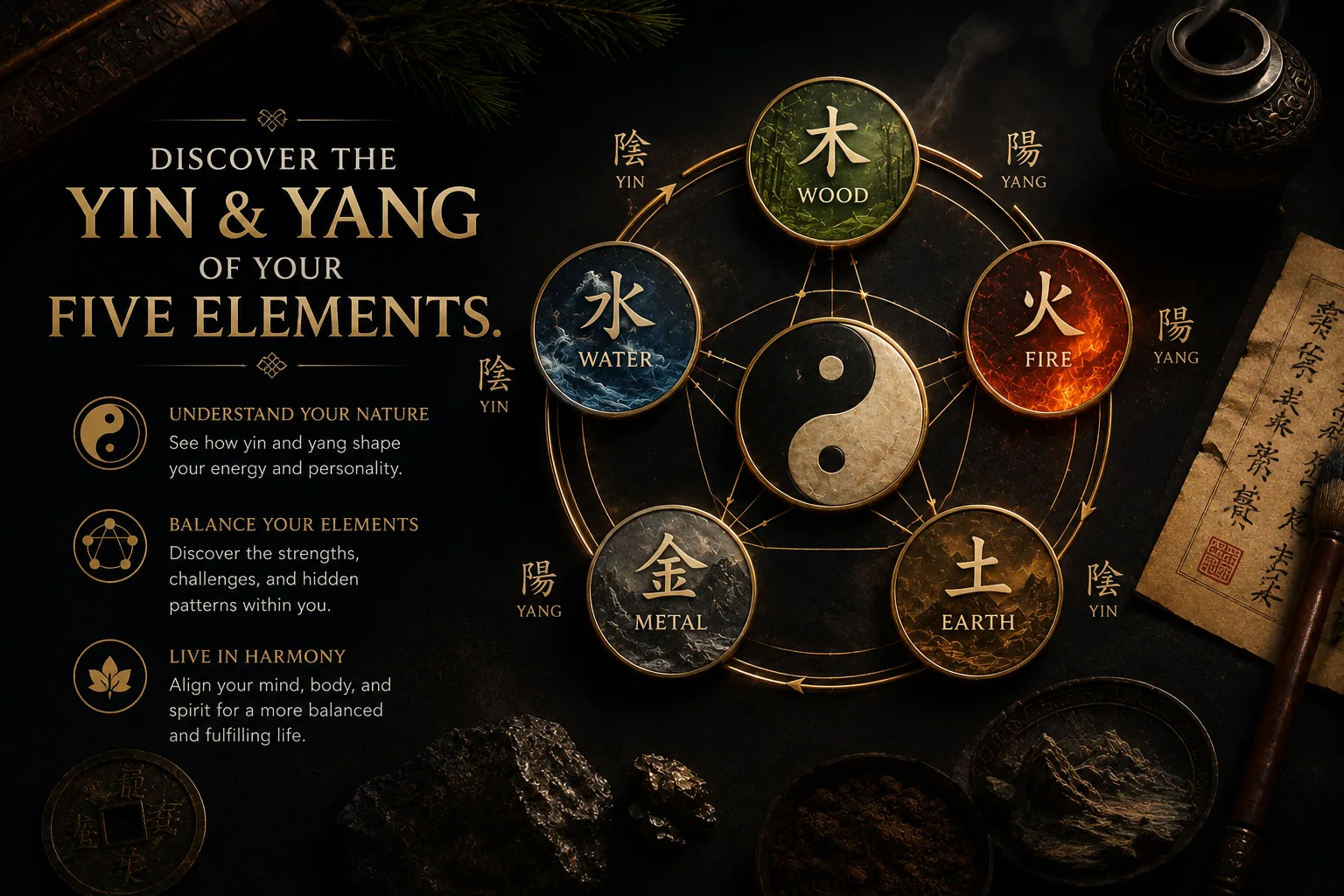
The Five Elements in BaZi: Wood, Fire, Earth, Metal & Water
If you're here, you've probably run into some version of this statement about yourself: you're a Wood person, or you need more Fire, or your chart is missing Metal. Maybe an app told you. Maybe a reader told you. Maybe you Googled your birth date at 2am and landed on a page that pronounced you an element and left it at that.
And now you have a question the page didn't answer: so what?
That "so what" is what this guide is about. The five elements — Wu Xing (五行): Wood (木), Fire (火), Earth (土), Metal (金), Water (水) — are the entire operating system of BaZi. Every stem, every branch, every pillar, every luck period, every clash, every Ten God, every reading — all of it is five-element math underneath. If you understand how the five elements actually work, you can read your own chart. If you don't, you're stuck reading horoscopes with fancier vocabulary.
The good news is that the system is smaller than it looks. Two cycles. Ten stems. A handful of interactions. That's it. What makes it powerful is how these few pieces combine — and how, once you know your own Day Master and your own Useful God, the same five elements start describing your life with unsettling precision.
Let's do this properly.
What are the five elements in BaZi?
The five elements in BaZi are Wood (木), Fire (火), Earth (土), Metal (金), and Water (水). They are not literal wood, fire, earth, metal, and water — they are phases of qi, five distinct patterns of how energy moves. The classical name 五行 Wǔ Xíng literally means "the five movements" or "the five phases." Movement is the operative word. Nothing in BaZi is static. The elements are verbs pretending to be nouns.
Each element carries a nature. A season. A direction. A colour. A body organ. A time of day. A kind of personality. A kind of career. A kind of grief. Classical BaZi treats these as facets of one underlying pattern, which is why the same word — Wood, say — meaningfully applies to spring, to green, to the liver, to growth-oriented careers, to the emotion of anger-turned-into-purpose, and to a specific person's rising ambition. It's one shape showing up in many domains.
Here is each element on its own terms.
Wood (木) — the vertical push
Wood is what a seedling does. It pushes up, out, forward. It insists on growing. In a chart, Wood energy shows up as vision, learning, expansion, kindness that has a spine to it, benevolence with direction. Wood is the person who sees where the project should go five years out and won't shut up about it. It is spring. It is morning. It is the eastward direction. It is the colour green. It is the liver in Chinese medicine — the organ that stores plans and gets sour when its plans are blocked.
Wood has two forms:
- 甲 Yang Wood (Jiǎ) is the tall tree. Trunk, timber, structure. Upright, principled, sometimes rigid. A 甲 person often looks like the reliable one in the room — the one who won't bend even when bending would help.
- 乙 Yin Wood (Yǐ) is the vine, the grass, the flower. Flexible, adaptive, expressive. It doesn't fight walls; it grows around them. 乙 people are often mistaken for soft when they are actually the most persistent element in the system — grass regrows after fire; timber doesn't.
If Wood is favourable in your chart, growing, learning, mentoring, and taking on more responsibility all feed you. If Wood is unfavourable, the same activities exhaust you and you have to be careful about what you commit to grow into.
Fire (火) — the outward radiance
Fire is what happens after Wood arrives. It expresses. It becomes visible. It gives off heat and light. In a chart, Fire energy is passion, expression, warmth, visibility, joy, the compulsion to be seen, the courage to be in front of the room. It is summer. It is noon. It is south. It is red. It is the heart — both the physical organ and the emotional centre.
Fire has two forms:
- 丙 Yang Fire (Bǐng) is the Sun. Bright, generous, public, impossible to hide. 丙 people announce themselves. They don't need permission to take up space. Leadership, stage work, and public roles come naturally.
- 丁 Yin Fire (Dīng) is the lamp, the candle, the refined flame. Precise, warm, illuminating one thing at a time. 丁 people are often the ones who see what others miss — the editor, the surgeon, the quietly excellent teacher.
If Fire is favourable, visibility and expression feed you and you should not shrink from attention. If Fire is unfavourable, being seen is expensive and you need to protect your energy — the sun burns as well as warms.
Earth (土) — the centre that holds
Earth is different. It doesn't push, express, refine, or flow — it contains. It's the ground beneath all the other movements. Earth energy in a chart is stability, trust, nurturance, the ability to hold things and people, patience, the instinct to build something that lasts. Classically, Earth doesn't get its own season — it lives in the transitions between them (辰戌丑未), the four tomb branches (墓庫) that store and stabilise the seasonal qi as it turns. Earth is centre. Earth is yellow. Earth is late afternoon.
Earth has two forms:
- 戊 Yang Earth (Wù) is the mountain. Vast, solid, immovable. 戊 people are steady leaders — the person you promote because you know they'll still be standing after everyone else has panicked.
- 己 Yin Earth (Jǐ) is the field, the garden, the soil that grows things. Nurturing, quietly practical, easy to underestimate. 己 people feed and grow the people around them. They are often the reason the team works and the last to take credit for it.
If Earth is favourable, providing stability, being the reliable centre, and building slow durable things all feed you. If Earth is unfavourable — usually because there's too much Earth already — you get stuck. Over-cautious, over-storing, over-holding. The move then is to introduce controlled Wood: push against the mass a little.
Metal (金) — the edge that cuts
Metal is what happens when the exuberance of summer is over and it's time to sort. In a chart, Metal energy is precision, decisiveness, refining, judgment, the ability to cut what's no longer useful, integrity that shows up as saying no. It is autumn. It is west. It is dusk. It is white. It is the lung — the organ that takes in and lets go.
Metal has two forms:
- 庚 Yang Metal (Gēng) is the axe, the sword, the raw iron. Direct, forceful, uncompromising. 庚 people are the ones who state the hard thing plainly and don't cushion it. Military, surgery, law enforcement, and heavy industry are classical fits.
- 辛 Yin Metal (Xīn) is the blade, the jewel, the refined ornament. Sharp but subtle. 辛 people are the precision instruments — the editor, the gemologist, the lawyer who wins on wording. They win by being exact where others are only approximate.
If Metal is favourable, decisiveness, editing, ending things, and setting standards all feed you. If Metal is unfavourable, sharpness turns brittle and precision turns into perfectionism that stalls you.
Water (水) — the depth beneath
Water is what happens after Metal has done its cutting. Everything settles, drops, moves inward, stores. Water energy in a chart is flow, reflection, depth, wisdom, adaptability, the willingness to move around obstacles instead of through them, memory. It is winter. It is midnight. It is north. It is black or deep blue. It is the kidney — the organ that stores essence.
Water has two forms:
- 壬 Yang Water (Rén) is the ocean, the river, the vast moving body. Broad, deep, generous, sometimes overwhelming. 壬 people move a lot of energy through themselves — dealmakers, connectors, travellers, people who see the big pattern.
- 癸 Yin Water (Guǐ) is the rain, the dew, the quiet water. Gentle, penetrating, patient. 癸 people go where no one else notices — deep research, private wealth, therapy, the invisible work that shapes what shows up on the surface.
If Water is favourable, reflection, planning, resting, and deep quiet work all feed you. If Water is unfavourable, you get lost in your own head, over-plan, and struggle to act.
The two cycles that drive everything
Everything above is just the vocabulary. The grammar is two cycles — generation (生) and control (克) — and once you see them, the whole chart starts to move.
The generating cycle (相生)
Wood → Fire → Earth → Metal → Water → Wood.
Each element feeds the next. Wood fuels Fire; Fire makes ash which becomes Earth; Earth bears Metal (ore in the ground); Metal produces Water (the classical image: cold metal condenses dew, and mineral springs flow from stone); Water grows Wood.
This is not just a science-class metaphor. In a chart, the generating cycle is how support flows. If your Day Master is Wood and you have Water in your chart, that Water is feeding your Wood — nourishing it, backing it up. If you're a Wood Day Master with a lot of Fire, that Fire is drawing from you — you're being expressed, but also drained.
Understanding this flow answers questions like: why do I feel more myself when I read late at night? If you're a Wood person, Water is your source. Night is Water time. You're literally sitting inside your own resource.
The controlling cycle (相克)
Wood breaks Earth → Earth dams Water → Water quenches Fire → Fire melts Metal → Metal cuts Wood → back to Wood.
Roots crack rock. Levees hold rivers. Water puts out flame. Flame smelts ore. Blade fells tree.
Control is not evil. Control is the system's way of keeping any single element from running away with the whole chart. Classical BaZi is very clear about this: a chart is only as good as its counter-forces are working. A Fire-heavy chart without any Water is a bonfire — brilliant for an hour and then ash. Add Water, and the same Fire burns for a lifetime.
When someone tells you that their favourite thing about themselves also seems to be the source of their biggest problem — the Wood person who can't stop planning, the Fire person who burns out on every project, the Earth person who won't move, the Metal person who is right but alone, the Water person who overthinks everything — what they're actually describing is an element without its natural check. The fix isn't to reduce the strong element (that never works). The fix is to strengthen its counter.
This is why the answer is almost never "have less of yourself." It's "put the missing counter-weight in place, and let yourself run at full strength."
Same-polarity and cross-polarity control
This is where the ten stems (rather than just five elements) start to matter. Control isn't a single relationship — it splits by polarity. When the controlling stem is the same polarity as the Day Master, classical BaZi calls the relationship Seven Killings (七殺) — raw pressure, unbuffered, sometimes destructive but sometimes forging. When the controlling stem is the opposite polarity, it's Direct Officer (正官) — structured authority, the legitimate boss, career, reputation.
Yang Metal (庚) controlling Yang Wood (甲) is 七殺 — same polarity, no negotiation, pure pressure. Yin Metal (辛) controlling Yang Wood (甲) is 正官 — opposite polarity, refined authority, legitimate order.
Same element. Same "Metal controls Wood." Completely different life experience. This is why the classical system tracks ten stems, not five elements — and why an app or reading that only tells you your element is throwing half the answer away.
Ten stems, not five elements
Here is the single most important thing to understand about a BaZi chart, and the thing most casual introductions to the five elements skip: there are ten stems, not five elements. Every element splits into a Yang form and a Yin form, and the two forms play different roles in your chart. Sometimes opposite roles.
The full ten:
| Element | Yang stem | Yin stem |
|---|---|---|
| Wood | 甲 Jiǎ | 乙 Yǐ |
| Fire | 丙 Bǐng | 丁 Dīng |
| Earth | 戊 Wù | 己 Jǐ |
| Metal | 庚 Gēng | 辛 Xīn |
| Water | 壬 Rén | 癸 Guǐ |
Why does the split matter so much? Because in the classical Ten Gods system, the label of a relationship changes with polarity. Take a Yang Wood (甲) Day Master. Fire is what they express. But Yang Fire (丙) is their Eating God (食神) — steady, nourishing creative output, the kind of expression that stays in a career. Yin Fire (丁) is their Hurting Officer (傷官) — brilliant, unconventional, boundary-pushing expression, the kind that lights up a room and offends the boss.
Both are Fire. Both are "Wood produces Fire." Same element in the crude accounting. But the stems are telling completely different stories about how you'll actually express yourself.
This is why the practical advice in classical BaZi is always at the stem level. Not "you need more Fire" but "lean into 丁 Yin Fire, ease off 丙 Yang Fire." Not "Wood is unfavourable" but "Yang Wood 甲 is the impurity; Yin Wood 乙 is fine." If your reading collapses everything back to five elements, it is discarding the polarity information — and polarity is often where the actionable answer lives.
If you ever wondered why the Ten Gods don't line up neatly with the five elements — this is why. There are ten of them because there are ten stems.
What element am I?
Almost everyone who lands here is really asking this: what element am I?
The short answer is that your element in BaZi is the element of your Day Master (日主) — the Heavenly Stem sitting on your birth day. If you're born on a 甲 day, you're Yang Wood. On a 癸 day, you're Yin Water. The Day Master isn't your whole chart, but it is the character standing in for "you" — the one whose relationships with the other seven characters define what you have going for you and against you.
But — and this is where casual BaZi readings mislead — you are not only your Day Master. You are also everything your chart contains, in the proportions your chart contains it. A 甲 Yang Wood person born in a Water-heavy chart lives a very different life from a 甲 Yang Wood person born in a Fire-heavy chart. Both are "Wood people." Both would give the same answer to what element am I? Their lives look nothing alike.
The correct way to think about it:
- Your Day Master's element = the character playing "you" in the chart.
- Your element mix = the world your character is standing in.
- Your Useful God = the element (or specific stem) your character most needs to thrive in that world.
The whole game — the whole reason BaZi exists — is figuring out that third thing. Naming the element you are is the easy part. Naming the element you need is where the actual reading begins.
Read more about how your Day Master works and what its element implies here: Day Master.
How do I know which element is favourable for me?
This is the real question, and this is where the classical system separates itself from horoscopes and generic personality tests.
The classical name for your favourable element is the Useful God (用神), sometimes translated Use God. It's the element (and, more precisely, the specific stem) that makes your chart work — the one that turns your Day Master's raw material into a functioning life.
There is no shortcut. The Useful God is identified by looking at:
- The Month Branch — the season you were born in. This dominates the initial strength of your Day Master. Wood born in spring is strong out of the gate; Wood born in autumn is fighting for footing.
- Your Day Master's overall strength across all four pillars. Not just the month — the whole chart. The classical rule is that a stem in season is not automatically dominant, and a stem out of season is not automatically weak. What matters is the total root support across all four branches (寅, 卯, and 辰 all root Wood in different ways).
- The Pattern (格局) — the classical structure your chart forms. From the Month Branch's dominant hidden stem, the classical system names one of a set of patterns — Direct Officer (正官格), Wealth (財格), Seal (印格), Food God (食神格), Seven Killings (七殺格), Hurting Officer (傷官格), Yang Blade (陽刃格), and a few others. Each pattern has its own Useful God formula.
- Climate. A Fire-heavy chart born in summer needs Water regardless of what the pattern says. A Water-heavy chart born in winter needs Fire. The classical name is 調候 — climate adjustment.
- Any special momentum in the chart — if the whole thing leans radically one direction, classical BaZi sometimes flips the usual advice and tells you to go with the momentum instead of resist it.
The categorical rule is simple even if the execution is subtle: the Useful God is the element (specifically, the stem) that, when present and healthy, makes the rest of the chart flow. Favourable elements are the ones that protect and strengthen your Useful God. Unfavourable elements are the ones that damage or combine it away.
If you want that computed properly for your specific chart — with the stem-level detail, not just "you need Wood" — Ming Map does it end to end. But the concept is what matters: your favourable element is not a personality preference. It's a specific structural role your chart is asking to be filled.
What if I'm missing an element?
Almost every anxious BaZi Google search sooner or later becomes this one. You've entered your birth date, you've been told your chart is "missing Metal" or "missing Water," and now you're wondering if you're broken.
You're not.
A missing element is only a problem if the missing element is your Useful God — or something your Useful God depends on.
Here's the classical view. A chart contains eight characters: four stems, four branches. The branches themselves contain hidden stems, sometimes three per branch. So a "chart with no Metal in it" often still has Metal hiding in a branch — 巳 conceals 庚 Yang Metal, for instance, and 丑 conceals 辛 Yin Metal. Missing at the surface, present in the depths. That element can still activate when a Luck Pillar or an annual pillar rolls in and lights up the hidden stem.
More importantly — sometimes a missing element is favourable. If you're a Yang Wood Day Master born in spring with plenty of Water support, you're already strong. What you don't need is more Wood or Water. If your chart is missing Metal (which controls Wood) or missing Earth (which drains Water), that's often exactly the missing counter-force you don't want anyway.
The correct question isn't "am I missing an element?" It's "what does my chart need to function, and is my chart getting it?" That's what pattern and Useful God analysis is for.
There is one legitimate concern in the missing-element category. If your chart is missing the element that would normally regulate your dominant one, you'll feel the imbalance sharply in daily life. A Fire-heavy chart with no Water burns out. A Wood-heavy chart with no Metal never finishes anything. An Earth-heavy chart with no Wood stalls. A Metal-heavy chart with no Fire hardens. A Water-heavy chart with no Earth floods. In those cases, the missing element is genuinely something to deliberately introduce — into your environment, your habits, your colours, your work, your relationships — because your chart isn't producing it internally.
What does it mean if I have too much of one element?
This is the mirror question, and often it's the more useful one. Too much of one element is more common than missing an element and, in classical practice, causes more life problems.
Here's what the surplus of each element tends to look like in real life:
- Too much Wood: You start too many things. You have opinions on how everything should be run. You can't stop planning the future. You struggle to finish. You get angry at bureaucracy. Cure: Metal (edges, editing, finishing, saying no) or Fire (turn the plans into visible output).
- Too much Fire: You burn out on cycles. You over-express, over-commit, over-perform. Your emotions swing hot. You crave attention, then hate the attention when you get it. Cure: Water (rest, depth, reflection) or Earth (ground, structure, hold).
- Too much Earth: You get stuck. You over-store, over-hold, over-protect. You become the person who should have moved cities years ago. Family and property weigh on you disproportionately. Cure: Wood (push, growth, expansion) or Metal (cut what isn't serving you).
- Too much Metal: You get brittle. You're right, but alone. You cut what should have been kept. Perfectionism stalls you. Cure: Fire (warmth, expression, softening) or Water (flow, adaptability).
- Too much Water: You over-think. You plan endlessly and never launch. You drown in information. You get depressed easily in winter. Cure: Earth (ground, contain) or Wood (turn thought into growth-oriented action).
Notice that the cure in each case is not "have less of what you are." You can't have less of what you are. The cure is the classical control or drain cycle — introduce the element that regulates the surplus and turns it into fuel. Wood turns Water's endless reflection into growth. Fire turns Metal's brittle judgment into warmth. Earth turns Fire's intensity into something durable. Metal turns Wood's endless planning into finished, edited output. Water turns Metal's cold precision into flowing wisdom.
This is not woo. It's a specific, testable claim: if you consistently spend time around your regulating element — its colours, its climate, its work, its people — you feel less like a runaway version of yourself and more like a stable one. Charts tell you which element that is.
Why balance doesn't mean equal
A common myth — one that even some modern BaZi introductions repeat — is that a good chart has all five elements in roughly equal amounts, and a "bad" chart is imbalanced.
This is wrong. Balance in classical BaZi means balance relative to your Day Master. It means having the elements you specifically need, in the amounts your chart specifically needs them.
Consider a Yang Wood (甲) Day Master born in spring. This person already has plenty of Wood. Adding more Wood doesn't "balance" the chart — it tips it further into surplus. What "balance" looks like for this chart is Fire to express the Wood outward, Metal to prune and shape it, and just enough Earth to give it wealth to grow into. A completely lopsided chart on paper. Balanced in practice.
Consider a Yin Water (癸) Day Master born in winter. This chart is drenched in Water. A textbook "unbalanced" chart. But if the chart also has Wood to drain the excess Water into productive growth, and a spark of Fire to warm the whole thing, it's a very high-functioning configuration — the classical books describe such charts as capable of great depth and long-term achievement.
Balance is not aesthetic. Balance is functional. A chart is balanced when it can do what it needs to do — support the Day Master, feed the Useful God, and keep the counter-elements alive enough to regulate the surpluses. That is often not a symmetric chart.
If your chart looks "unbalanced" and someone is worried on your behalf, ask whether it's functionally unbalanced (missing what it needs to work) or aesthetically unbalanced (just uneven-looking). Very often it's the second, which is not a problem at all.
How to actually use your elements day to day
Once you know your Useful God — and specifically, the stem it maps to — you can start aligning your daily choices. This is not superstitious ritual. It's a structured way of biasing your environment toward the balance your chart is trying to reach.
Colour. Wear the colours of your favourable element more; the colours of your unfavourable element less. If Yin Fire (丁) is your Useful God, warm oranges, deep reds, candle-light tones. If Yang Water (壬) is unfavourable, ease off deep blacks and navy.
Environment. Fire-favourable? South-facing rooms, natural light, warm materials. Water-favourable? North-facing quiet, dark tones, actual water in the space. Wood-favourable? Green, plants, morning light, wooden materials. This isn't feng shui in the fortune-cookie sense; it's the same five-element grammar applied to space.
Work. Every industry has an elemental character. Media and entertainment are Fire. Finance and mining are Metal. Real estate and hospitality are Earth. Publishing, education, and design are Wood. Trading, logistics, and research are Water. If your Useful God is Metal and you've spent your career in Fire industries, the friction you keep feeling isn't a personal failing — you've been swimming against your chart's grain.
Relationships. Notice which people leave you feeling more like yourself and which leave you drained. Very often the recharging people carry your favourable elements in their own Day Masters; the draining people carry your unfavourables. Not always — humans are more than their charts — but often enough to notice.
Rhythm. Every element has a peak time of day and year. Wood: spring, dawn to mid-morning. Fire: summer, noon. Earth: late afternoon and the inter-seasonal windows. Metal: autumn, late afternoon to dusk. Water: winter, night. Do your important work in your favourable window.
None of this is deterministic. You are not required to only wear one colour or work in one industry. But if you're wondering why some periods of your life felt easier than others, the answer is often that those periods aligned with your favourable elements — sometimes by accident, sometimes by design.
FAQ
What are the five elements in BaZi? Wood, Fire, Earth, Metal, and Water. In Chinese, 五行 Wǔ Xíng — the five movements. Each has a Yang and a Yin form, giving ten Heavenly Stems total (甲乙 for Wood; 丙丁 for Fire; 戊己 for Earth; 庚辛 for Metal; 壬癸 for Water). Every character in your chart carries one of them, and the way they generate and control each other defines the whole reading.
What element am I? You are the element of your Day Master — the Heavenly Stem sitting on your day of birth. That's what "being a Wood person" or "being a Fire person" means in BaZi. But you are also everything your chart contains. Two people with the same Day Master element can live very different lives depending on what surrounds it.
What if I'm missing an element? Only a problem if the missing element is your Useful God or a counter-force your chart critically needs. Sometimes a missing element is favourable — meaning the chart didn't need it and is fine without it. Also, elements often hide inside branches — 巳 hides Metal, 丑 hides Water, and so on — so "missing on the surface" doesn't always mean "absent from the chart." The right question is whether your chart is getting what it functionally needs, not whether every element is present.
What does it mean if I have too much of one element? Usually more disruptive than missing one. Surplus of any element shows up as the exaggerated shadow version of that element's gift: too much Wood plans endlessly, too much Fire burns out, too much Earth stalls, too much Metal isolates, too much Water over-thinks. The classical fix is to strengthen the element that regulates the surplus, not to try to reduce what you already are.
How do I know which element is favourable for me? By identifying your Useful God — which requires looking at your Day Master's strength across all four pillars, the season you were born in, the classical pattern your chart forms, and the climate. It's not a personality quiz. It's a structural analysis. Any tool that tells you your favourable element from your birth year alone is guessing.
Is more of my favourable element always better? Up to a point. BaZi is about balance, so even a favourable element can be overdone. This is where stem-level polarity matters — a Wood-favourable chart might need Yin Wood (乙) but be harmed by more Yang Wood (甲). Element-only advice hides this. Stem-level advice makes it actionable.
Can my favourable element change over time? Your Useful God is stable — it comes from the birth chart. What changes is which elements are available to you at any given time, based on your luck pillars and each year. So the practical emphasis shifts across your life even though the underlying prescription doesn't. Some decades bring your Useful God abundantly; others starve it.
Am I doomed if my Useful God is missing from my chart? No. The classical view is that a chart missing its Useful God at the natal level is one that "waits" — the person often reports feeling like their real life hasn't started yet, until a Luck Pillar arrives that brings the missing element in. When it does, life famously lifts. It's a hard configuration, not a hopeless one. Many high-achieving charts look exactly like this before the right luck period arrives.
Do the five elements really predict health, career, and relationships? They correlate with them, in ways the classical texts document extensively. Fire relates to the heart and cardiovascular system; Wood to the liver and planning; Metal to the lungs and cutting/finishing work; Earth to digestion and endurance; Water to kidneys and reflection. Elements are not fate. They are the substrate on which choices land. Two people with the same Fire-heavy chart can produce very different lives depending on whether they build in the Water they need.
Where do I actually go from here? Get the four pillars of your birth calculated properly, identify your Day Master, get your Useful God — with stem-level precision — and start reading the rest of the chart from there. That's the only way this vocabulary starts describing your specific life rather than five archetypes.
If you want to see your five-element profile — not just as five bars but split properly into all ten stems, with your Day Master, Useful God, favourable stems, and impurity mates all named — Ming Map does the full classical analysis. It's the same system this guide is describing, applied to your exact birth data. Every claim traceable to a classical rule; no invented math. Have a look at your own chart and see which of the patterns you just read about are actually running your life.