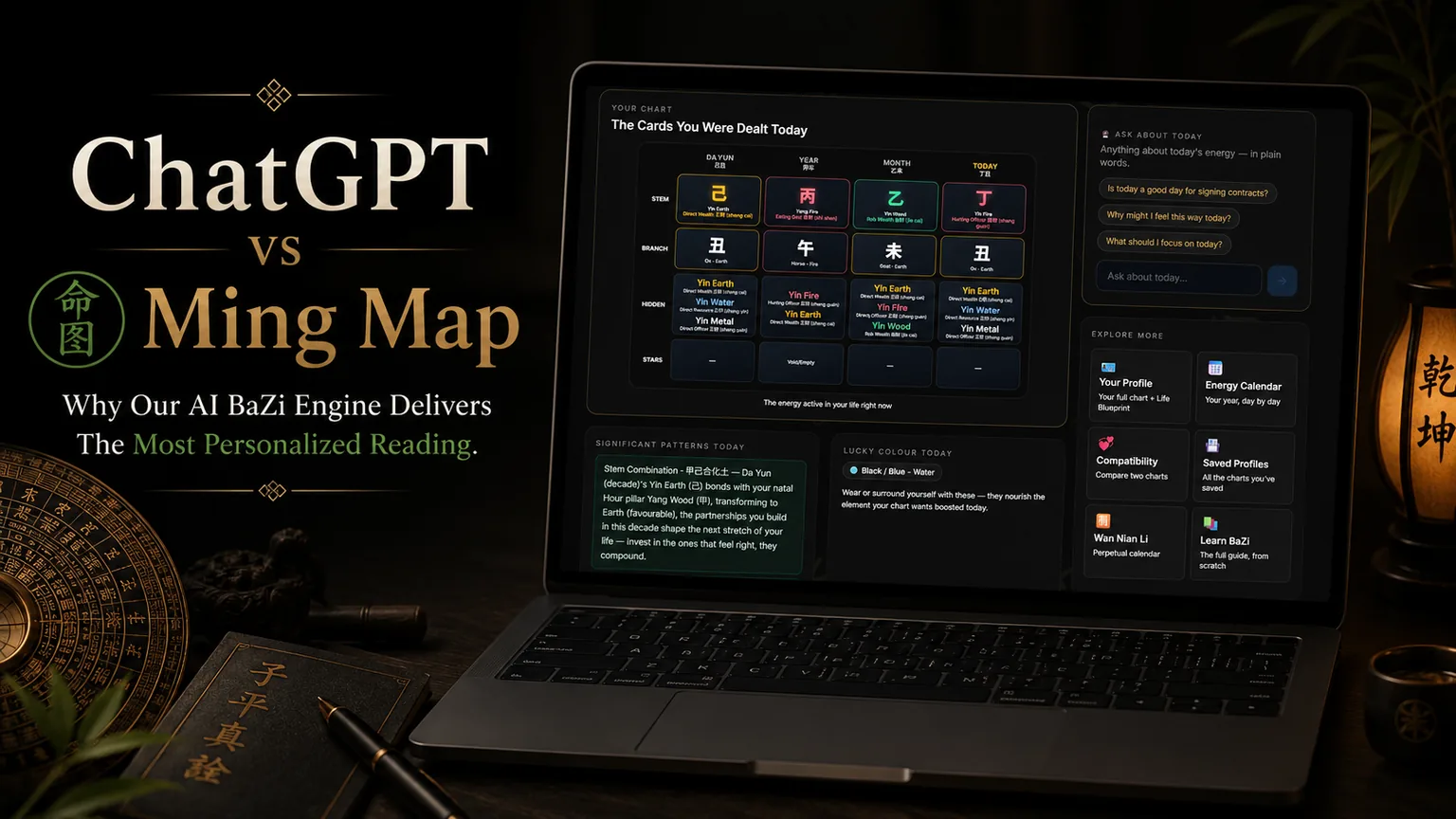
ChatGPT BaZi vs a Real BaZi Engine: Why AI Gets Your Chart Wrong
You typed your birthday into ChatGPT. It came back with eight characters, a confident paragraph about your Day Master, some talk about your Useful God, maybe a warning about a coming clash. It sounded plausible. You screenshotted it. Then, out of curiosity, you asked again a week later — same birthday, same time zone — and got a different set of pillars, a different Day Master, a different verdict.
You are not imagining that. And you are not doing anything wrong.
The honest answer is this: ChatGPT is a language model, not a BaZi engine. It doesn't compute your chart — it predicts what a BaZi reading is likely to sound like. Those are two completely different operations. One is arithmetic on a calendar and lookup tables. The other is fluent text generation. When they collide, you get a beautifully written reading of a chart that isn't yours.
This is the guide that explains — with real classical mechanics, side by side — exactly where the language model breaks, why it breaks there, and what a properly built BaZi engine does differently. It's also the guide that answers, honestly, whether AI has any place in a serious BaZi reading. (It does. Just not the place ChatGPT is playing.)
If you've been asking yourself any of these questions, you're in the right place:
- Can ChatGPT read my BaZi chart?
- Why does ChatGPT give me different BaZi answers each time?
- Is ChatGPT accurate for Chinese astrology?
- Can I trust AI-generated BaZi readings?
- What's the best AI BaZi tool?
- Is ChatGPT lying to me about my chart?
Let's start with what BaZi actually is, mechanically, so the failure modes make sense.
What "reading a BaZi chart" actually means, mechanically
BaZi (八字, "eight characters") is a formal system. It is not vibes. It is not intuition dressed up in Chinese characters. It is a small pile of deterministic operations that convert one input — a birth moment, precise to the hour — into a very specific output: four pairs of stems and branches, plus everything that classical Chinese metaphysics has to say about that specific configuration.
Here is the pipeline, spelled out:
Convert the birth moment to the Chinese solar calendar. This is not the lunar calendar. BaZi runs on the 24 solar terms (二十四節氣). The year begins at 立春 (Lì Chūn, "start of spring") — around February 4th — not January 1st and not Lunar New Year. The month begins on its own solar term (立春, 驚蟄, 清明, 立夏 and so on). A baby born on February 3rd 1990 is a 1989 BaZi year. This trips up more chatbots than anything else, and it's the first bug in most AI readings.
Look up the Year, Month, Day, and Hour pillars. Each pillar is one Heavenly Stem (天干) sitting over one Earthly Branch (地支). There are 10 stems (甲乙丙丁戊己庚辛壬癸) and 12 branches (子丑寅卯辰巳午未申酉戌亥). The Year, Month, and Day pillars are determined by the sexagenary cycle (a 60-pillar rotation running since antiquity). The Hour pillar is looked up from a fixed table keyed to the Day stem and the hour-of-day.
Enumerate the hidden stems (藏干) inside each branch. Every branch contains one to three stems buried inside it. 子 hides 癸. 午 hides 丁 and 己. 辰 hides 戊, 乙, and 癸. These hidden stems matter enormously — they carry roots, they light up Ten Gods that the visible stems don't show, and they change the entire pattern reading.
Identify the Day Master (日主). This is the Day pillar's stem. Yang Fire (丙) Day Master, Yin Wood (乙) Day Master, and so on. Every subsequent classical judgement is from the Day Master's point of view.
Derive the Ten Gods (十神) from Day Master to every other stem in the chart — visible stems and hidden stems alike. There are ten roles (正官 Direct Officer, 七殺 Seven Killings, 正財 Direct Wealth, 偏財 Indirect Wealth, 正印 Direct Resource, 偏印 Indirect Resource, 食神 Eating God, 傷官 Hurting Officer, 比肩 Friend, 劫財 Rob Wealth), and the correct label depends on both the element relationship and the polarity match between Day Master and the target stem. Same element same polarity is Friend (比肩); same element opposite polarity is Rob Wealth (劫財). These are not interchangeable. Their character is completely different.
Assess Day Master strength (身強/身弱). Count the roots — every branch whose hidden stems support the Day Master's element gives the Day Master root; every branch whose hidden stems drain, control, or oppose it takes root away. Count across all four pillars, not just the month.
Identify the pattern (格局). The pattern comes from the Ten God relationship between the Day Master and the commanding stem of the month branch. For the standard months, that's the branch's dominant hidden stem. For the tomb months (辰戌丑未), it's whichever hidden stem shows up transparently among the four visible stems.
Resolve the Useful God (用神). The Useful God is the element the chart most needs — the one the chart is built to protect. Its identity depends on the pattern and the Day Master's strength together. It is not "the element you're weak in." It is not "the missing element." It is a formal resolution from the classical pattern tables.
Only now can you actually read the chart. Favorable elements protect the Useful God. Unfavorable elements damage it. Luck pillars either bring in the elements the chart wants or the elements the chart fears. Everything downstream — timing, career fit, health, relationship — reads from that spine.
Notice what none of this is: guesswork. Every single step is a lookup or an arithmetic operation. Given the same birth moment, a correctly built engine produces the same eight characters, the same Ten Gods, the same pattern, the same Useful God — every time, on every device, forever.
Now ask yourself what a language model does with any of this.
Why ChatGPT hallucinates BaZi charts
A language model, at its core, does one thing: given a prompt, it predicts the next most-plausible token. Then the next. Then the next. It doesn't know arithmetic. It doesn't have a calendar in the sense a computer has a calendar — it has read a lot of text about calendars. It doesn't have the sexagenary cycle in memory as a rotating table — it has read a lot of sentences that mention the sexagenary cycle.
When you ask it, "What is the BaZi chart for someone born on August 12th 1989 at 3:47 PM in Taipei?" — it doesn't run the pipeline above. It generates text that sounds like the output of that pipeline. Sometimes those two things match. Frequently they don't.
The hallucinations happen at very specific, predictable places:
It gets the Year pillar wrong for birthdays near 立春
The classical year boundary is 立春, on or around February 4th. A birth on February 2nd 1990 is still 己巳 (1989's Snake year). A birth on February 5th 1990 is 庚午 (1990's Horse year). Ask ChatGPT about a February-3rd birth and it will very often — not sometimes, often — hand you the wrong year pillar, because the training data conflates "born in early 1990" with "1990 BaZi year." It has read both. It picks the one that sounds more natural in context.
Same problem, sharper edge, at the month boundaries. Every BaZi month begins on a solar term. A birth on March 5th is a Tiger month (寅). A birth on March 7th is a Rabbit month (卯). The chatbot doesn't check. It picks whichever month name sounds right and moves on. That single choice cascades through the whole reading — because the month branch drives the pattern, and the pattern drives the Useful God, and the Useful God drives every subsequent judgement.
It gets the Hour pillar wrong or ignores time zone entirely
The Hour pillar depends on both the local solar hour and the Day pillar's stem (via the 五鼠遁時訣, the "five rats hiding" hour lookup rule). ChatGPT rarely runs that lookup. When it does, it often uses the wrong Day stem to key into it, because it already guessed the Day pillar wrong. When it doesn't, it just picks an hour-branch that sounds plausible and staples a stem on top.
Time zones make this worse. BaZi uses local solar time — meaning the hour a person is born under depends on where the sun is, not what the clock on the wall says. A birth in London and a birth in Beijing at the same UTC moment have different Hour pillars. Chatbots essentially never handle this correctly.
It hallucinates hidden stems
Ask ChatGPT what's hidden inside the branch 未. The correct answer, from the classical dominance order, is 己 (Earth), 丁 (Fire), 乙 (Wood). Not sometimes. Always. It's a fixed table. But ChatGPT will occasionally omit one, occasionally invent an extra, occasionally swap the order — and since hidden stems drive so many downstream judgements (Ten Gods, roots, pattern for tomb months), a single-character error here rewrites the reading.
It derives Ten Gods incorrectly
The Ten God label is a two-parameter lookup: the element relationship between Day Master and target stem (generates, controls, is generated by, is controlled by, or matches), and the polarity match (yang-yang, yang-yin, yin-yang, yin-yin). Get one parameter wrong and you get the wrong label. Yin Wood (乙) Day Master looking at Yin Fire (丁) is not the same Ten God as Yin Wood looking at Yang Fire (丙). The first is Eating God (食神). The second is Hurting Officer (傷官). Two different personalities. Two different life themes. ChatGPT swaps them frequently — because in fluent English text about BaZi, both labels appear near "Fire," and either could plausibly be the next word.
It invents Useful Gods
This is the worst of them. The Useful God (用神) is the linchpin of a real BaZi reading. It's not intuition-derived. It's not "the element you have the least of." It comes from applying the pattern-specific classical tables to your pattern and your Day Master strength. There are eight standard patterns, each with its own resolution logic. There are also the external patterns (從格 and 化格) reserved for very specific extreme configurations. Get the pattern wrong and the Useful God flips. Get the Day Master strength wrong and it flips again.
ChatGPT will confidently name a Useful God without doing any of that. It essentially picks an element that sounds right for the tone of the reading it's already writing. Sometimes it gets lucky. Often it doesn't. And the reader has no way to tell.
It contradicts itself between sessions
Ask ChatGPT the same birth chart today and tomorrow. You will very often get different pillars. Different Ten Gods. Different Useful Gods. Different verdicts. Not because BaZi is subjective (it isn't). Because the model is sampling probabilistically from a fuzzy internal representation, not looking up a fixed answer. Two rolls of the same weighted die give different faces.
This is the answer to "why does ChatGPT give me different BaZi answers?" The system is not reading a chart. It's generating something that looks like a chart reading each time. Consistency is not one of its features.
Can ChatGPT read my BaZi chart?
Short answer: not the way you need it to.
Slightly longer answer: it can read about BaZi. It can explain what the Direct Officer (正官) means. It can walk you through the difference between Yang Fire (丙) and Yin Fire (丁) as Day Masters. It can summarise the twelve-life-stage tradition or the six great clashes or what "Useful God" points to conceptually. As a study partner and tutor, it's genuinely useful — better than most books for someone who wants questions answered patiently and at their level.
But when you ask it to compute your chart, or interpret it, you are asking it to do a job it was never architected to do. The failure isn't malicious. It's structural. A language model produces plausible text. Your BaZi chart requires exact arithmetic on a calendar. Those overlap approximately never.
The correct mental model: ChatGPT is a brilliant BaZi student who has read every book but never learned to do the arithmetic. Ask it what a Direct Officer means, and you'll get a beautiful essay. Ask it whether you have one, and it will guess.
Is ChatGPT accurate for Chinese astrology, in general?
More accurate for the conceptual content than for the chart-specific content. It handles:
- Classical definitions and terminology — good.
- Historical context of Ziping-style analysis — good.
- Explanations of relationships (何为食神 vs 傷官, 生克制化) — mostly good, with occasional overreach.
- Actual chart computation for a specific person — unreliable.
- Pattern-and-Useful-God resolution — unreliable.
- Timing predictions from luck pillars and annual pillars — highly unreliable, because they cascade from the earlier errors.
For the general study of Chinese metaphysics — Zi Wei Dou Shu (紫微斗数), Qi Men Dun Jia (奇门遁甲), Da Liu Ren (大六壬), Feng Shui — the pattern is the same. Concepts, fine. Computation, avoid.
Can I trust AI-generated BaZi readings?
Here we have to split the question, because "AI-generated" covers two very different products.
AI generating the chart — no, don't trust that. This is the core failure mode described above. If the pillars are wrong, everything downstream is wrong, and the fluent prose makes it worse rather than better because it inspires false confidence.
AI generating the interpretation of a correctly-computed chart — yes, cautiously. If a deterministic engine has already produced the correct eight characters, the correct Ten Gods, the correct pattern, the correct Useful God, and hands those verified facts to a language model to explain to you in plain English — that's a fundamentally different operation. The AI is no longer guessing at the chart. It's translating a verified reading into human language.
That's the split every serious BaZi tool has to make. The chart itself must be computed by an engine. The reading of the chart can be softened, humanised, and made conversational by AI. In that order. Never reversed.
A side-by-side: same birthday, ChatGPT vs a real engine
Let's work an example. Take a real-feeling birthday: March 5th, 1990, 07:14 in Taipei.
Here is the kind of answer you'd typically get by pasting that into ChatGPT and asking for the BaZi chart:
"Your BaZi chart for March 5th, 1990 at 07:14 in Taipei:
Year: 庚午 (Yang Metal Horse) Month: 己卯 (Yin Earth Rabbit) Day: 丙申 (Yang Fire Monkey) Hour: 壬辰 (Yang Water Dragon)
Your Day Master is Yang Fire (丙), which represents the sun — expressive, radiant, generous. Your Useful God is Water, because Fire needs to be balanced. You should focus on career growth this year..."
Sounds fine. Now let's actually run the pipeline.
Step 1 — Solar term boundary check. March 5th, 1990 is very close to 驚蟄 (Jīng Zhé, "awakening of insects"), which is the classical start of the Rabbit month (卯). In 1990, 驚蟄 fell on March 6th at approximately 03:19 Beijing time (which is 03:19 local for Taipei since both use UTC+8). So a birth on March 5th at 07:14 in Taipei is still in the Tiger month (寅), not the Rabbit month. The chatbot skipped the boundary check — and mis-assigned the month before it even started.
Step 2 — Year pillar check. Also worth confirming: 立春 for 1990 fell on February 4th. March 5th is well after that, so the year pillar is indeed 1990's 庚午. Good, the chatbot got the year right — probably by accident, but right.
Step 3 — Correct pillars. Running the actual calendar computation:
- Year: 庚午 (Yang Metal Horse) — correct.
- Month: 戊寅 (Yang Earth Tiger), not 己卯. The chatbot handed us the next month.
- Day: 丙申 (Yang Fire Monkey) — correct (the day pillar rotates on the sexagenary cycle and is well-attested for that date).
- Hour: 壬辰 (Yang Water Dragon) — correct at 07:14, but only by luck. The chatbot happened to name the hour that actually corresponds to the 07:00-09:00 range for a 丙 Day Master using the 五鼠遁時訣.
So one pillar out of four is silently wrong. That's not a small error.
Step 4 — Downstream consequences. With the wrong month pillar:
- The chatbot's month branch was 卯 (Rabbit). The correct one is 寅 (Tiger).
- The dominant hidden stem of 卯 is 乙 (Yin Wood). The dominant hidden stem of 寅 is 甲 (Yang Wood).
- 乙 seen from a 丙 Day Master is Direct Resource (正印). 甲 seen from 丙 is Indirect Resource (偏印).
- Different Ten God. Different pattern. Different life theme. Direct Resource says "formal mentors, credentials, traditional education, protective mother." Indirect Resource says "unconventional teachers, self-taught, non-linear path, complex mother dynamic." Those are not synonyms.
Step 5 — Useful God. The chatbot said "Water, because Fire needs to be balanced."
Let's actually resolve it. Day Master is 丙 (Yang Fire). Month branch is 寅 (Yang Wood Tiger). 寅 is the 長生 birth-stage branch for Fire — meaning the Day Master has a nascent root in the month. Add in the fact that 寅's hidden stems include 甲 (Wood) and 丙 (Fire itself), and this Day Master is being fed and rooted by the month. That's the opposite of what the chatbot said.
Look at the rest: Year branch 午 is Fire's imperial stage — huge root for 丙. Day branch 申 is Metal (Fire's Wealth, not its root). Hour branch 辰 is Water storage.
The classical read: this Day Master is moderately strong — rooted in the month and doubled-down by the year. The pattern here (Indirect Resource in the month) is a Seal pattern (印格). For a strong Day Master in a Seal pattern, the classical rule is: the Useful God is typically Wealth (財) — the element that controls the over-supportive Resource — with Officer (官) as the supporting god that stabilises Wealth.
So the actual Useful God for this chart is Metal (Wealth for Fire), not Water. Water plays a supporting role, not the lead. The chatbot got the whole verdict backwards.
Step 6 — What this changes. If Metal is your Useful God, you thrive in disciplined, revenue-focused, quantifiable work. You want structure, targets, execution. Environments that reward finishing over starting. Careers in finance, engineering, precision manufacturing, surgery, law — anywhere Metal is the operative element. Your favorable years are Metal-rich luck pillars. Your risky years are Wood-and-Fire heavy pillars that further inflate the Resource star.
If Water is your Useful God — the chatbot's guess — you'd be told the opposite. Seek out challenges (Water = Officer for Fire), take on authority, put yourself under structured pressure. Different career, different luck reading, different everything.
That single wrong month pillar cost this reader the entire reading.
Now imagine reading that beautiful ChatGPT paragraph, believing it, and making a career decision based on it. That's the trap. The prose was perfect. The chart was wrong.
What a real BaZi engine does differently
The difference between a real engine and a language model is not sophistication. It's not model size. It's not training data. It's architecture. A real engine has three properties a language model doesn't have:
Determinism. Given the same birth moment, it returns the same eight characters, every time, forever. There is no sampling. There is no randomness. There is no "temperature." The Year pillar is looked up from a table. The Day pillar is looked up from the sexagenary rotation. The Hour pillar is looked up from the 五鼠遁時訣 with the correct Day stem as the key. Same input, same output — the way a calculator adds numbers.
Calendar correctness. It knows the 24 solar terms to the minute for every year in its range, in Beijing time, and converts your local birth time properly. Born the day before 立春? It gives you the previous year's pillar. Born fifty-three minutes before 驚蟄? It gives you the Tiger month, not the Rabbit month. This is not an interpretation call. It's a calendar boundary. The engine either respects it or it's broken.
Table-driven Ten Gods and hidden stems. The 藏干 dominance table is fixed. The Ten God relationships are a 10×10 matrix that never changes. A real engine encodes them once, correctly, and applies them mechanically. There is no room for the model to "guess" that 乙 hides inside 未 in second dominance rather than second-to-last. It just does.
Classical pattern resolution. The pattern-and-Useful-God logic is expressed as rules — not vibes. Which branch is the month? What's its commanding stem (dominant hidden stem, or transparent hidden stem for tomb months)? What Ten God does that produce against the Day Master? That's your pattern candidate. Then: what's the Day Master's strength across all four pillars? Then: apply the classical Useful God table for that pattern and that strength. Done. Reproducible. Testable.
None of this is exotic. It's just software doing what software does: arithmetic and lookup. What's exotic is trying to persuade a text-prediction model to do arithmetic and lookup, which — spoiler — it doesn't reliably do.
So where does AI belong in a serious BaZi tool?
Here's the interesting part. Everything above is a case against ChatGPT computing your chart. It's not a case against AI in BaZi more broadly. Because once the chart is computed correctly, the interpretation work is exactly where a language model shines.
Think about what a good BaZi reading requires after the mechanical work is done:
- Translating "you have a Seal pattern with a strong Day Master, Wealth-favorable" into English a normal person can act on.
- Handling nuance: this favorable element is stronger in this luck pillar than that one; this clash is worse for you because it hits your Day branch; this Ten God's advice sharpens or softens depending on whether it's transparent or hidden.
- Answering follow-ups. "Okay but what does this mean for my career specifically?" "Should I take the offer in Singapore?" "My partner has 甲 as their Day Master — how do we clash and support?"
- Handling all of that in three languages, in warm human prose, without losing the underlying accuracy.
That is genuinely well-suited to a language model. Not because language models understand BaZi — they don't, in any meaningful sense — but because language models are very good at translating structured facts into fluent prose. Feed them the verified pattern, the verified Useful God, the verified Ten Gods, and they can produce a reading a professional practitioner would recognise. Feed them the birth date and let them guess, and you get the mess we started with.
So the correct architecture is:
Engine → Facts → AI → Prose → You
Not:
You → AI → Prose that pretends to be facts
That's the entire design difference. It's not subtle. And it's what separates a real BaZi tool from a chatbot with Chinese characters sprinkled through it.
What's the best AI BaZi tool?
The best AI BaZi tool is the one where the AI is downstream of the chart engine, not doing the chart engine. That's the only architecture that solves the accuracy problem.
That's what we built Ming Map to be. The pipeline is:
You enter your birth moment. Date, time, location.
A deterministic engine computes your Four Pillars. Solar term boundaries respected, time zone converted properly, sexagenary lookup done in software. Given the same input, you get the same eight characters every time — because they're actually your eight characters, not a guess.
The engine derives Ten Gods, hidden stems, and Day Master strength. All from fixed tables. All traceable to classical rules. No invented weights or thresholds. If a value can't be computed from real rules, the engine returns null rather than a plausible-sounding fake.
The engine resolves your pattern and Useful God. Using the classical pattern tables — the Direct Officer method for Officer patterns, the Wealth method for Wealth patterns, the Seal method for Seal patterns, and so on down the eight standard patterns and their variations. If the chart is in a tomb month, the transparent-hidden-stem rule applies. If the chart resists standard pattern resolution, external patterns (從格, 化格) are considered as the last resort, exactly as the classical texts prescribe.
Only then does the AI layer speak. It reads from the verified chart output, not from your birth date. It explains your Day Master, your pattern, your Useful God, your favorable and unfavorable elements, your Ten God flavors — all in warm, plain English (or Simplified Chinese, or Traditional Chinese). You can ask follow-up questions and they hit the same verified chart, not a re-guess of your birthday.
That's the split. Engine does the arithmetic. AI does the translation. Neither one pretends to do the other's job.
The result is that you finally get what people thought they were getting from ChatGPT: an accurate chart with a fluent conversation on top of it. The accuracy is real (deterministic engine). The conversation is real (AI over verified facts). And crucially, the two can't drift apart — because the AI can only comment on what the engine actually produced.
Comparison: the five ways a real engine differs from ChatGPT
Let's make it concrete. Same birthday, five specific points where a real engine beats a chatbot every time.
1. Solar term boundary. A real engine checks whether the birth moment is before or after 立春 for the year pillar, and before or after the month's solar term for the month pillar. ChatGPT guesses.
2. Hour pillar lookup. A real engine uses the 五鼠遁時訣 with the correct Day stem to look up the Hour stem. ChatGPT often uses the wrong Day stem (because it guessed the Day pillar wrong) or skips the lookup entirely.
3. Hidden stems. A real engine enumerates hidden stems from the fixed 藏干 table — 己 hides 丁己, 未 hides 己丁乙, 辰 hides 戊乙癸, and so on. ChatGPT sometimes omits, sometimes invents, and often gets the dominance order wrong.
4. Ten God derivation. A real engine applies the 10×10 element-and-polarity matrix. Yang Fire looking at Yang Water is Seven Killings (七殺); Yang Fire looking at Yin Water is Direct Officer (正官). They're not swappable. ChatGPT swaps them anyway when the text-prediction is close.
5. Useful God resolution. A real engine applies the pattern-specific classical table. Strong Day Master with a Seal pattern gets Wealth as Useful God, with Officer as supporting. Weak Day Master with a Seven Killings pattern gets Resource (Seal) as Useful God. ChatGPT picks whichever element sounds balancing.
Any one of these being wrong contaminates the whole reading. Real engines get them all right by construction. ChatGPT can't be made to get them all right by any amount of prompt engineering — because the failures aren't about how you ask, they're about what the tool architecturally does.
But ChatGPT sounded so confident — is it lying to me?
No, it's not lying. It's not aware of what it doesn't know.
The technical term is hallucination, but it's a bit misleading. The model isn't seeing things. It's producing the most probable next tokens given your prompt. When your prompt asks for a BaZi chart, the most probable next tokens look like a BaZi chart — because that's the shape of the training data it saw. Whether those tokens are the right BaZi chart is a separate question that the model has no mechanism to check.
So it isn't confident. It's just fluent. The confidence you're reading is a property of the style of the output, not the correctness of the output. Fluent text pattern-matches to confident text in your reader-brain. That's a human perception, not a model claim.
This is also why re-asking usually doesn't help. Ask ChatGPT to double-check its work and it will "double-check" by generating more fluent text that sounds like careful checking. It's not actually going back to a calendar and verifying anything, because it never went to a calendar in the first place. It read text about calendars. Big difference.
The professional practitioner's view
Ask any working BaZi practitioner — the ones who read charts as their livelihood — whether they use ChatGPT to compute charts. They laugh. Then they explain that they use engines. Standalone software, professional BaZi tools, sometimes their own scripts, sometimes a good app. The engine gives them the eight characters, the ten gods, the hidden stems, the luck pillars — all reliably. Then their skill goes into the reading itself.
They don't trust ChatGPT with the chart because they know exactly how much can go wrong in the mechanics — and they've watched clients arrive with ChatGPT printouts full of confidently-wrong pillars. They spend the first five minutes of the session correcting the chart. Only then does the actual reading begin.
The parallel to a serious tool is direct: the engine's job is to be the reliable calculator every practitioner needs. The AI's job is to translate the calculator's output into a conversation, so you don't need to hire a practitioner just to understand what a Seal pattern with strong Day Master means for your Tuesday.
What to do if you've already gotten a ChatGPT reading
Don't panic. Also, don't trust it.
The steps to sanity-check any AI-generated BaZi output:
Verify the year pillar against 立春. Look up when 立春 fell in your birth year (roughly Feb 4th, but the exact minute varies year to year). If you were born before it, your year pillar is the previous year's sexagenary pillar. If your ChatGPT reading gave you the year everyone thinks of as your birth year — but you were born in late January or very early February — it's almost certainly wrong.
Verify the month pillar against the month's solar term. The Tiger month (寅) begins at 立春, the Rabbit (卯) at 驚蟄, the Dragon (辰) at 清明, and so on down the calendar. If you were born within a day or two of a solar term boundary, get an engine to check.
Verify the day pillar with a professional ephemeris. This one ChatGPT usually gets right (day pillars have been tabulated forever), but if the pillars around it are wrong, sometimes it fabricates a day pillar to match. Cross-check.
Ignore any Useful God claim that isn't tied to a stated pattern. If the reading says "your Useful God is Water" without saying "because your pattern is [X] and your Day Master is [strong/weak]," it's decoration. Real Useful God resolution names its pattern explicitly.
Feed the verified chart to a real engine for the reading. Once you have the correct eight characters, a good engine will re-derive everything — pattern, Useful God, favorable elements, timing — from actual rules. That's the reading to trust.
Or, more efficiently: enter your birth details into Ming Map and let the engine handle steps 1-5 in a single pass.
FAQ
Can ChatGPT calculate my BaZi chart accurately?
Not reliably. It often produces the wrong pillars — especially near solar-term boundaries, and especially the month pillar, which is the most consequential. Use it to explain concepts and terminology. Don't use it to generate your chart.
Why does ChatGPT give me different BaZi answers when I ask twice?
Because it isn't computing a chart. It's generating a plausible-sounding chart-shaped response each time. Language models sample probabilistically, so the second answer is a fresh guess, not a lookup. Real BaZi engines are deterministic — same input, same output, every time.
Is ChatGPT accurate for Chinese astrology, in general?
Fine for concepts, unreliable for chart-specific computation. The same failure mode applies across Zi Wei Dou Shu, Qi Men Dun Jia, and other computed systems. Any tradition that requires exact calendar arithmetic and lookup tables — which is most classical Chinese metaphysics — sits outside what language models can do reliably.
Can I trust AI-generated BaZi readings at all?
Yes, with a caveat: only if the AI is reading a correctly-computed chart produced by a real engine. AI is good at translating verified facts into fluent prose. It's bad at producing the verified facts in the first place. The trick is knowing which product you're using.
What's the best AI BaZi tool?
One where the engine computes the chart deterministically and the AI is layered on top as an interpretation and conversation layer — never the other way around. That's what Ming Map is built to be.
Is ChatGPT lying to me about my chart?
No, but it's not being accurate either. It's fluent. Fluent text feels confident to a human reader, which is where the trust illusion comes from. The model has no mechanism to know what's correct — it can only produce text that pattern-matches to correct-looking text. Those two are close cousins, not identical twins.
Why does ChatGPT get the Useful God wrong?
Because Useful God resolution requires: knowing the correct pattern, knowing the correct Day Master strength, and applying the correct classical table for that specific pattern-and-strength combination. Get any one of those wrong and the Useful God flips. ChatGPT gets any of the three wrong routinely, so the Useful God output is essentially random on hard charts.
Can I fix ChatGPT's chart output with a really good prompt?
You can improve it. You can't fix it. Even the best prompt — "please use 立春 as the year boundary, please use the correct solar term for the month, please look up the Hour pillar with 五鼠遁時訣, please enumerate hidden stems from the standard 藏干 table" — doesn't force the model to do those operations. It just makes the model produce output that talks about doing them. That's not the same operation.
What about specialised GPTs or BaZi plugins for ChatGPT?
Better, sometimes — if they call a real engine under the hood. Worse, sometimes — if they don't. Ask: does this plugin compute the chart with real code, or is it just a prompt template? If you can't tell, assume the latter and cross-check with an engine.
Can I just cross-check my ChatGPT reading myself?
You can cross-check the pillars against a real ephemeris. You can cross-check hidden stems against the 藏干 table. You can cross-check Ten Gods against the polarity-and-element matrix. But cross-checking the pattern and Useful God requires enough classical knowledge that at that point you're doing the reading yourself, not verifying it. Easier to start with an engine.
How does Ming Map handle this differently?
The chart is computed by a real engine — deterministic, table-driven, calendar-correct. Once the engine has verified the eight characters, the Ten Gods, the hidden stems, the pattern, and the Useful God, an AI layer explains that verified chart in plain language. You can ask follow-up questions and they're answered against the engine's verified output, not a fresh guess at your birthday. That's the architectural split that makes it trustworthy.
The invitation
If you've been asking ChatGPT to read your BaZi, you already have the right instinct: you want accuracy and fluent explanation. You just landed on a tool that can only do the second half. The first half — the calendar arithmetic, the solar term boundary detection, the Ten God derivation, the pattern-and-Useful-God resolution — is engine work. It has to be done properly, or the reading collapses regardless of how well it's written.
That's the whole reason Ming Map exists. A real BaZi engine, computed the classical way, with an AI layer on top that explains it warmly in the language you speak. You get the accuracy of the practitioner and the conversation of the chatbot, without the chatbot's habit of quietly getting your chart wrong.
If you're new to BaZi and want to understand what a chart actually contains, start with our Four Pillars guide — it walks the same pipeline this article does, in more detail. If you want to understand the character behind your Day Master, the Day Master guide covers all ten stems as personalities. To go deeper into what the Ten Gods actually mean for career and relationships, the Ten Gods guide is the next stop. And if you want to understand why the Useful God matters so much — why it's the linchpin of every serious reading — the Useful God guide covers that in full.
Or if you'd rather just see your chart done correctly, without becoming a scholar first, Ming Map's free calculator is the fastest way in. Same classical rules, actually computed. Your real chart, not a plausible one.
Ming Map gives you the deterministic accuracy of a real BaZi engine and the plain-language answers of an AI tutor — layered in the correct order. Compute your Four Pillars once, correctly, then ask unlimited follow-up questions about your actual chart, for $9.90/month or $99.90/year. Try it free → · web