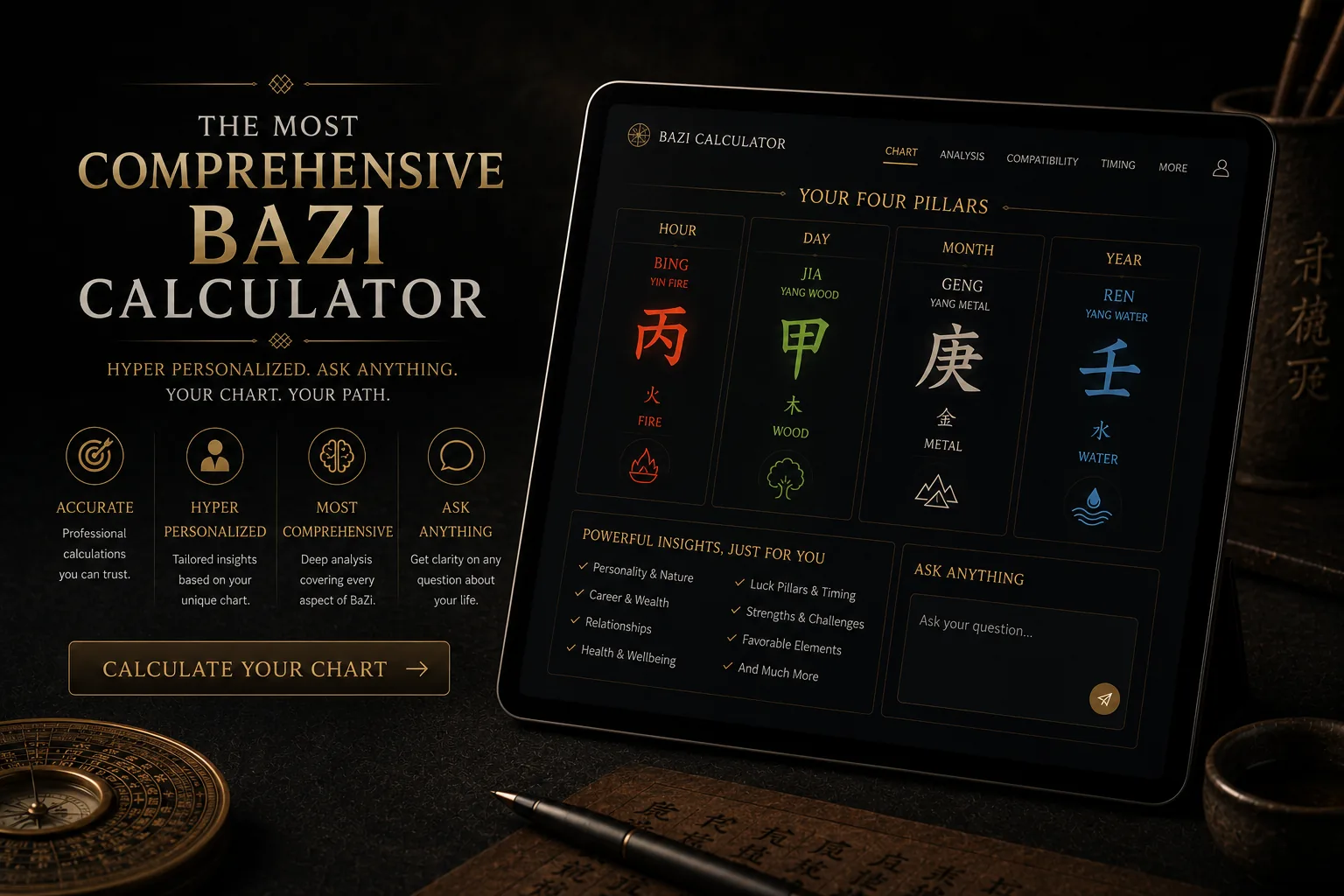
Best Free BaZi Calculator: Get Your Chart Instantly (2026)
You searched for a free BaZi calculator. You are probably not looking for a novelty. You are looking because something in your life has been off, and someone told you that the eight characters of your birth carry a real answer, and you want to see the chart before you spend money on anything, and you want the tool to actually mean what it says.
Fair. Most free calculators will give you eight characters in three seconds. Almost none of them will tell you what those characters mean for the actual question you came in with. That is the honest gap in this space, and this guide is about how to see through it — how to evaluate a free BaZi calculator like someone who knows what the classical system is supposed to do, so you end up with a real reading instead of a random string of Chinese.
By the end you will know exactly what to demand from any free tool, why some of them are basically wrong, how the classical BaZi engine works under the hood, and — because this article lives on one — how the calculator here on Ming Map is built to meet every criterion. No signup. No paywall on the chart itself. If you just want to see yours, run it now and come back to read.
What's the best free BaZi calculator?
Let's answer the search directly, because that is the question you typed.
The best free BaZi calculator is the one that (1) computes your Four Pillars using true solar time and solar terms — not the Gregorian calendar; (2) shows you the hidden stems inside each branch, not just the surface eight characters; (3) derives your Ten Gods automatically from your Day Master; (4) names your Useful God (用神) with a specific classical reason; and (5) plots your Luck Pillars so you can see what your life is passing through.
Anything less than that is a chart printer, not a calculator. A chart printer gives you 甲乙丙丁 in a nice grid and calls it done. A real calculator gives you a chart and the tools to read it — because the eight characters mean nothing without the machinery that interprets them.
You will notice most free tools online stop at step one. They print the eight characters, maybe add an animal zodiac line at the bottom, and let you leave. That is not a BaZi reading. That is like handing you an EKG printout with no cardiologist. The paper is real; the reading is missing.
We are going to walk through what a good calculator does at each of those five steps, so you can spot the real ones on sight.
The five things a real BaZi calculator must do
1. Use solar time and solar terms, not the calendar month
BaZi is a solar system. The Chinese year does not begin on January 1 and it does not even begin at Chinese New Year. It begins at 立春 (Lì Chūn, the "Start of Spring") — a solar term that falls around February 4 each year, when the sun reaches an exact ecliptic longitude. Every one of the twelve BaZi months begins the same way — at a specific solar term, not at midnight on the first of the month.
This matters because a huge number of people are born within a few days of a solar-term boundary, and a lazy calculator gets their month pillar wrong. If you were born on February 3 versus February 5, you might be in a totally different Year pillar, let alone Month pillar. Same for anyone born near the start of any lunar month — the boundary is a solar-term event, computed to the minute.
Location matters for the same reason. Solar terms occur at a moment in universal time, and your local clock displaces that moment. If you were born in Vancouver at 11:30pm and the solar term crossed at 12:15am local, but the calculator naïvely used UTC, your pillar swings a full stem-branch cycle out of correct.
How to test a calculator: enter a birth date on February 3 versus February 5 (both at noon, same location). If the Year pillar is identical, the tool is broken. It should shift — that is the boundary of 立春. Same test at any month boundary. Same test with different time zones for the same clock reading.
A calculator that quietly rounds to Gregorian months is guessing at your chart. Most free ones do this. Ming Map's engine uses astronomically-computed solar-term boundaries and full time-zone handling, because otherwise the whole downstream reading is built on a wrong pillar.
2. Show hidden stems inside each branch
The eight characters — Year Stem, Year Branch, Month Stem, Month Branch, Day Stem, Day Branch, Hour Stem, Hour Branch — are only the surface of your chart. Each of the four branches has one to three hidden stems (藏干) inside it, and the classical BaZi tradition considers those hidden stems every bit as real as the visible ones.
Here is the full table. It is not a table you have to memorise; it is a table your calculator should display for you:
| Branch | Main hidden stem | Secondary | Tertiary |
|---|---|---|---|
| 子 (Zǐ, Rat) | 癸 | — | — |
| 丑 (Chǒu, Ox) | 己 | 癸 | 辛 |
| 寅 (Yín, Tiger) | 甲 | 丙 | 戊 |
| 卯 (Mǎo, Rabbit) | 乙 | — | — |
| 辰 (Chén, Dragon) | 戊 | 乙 | 癸 |
| 巳 (Sì, Snake) | 丙 | 庚 | 戊 |
| 午 (Wǔ, Horse) | 丁 | 己 | — |
| 未 (Wèi, Goat) | 己 | 丁 | 乙 |
| 申 (Shēn, Monkey) | 庚 | 壬 | 戊 |
| 酉 (Yǒu, Rooster) | 辛 | — | — |
| 戌 (Xū, Dog) | 戊 | 辛 | 丁 |
| 亥 (Hài, Pig) | 壬 | 甲 | — |
If your Month Branch is 寅 (Tiger), you don't just have Tiger. You have 甲 Yang Wood as the ruling force, 丙 Yang Fire as a secondary influence, and 戊 Yang Earth as a supporting root — all at once, layered inside one branch position. Any reading that ignores this is reading roughly a quarter of your chart.
The four tomb branches — 辰戌丑未 (Dragon, Dog, Ox, Goat) — are especially rich. They each hold three hidden stems, which is why the classical tradition treats them with a whole category of specific rules. When you were born in a tomb month, the standard "commanding stem" rule shifts, and a good calculator has to know that.
How to test a calculator: run a chart born in a Dragon month (辰月). If the reading treats the Month Branch as pure Earth and stops there, the tool is missing the fact that 辰 also stores 乙 Yin Wood and 癸 Yin Water — and any of those three can be the actual ruling force depending on your other pillars. That distinction changes your Useful God, and therefore changes almost everything.
3. Derive your Ten Gods automatically from your Day Master
The Ten Gods (十神) are the classical map of who each stem is to you. They are not personality types; they are structural roles, derived rigidly from your Day Master's element and polarity. Every other stem in the chart becomes one of these ten roles the moment you know your Day Master.
The ten roles: 比肩 Friend, 劫財 Rob Wealth, 食神 Eating God, 傷官 Hurting Officer, 偏財 Indirect Wealth, 正財 Direct Wealth, 七殺 Seven Killings, 正官 Direct Officer, 偏印 Indirect Resource, 正印 Direct Resource.
Their derivation is not intuition or interpretation. It is a fixed rule per element cycle and polarity, and a calculator either does the derivation for you or leaves you alone with raw characters. For example, if your Day Master is 丙 (Yang Fire):
- 壬 (Yang Water) is your Seven Killings — the same element that controls you, matched polarity, so the pressure is raw and unstructured.
- 癸 (Yin Water) is your Direct Officer — the same element that controls you but opposite polarity, so the pressure is structured, institutional, formal.
- 庚 (Yang Metal) is your Indirect Wealth — the element you control, matched polarity, so the money is unpredictable and speculative.
- 辛 (Yin Metal) is your Direct Wealth — the element you control, opposite polarity, so the money is steady, earned, salary-shaped.
You see how much meaning is encoded in the Ten God label. And every stem, visible or hidden, in your chart carries one of these labels the moment you know your Day Master. If the calculator does not label them for you, you are on your own with lookup tables — and even then you'd only have half the picture, because hidden stems also need to be resolved into Ten Gods.
How to test a calculator: it should show you a Ten God label next to every stem — including hidden ones. If all you get is 甲乙丙丁 with no role assignments, the tool never made the Day Master calculation, and everything downstream is missing.
Ming Map's engine derives Ten Gods for every visible and hidden stem, then aggregates them so you can see at a glance which roles are present, absent, or crowded in your chart. That is the difference between "here are your eight characters" and "here is a map of your life's structural forces." See the full explanation in the Ten Gods guide.
4. Show your Useful God (用神) with a real classical reason
This is where free tools separate from serious ones — and where most free tools quietly fail.
The Useful God (用神) is the single most important concept in classical BaZi. It is the element that, when strong and unbroken in your chart, makes the chart work. It is what tells you which elements to lean into, which to avoid, which years will lift you, which years will drain you. Without a Useful God, the eight characters are just characters. With one, they become a compass.
A trustworthy calculator names your Useful God and tells you why. Not "your favorable element is Water" as a bare declaration — but "your Useful God is Yin Water because you are a Yang Fire Day Master born in a summer month with strong roots, your chart forms the Direct Officer pattern (正官格), and per the classical pattern method Water both cools and structures you." That is a real answer. It cites the classical machinery.
If the tool instead gives you a bar chart with "Water: 62% favorable" and no explanation, it has invented a number. There is no percentage in classical BaZi. There is no ratio. The tradition works categorically — a Useful God either fits the pattern or it doesn't. Any calculator that dresses up its verdict in fake percentages is either faking the whole thing or has confused itself into thinking a numerical presentation makes the analysis more scientific. It doesn't. It just hides that the tool never did the classical work.
The full Useful God guide walks the identification process end to end. In brief, it flows like this:
- Read the hidden stems of the Month Branch.
- Identify which stem is commanding the season (the ruling hidden stem, adjusted for tomb months where the transparent hidden stem takes precedence).
- That stem's Ten God role defines your pattern (格局) — one of the eight classical patterns: Direct Officer, Wealth, Seal, Eating God, Seven Killings, Hurting Officer, Yang Blade, or Month-Companion.
- Combined with your Day Master's strength (strong, weak, or balanced — determined by root scoring across all four pillars), the pattern's classical formula names your Useful God.
- The Useful God then defines your favorable elements (those that protect it) and unfavorable elements (those that damage it or combine it away).
That process is fully deterministic. It's a lookup and a decision tree with no invented weights. A calculator that runs it will always be able to tell you which of the eight patterns you're in, why, and what your Useful God is. A calculator that can't tell you those things is not running the classical method — it is either running a homebrewed formula or skipping the analysis altogether.
How to test a calculator: ask it (implicitly, by looking at what it outputs) — what is my pattern, and what is my Useful God? If it can't tell you your pattern name in the eight classical categories, walk away.
5. Plot your Luck Pillars (大運) so you can see the arc of your life
Your natal chart is fixed at birth — those eight characters do not change. But the classical tradition includes a second layer: your Luck Pillars (大運), which are ten-year periods, each with its own Heavenly Stem and Earthly Branch, that sweep across your life in sequence.
Every Luck Pillar interacts with your natal chart. Some of them reinforce your Useful God, and those decades tend to feel like tailwinds — the doors open, the work compounds, the effort you make actually lands. Some of them attack your Useful God, and those decades feel like headwinds — you work harder for less, and the same effort that used to compound stops compounding. Same person, same chart, different decade, different weather.
This is one of the most powerful features of classical BaZi and one of the most useful things a calculator can show you. Every serious BaZi calculator plots your Luck Pillars. It should show you the ten pillars covering your life, mark the one you are currently in, and — ideally — indicate which are favorable and which are challenging relative to your Useful God.
Without Luck Pillars, you have your natal chart but no timeline. You know your structural setup but not your current season. That's like knowing what car you're driving without knowing what road you're on.
If a free tool skips Luck Pillars entirely — or worse, shows them without any interpretation of what they do — it has abandoned the classical time layer, and you're left with a static reading of a dynamic system. Read the Luck Pillars guide for the mechanics; check that your calculator plots them.
Is there a free BaZi calculator that actually explains my chart?
This is a fair question and probably the second thing you typed into Google after "free bazi calculator." Yes — this is the pitch, and it is also the honest state of the space.
Most free BaZi calculators explain nothing. They show the eight characters, sometimes a five-element pie chart, occasionally a zodiac paragraph. The reader is expected to hire a practitioner for the actual reading. That was fine before software could do the work, but it's an artifact now. There is nothing in the classical method that requires a human hand — the pattern identification is a decision tree, the Useful God derivation is a lookup, the Ten Gods are a formula. A calculator can absolutely do all of it if the people who built it bothered to do the classical work properly.
Ming Map is built as that calculator. It generates your Four Pillars with solar-term accuracy, shows every hidden stem in every branch with its Ten God label, identifies your pattern using the classical rule (with the transparent-hidden-stem exception properly handled for tomb months), determines your Day Master strength using root scoring across all four pillars, names your Useful God with the specific classical reason, and plots your ten Luck Pillars against your natal chart. All of that. Free. No signup for the chart itself.
The paid tier adds unlimited readings — daily, monthly, yearly guidance, per-question deep dives — for less than a single one-off consultation would cost. But the chart itself, and everything you need to read the chart, is free.
Is Ming Map the only tool that does this? No — there are others attempting it, at various levels of rigour. But most of the field is a long way from meeting the five criteria above. Test them yourself. Enter your birth data on any free calculator and check whether you get: solar-term-accurate pillars, all hidden stems, Ten God labels on every stem, a named pattern, a named Useful God with a reason, and full Luck Pillars. That is the bar.
How do I calculate my BaZi chart by hand?
You can. It takes about twenty minutes if you have the tables. Here is the procedure, in case you want to check your calculator or understand what it's doing:
Step 1: Determine your Year pillar. The Chinese solar year starts at 立春 (around February 4). If you were born before that date, use the previous year's stem-branch pair. The 60-year cycle repeats — 甲子, 乙丑, 丙寅, ... — and every year has one stem-branch pair. Look up which year yours is. (2026 = 丙午, for example.)
Step 2: Determine your Month pillar. Find which of the twelve solar-term months you were born in (each starts at a specific solar term). The Month Branch is fixed by the season (寅 for the first month at 立春, 卯 for the second, and so on). The Month Stem is derived from the Year Stem using the classical "Five Tigers Rule" (五虎遁月訣), which tells you which stem starts 寅 for any given year stem, and the rest follow in sequence.
Step 3: Determine your Day pillar. This is the hard part by hand. There is a mathematical formula (or a perpetual calendar lookup) that maps any date to a specific stem-branch pair from the 60-day cycle. Traditional almanacs (通書) publish these tables; a calculator does the arithmetic for you.
Step 4: Determine your Hour pillar. The Hour Branch is fixed by the two-hour block your birth falls into (子時 = 11pm–1am, 丑時 = 1am–3am, and so on around twelve two-hour blocks). The Hour Stem is derived from the Day Stem using the "Five Rats Rule" (五鼠遁時訣), analogous to the Five Tigers Rule but for hours.
You now have your eight characters. To read the chart, you'd then:
- Identify your Day Master (the Day Stem).
- Look up hidden stems for each branch.
- Label every stem as one of the Ten Gods relative to your Day Master.
- Score Day Master strength via root scoring across all four branches (Emperor's Prosperity 帝旺 and Taking Office 臨官 are strong roots; Tomb 墓 is a modest stored root; Death 死 and Extinction 絕 give no root).
- Identify your pattern from the Month Branch's ruling hidden stem.
- Apply the classical pattern-specific formula to name your Useful God.
- Compute your Luck Pillars (starting stem-branch derived from your Month pillar, direction determined by your sex and Year Stem polarity, ten-year increments).
Perfectly doable by hand, and this is exactly what a serious calculator does automatically. If you want to understand the machinery, calculating one chart by hand is a great exercise. If you want your chart read, use the tool.
Do I need to pay for an accurate BaZi reading?
For the eight characters themselves? No. Solar-term-accurate chart generation is deterministic — any tool that does it correctly gets the same answer as any other tool that does it correctly. It's arithmetic and lookup. The classical machinery for the Ten Gods, hidden stems, pattern identification, and Useful God is also deterministic — same inputs, same outputs. A well-built free calculator can do all of it.
Where money enters the picture is in the guidance layer: what to do with what you've learned. Should you take this job? Is this relationship worth staying in? How do you play the next twelve months? A human practitioner charges by the reading because their time is limited. A software engine can produce that guidance at scale — Ming Map's paid tier is unlimited daily readings, unlimited monthly and yearly forecasts, unlimited follow-up questions on the classical method, for the price of a modest lunch per month.
The chart itself and the reading of the chart's structure — Day Master, Ten Gods, hidden stems, pattern, Useful God, Luck Pillars — is free on Ming Map. You do not need to pay to see any of it. You only pay if you want the ongoing period readings and unlimited question-asking.
If a free tool is charging you for the chart itself, they are gating what is effectively a public utility. Walk away.
Which BaZi calculator do professionals use?
Practitioners vary. Some old-guard practitioners still calculate by hand or use paper almanacs (通書) — partly for the training, partly because they don't trust software. Some use paid Chinese-language software packages that generate the chart and offer research databases of classical texts alongside. The Chinese-language pro tools tend to be strong on chart generation and reference material, weaker on English guidance for clients who don't read classical Chinese.
Practitioners who see English-speaking clients often use a hybrid setup: generate the chart in a professional Chinese tool, then translate the reading themselves. This is fine but slow.
A calculator like Ming Map is aimed at a different audience — the person who wants the chart and the reading, in their own language, without a practitioner middleman. It is the same classical machinery a good practitioner would run. The pattern identification uses the exact rules from the classical pattern system. The Useful God derivation follows the classical method — not a made-up scoring function. The Ten Gods and hidden stems come from fixed lookup tables that every practitioner uses.
The differences from a human practitioner: a calculator can't ask you follow-up questions in real time the way a person can, and a calculator can't read subtle contextual cues about your life the way a person can. But a calculator can be right about the structural reading — the pattern, the Useful God, the favorable and unfavorable elements — and it can be right at 3am on a Tuesday when you need to think through a decision, which a human practitioner cannot.
If you want to test any calculator against professional-grade output, run your chart on two or three and compare the pattern names and Useful God verdicts. They should agree — because there is a correct answer from the classical machinery. If they disagree, at least one of them is faking.
The classical machinery that a good calculator runs
For readers who want to understand what the calculator is actually doing when you press "generate":
Root scoring for Day Master strength. The Day Master (the Day Stem — Yang Wood 甲, Yin Wood 乙, Yang Fire 丙, Yin Fire 丁, Yang Earth 戊, Yin Earth 己, Yang Metal 庚, Yin Metal 辛, Yang Water 壬, Yin Water 癸) draws strength from the branches of the chart. The twelve-life-stage tradition scores this: your Day Master's Taking Office (臨官) and Emperor's Prosperity (帝旺) branches are strong roots, Long Life (長生) and Crown-Sash (冠帶) are meaningful roots, Tomb (墓庫) is a modest stored root, and Death (死) and Extinction (絕) give no root at all. Sum the roots across all four branches and you get a categorical verdict — Strong, Balanced, or Weak. There is no percentage. The tradition works categorically.
Pattern identification (格局). Your pattern is the Ten God role of the Month Branch's ruling hidden stem. For most months, that's the main hidden stem (the 本氣). For tomb months (辰戌丑未), the ruling stem shifts to the transparent hidden stem — the first of the tomb's hidden stems (in dominance order) that appears among the four Heavenly Stems of your chart. This produces one of the eight classical patterns. If the ruling stem's Ten God role is the Day Master's own element, no external pattern forms and the chart is read under the Month-Companion (建祿月劫) approach — the Useful God has to be found elsewhere.
Useful God derivation. With pattern and Day Master strength known, the classical method reads deterministically. Favorable Gods (正官, 財, 印, 食神) are used directly — the Useful God is the pattern-defining element itself, and the favorable elements are those that protect and support it. Unfavorable Gods (七殺, 傷官, 陽刃) are countered — the Useful God is the element that controls or channels them. For each of the eight patterns, the classical texts specify the exact Useful God formula. A calculator that has transcribed those formulas correctly will give you an answer that agrees with any competent human practitioner.
Branch interactions. Beyond the eight characters themselves, the branches of your chart interact — clashes (六沖, the six opposing pairs), harmonies (六合, the six paired unions), three-way combinations (三合, four element-forming trinities), and punishments (三刑). These interactions can activate hidden stems, neutralise one another, or reshape the effective strength of your chart. A serious calculator should surface these interactions when they occur in your natal chart or when a Luck Pillar or an annual pillar triggers one against your natals — because that's how the classical method reads the flow of your life across time.
If your calculator does all this and shows its work, you have a real one.
Common questions when you're standing in front of a free calculator
Why does my chart look different on different websites? Usually one of three reasons: (1) the tools disagree on time-zone or solar-term handling and land in different pillars for boundary births; (2) one of them is using the lunar calendar directly instead of solar terms; or (3) one of them has miscomputed your Day pillar because it used a bad perpetual-calendar formula. Cross-check two or three well-regarded tools and use the one that agrees with itself under boundary tests.
Can I get my BaZi chart without knowing my birth time? Yes, with a caveat. Without birth time your Hour pillar (two of your eight characters) is missing, and any interpretation that depends on the Hour pillar — spouse and children readings especially — will be incomplete. Everything else still reads: Year, Month, Day pillars are all there. Ask a family member for your time if at all possible, or check hospital records.
Am I meant to be alone? / Why can't I hold onto money? / Am I doing something wrong? These are the questions people actually ask when they run a BaZi chart, and the classical method has real answers. Loneliness readings live in the Day pillar (your Spouse Palace — the branch directly under your Day Master) and the relationship interactions across your chart. Money readings live in your Wealth stars (財 — Direct and Indirect Wealth) and whether your Day Master has the strength to hold them. Neither is answered by "your zodiac is Rooster." Both are answered by the machinery this article has walked you through — Day Master strength, Useful God, Ten Gods, branch interactions.
Is there a difference between BaZi and Chinese astrology? Yes. Chinese astrology as most Westerners encounter it is zodiac-column reading — just your birth animal, then a paragraph. BaZi is the classical Four Pillars method using ten Heavenly Stems, twelve Earthly Branches, hidden stems, Ten Gods, and pattern analysis. BaZi is what serious Chinese-language astrologers have been doing for a thousand years. Zodiac columns are the airport-magazine version. A real BaZi calculator does BaZi; a bad one does zodiac columns dressed up with characters.
Should I trust a free BaZi calculator with my birth data? For calculation, sure — birth date, time, and location aren't especially sensitive alone. For storage, choose a tool that either doesn't require an account for the chart (like Ming Map) or has a clear privacy policy. Avoid tools that demand email signup just to see eight characters — the chart calculation is a public utility and shouldn't be gated.
FAQ
What is the best free BaZi calculator right now? The one that computes solar-term-accurate pillars, shows hidden stems with Ten God labels, names your pattern and Useful God with a classical reason, and plots your Luck Pillars. Ming Map is built to all five criteria. Test any competitor against those five and use whichever passes.
Is a free BaZi calculator accurate? For the eight characters themselves, yes — if the tool correctly handles solar terms and time zones. For interpretation, quality varies enormously. This is where most free tools fall short.
How do I know if my BaZi chart is right? Cross-check with two well-regarded tools. They should agree on your Four Pillars exactly. If they disagree, one of them is mishandling solar terms or the Day pillar formula. Also verify: your Day Stem matches the day you were born, and your Year Stem shifts correctly if you were born before 立春 (around February 4) — for a January baby, you should be reading the previous year's pillar.
Do I need my exact birth time? Strongly recommended. Without it you lose your Hour pillar and the classical machinery that reads spouse, children, and later-life patterns. Two of your eight characters go missing.
Do I need to pay for an accurate BaZi reading? No. The classical machinery is deterministic, and a well-built free calculator can execute it as correctly as a practitioner. You may pay for ongoing guidance, unlimited questions, or a human practitioner's judgement — but the chart itself and the structural reading should be free.
Which BaZi calculator do professionals use? Chinese-language pros often use paid Chinese-language desktop software; English-speaking pros often use a hybrid setup. For a solo user who wants the chart and the reading in their own language, a purpose-built classical-method calculator like Ming Map is the more practical route.
How do I calculate my BaZi chart by hand? Determine your Year pillar (from a table of the 60-year cycle, adjusting for 立春); Month pillar (from the season and the Five Tigers Rule); Day pillar (from a perpetual calendar or the classical Day pillar formula); Hour pillar (from the two-hour block and the Five Rats Rule). Then look up hidden stems, derive Ten Gods, score Day Master strength, identify your pattern, and name your Useful God. See the walkthrough above.
What is a "Useful God" in BaZi? The element that, when strong and unbroken in your chart, makes the chart work. Identifying it is the single most important step in a classical reading, and it dictates which years, decades, environments, and choices will support you versus stretch you. Full explanation in the Useful God guide.
Why does BaZi feel more specific than my Western astrology chart? Because it is. BaZi generates eight characters with hundreds of possible interactions between them (Ten Gods, hidden stems, pattern types, Useful God, Luck Pillar interactions, annual pillar interactions, branch clashes and combinations). The unique-chart space is enormous. Two people born in the same hour still differ in their Luck Pillars if they are different sexes with the same Year Stem polarity — the direction of the pillar sequence flips. A well-built calculator surfaces all of this.
Can I use a free BaZi calculator for compatibility readings? Yes — enter both charts and compare Day pillars (spouse palaces), Useful Gods, and how each person's chart activates or clashes the other's. Ming Map's compatibility layer does this using the classical method. Same rule: if a tool is scoring "compatibility" with an invented percentage, it's not doing the classical work.
The honest bottom line
If you came here looking for a free BaZi calculator, here's the summary you can take with you:
- The eight characters are the easy part. Almost any calculator can get them right if it handles solar terms and time zones properly. That's the floor, not the ceiling.
- What you actually want is a tool that reads them. Hidden stems, Ten Gods, pattern, Useful God, favorable and unfavorable elements, Luck Pillars — that's the classical machinery, and it's a solvable, deterministic pipeline that a well-built calculator can run as competently as a practitioner.
- Percentages and scores are red flags. The classical method doesn't work in percentages. If a tool tells you "your favorable element is Water at 62%," it has invented the number. Real answers come with real classical reasons.
- Free is fine for the chart itself. Charging for chart calculation is gating a public utility. What you might pay for is ongoing daily guidance, unlimited questions, or human judgement — but the chart is free on any tool worth using.
Ming Map is built as the calculator this article describes — solar-term-accurate, hidden stems everywhere, Ten Gods derived on every stem, pattern named, Useful God named with a classical reason, Luck Pillars plotted. No signup for the chart. No invented math anywhere in the engine. Every piece of the reading is either something the classical tradition explicitly says, or it is left blank and honestly labelled.
If you've been carrying a question — why does this keep happening, am I in the right work, why is this relationship so hard, what am I supposed to do next — the answer isn't in your zodiac animal. It's in the eight characters of your birth, read the classical way. Enter your birth date, time, and place on the Ming Map chart page and see what your chart actually says. Free, instant, and readable.
Everything in this guide is grounded in the classical BaZi machinery: your Day Master, your Useful God, your Ten Gods, your five elements balance, your Luck Pillars, and the Four Pillars structure that ties it all together. If you're new to the system, start with What is BaZi? and then run your chart.