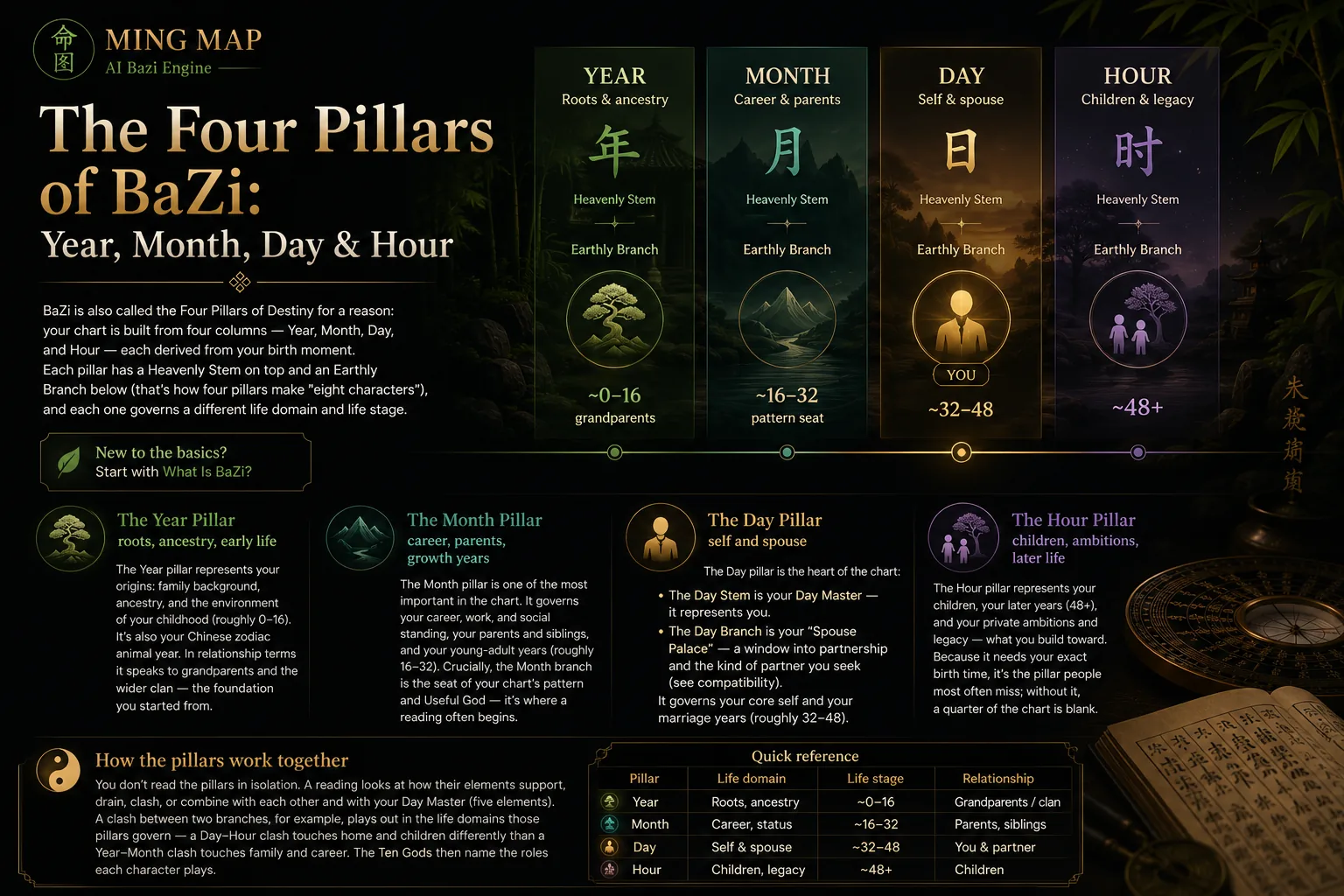
The Four Pillars of BaZi: Year, Month, Day & Hour
If you've landed here, chances are you already know your chart has four pillars, and you're trying to figure out what each one is actually telling you. Maybe someone read your Day Master and told you your Day pillar is "you." Maybe your Hour pillar came out looking dramatic and you're worried. Maybe you're just trying to work out which pillar governs your marriage, or your career, or your children, and the internet is giving you five different answers.
Let's slow down and do this properly.
BaZi is called the Four Pillars of Destiny (四柱命理) for a very literal reason. Your birth moment gets converted into four vertical columns of Chinese characters — the year, the month, the day, and the hour of your birth. Each column has a Heavenly Stem (天干) on top and an Earthly Branch (地支) below. Four columns, two characters each — that's how "four pillars" produces "eight characters" (八字, bā zì). Every pillar governs a specific life stage, a specific set of relationships, and a specific domain of your life. Reading a chart is largely a matter of reading those four columns in the right order, at the right depth.
This guide walks all of them. Not as a table of correspondences you have to memorise — as a real map of the life you're already living.
New to the basics? Start with What Is BaZi? and come back.
Before we go pillar by pillar, hold this in your head — because if you get this, everything else falls into place.
Each pillar is a lens onto a different phase of your life. The Year pillar looks backward and outward — where you came from, who you inherited from, and how the world first encountered you. The Month pillar looks at your formative career years — parents, work, the identity you built as an adult. The Day pillar is you now — the Day Stem is your Day Master, and the Day Branch is the palace of your spouse. The Hour pillar is your finish line — children, later years, and the legacy of everything the first three pillars produced.
Each pillar is also a lens onto a different relationship. Grandparents live in the Year. Parents live in the Month. Your spouse lives in the Day Branch (the classical Spouse Palace, 夫妻宮). Your children live in the Hour.
And each pillar has its own weight in a reading. They are not equal. The Day pillar is the anchor — it holds you. The Month pillar is the driver — the Month Branch decides your Useful God (用神), which is the single most important classical judgment in the whole system. The Year is your context. The Hour is your consequence. Ignore any one of them and you're reading a partial chart.
This is why a proper BaZi reading is a four-way conversation, not a horoscope. Let's take them one at a time.
The Year Pillar — roots, ancestry, and the you the world sees
The Year pillar is the pillar farthest from you and closest to the outside world. Think of it as the address on the envelope. It holds two things at once: where you came from, and how you present to the wider social field.
Life stage: roughly your first sixteen years, plus the reputational shell you carry with you your whole life. Your Year pillar is what strangers register when they hear about you before meeting you.
Relationships: grandparents, the wider clan, ancestral influence, the family name and legacy. If you were born into an old family with heavy expectations, the Year pillar is where those expectations sit in your chart.
Domain: early environment, national or cultural background, the general "weather" of your childhood.
The Year Branch is also your Chinese zodiac animal — 子 Rat, 丑 Ox, 寅 Tiger, 卯 Rabbit, 辰 Dragon, 巳 Snake, 午 Horse, 未 Goat, 申 Monkey, 酉 Rooster, 戌 Dog, 亥 Pig. When friends ask what year you were born in and you say "Year of the Dragon," you're naming one of eight characters. It's real, but it's a fraction of the chart. The classical tradition explicitly warns against treating your zodiac animal as your whole destiny — that's zodiac-column reading, not BaZi.
A well-formed Year pillar — a Year Stem that harmonises with the rest of your chart, and a Year Branch that isn't clashed by later branches — usually reads as a stable foundation. You came from somewhere. There was air in your lungs when you started.
A troubled Year pillar — say a Year Branch that gets clashed by your Day or Hour Branch (六冲, one of the classical Six Clashes) — reads differently. It often shows up as a person who left their origins. Sometimes voluntarily (emigrated, changed careers away from the family tradition), sometimes through disruption (family upheaval in childhood, distance from grandparents, an early move). Neither is "bad" — but both are meaningful, and both explain something about how you carry yourself now.
"What does my Year pillar say about my family?"
The Year Pillar governs the Ancestral Palace (祖宮). If the ancestors' element sits harmoniously — for example, a Year Stem that generates your Day Master, or a Year Branch that forms a Three Harmony (三合) with your Day Branch — the classical reading is inheritance, in some form. Not necessarily money. It might be a family reputation, a trade passed down, a network of contacts, a religious or moral inheritance. The clan is with you.
If the Year is at odds with the rest of your chart — a Year Branch that clashes yours, a Year Stem controlled aggressively by the Month or Day — the classical reading tilts toward self-made. You built without their scaffolding. That's not a curse; it's a specific chart signature.
The Month Pillar — parents, career, and adult identity
Now we move closer. The Month pillar is the loudest column in the entire chart, and if you only had time to read one pillar, this would be a defensible choice. The classical Zi Ping method opens with the Month Branch and derives most of the reading from what lives inside it.
Life stage: your young-adult years — roughly sixteen to thirty-two — the years you built your career, formed your professional identity, and figured out who you were away from your parents' house.
Relationships: parents (father especially in classical male charts), older siblings, mentors, and the authority figures who shaped your early career.
Domain: work, profession, social standing, your career trajectory and its ceiling.
And here is the piece almost everything else hinges on: the Month Branch decides your chart's Pattern (格局), and its dominant hidden stem points to your Useful God (用神). The Useful God is the single element the whole rest of your chart needs to protect. If we asked "what element does this chart want?" — the answer emerges from the Month Branch. That's why the Month Pillar is often called the seat of the reading in the classical tradition.
Every classical pattern name — Direct Officer (正官格), Wealth (財格), Seal (印格), Food God (食神格), Seven Killings (七殺格), Hurting Officer (傷官格), Yang Blade (陽刃格), Month Companion (月劫格) — is named after what the Month Branch's dominant hidden stem is to your Day Master. Change the month, change the pattern, change the entire chart's script. Same year, same day, same hour — different month — different destiny.
Which pillar represents my career?
Month Pillar. Always start there. Your career readings, your professional ceiling, your industry tilt, your relationship to authority — all read from the Month Pillar and its interactions with the rest of the chart.
Some specifics you can look for:
- Month Stem generates your Day Master — parents supported you; career environment nurtured you; early career was formative in a healthy way.
- Month Stem controls your Day Master — pressure from authority figures early; career forged you through friction; you may have felt the weight of expectations from a young age.
- Month Stem is the same element as your Day Master (Month Companion) — this is the classical 建祿月劫格 — you grew up with peers and rivals of your own kind; you had to define yourself against your family, not with them.
- Month Branch in Three Harmony with the Day Branch — career and personal life aligned; work and marriage support each other.
- Month Branch clashing the Day Branch — internal tension between the career you built and the person you actually are. Common in mid-life career pivots.
If you want to go deeper on how the Month Branch produces your pattern, read Useful God in BaZi. That guide is the follow-up to this one.
"Am I doing the right career?"
The question people are really asking here is: does my chart support what I'm doing? And the answer lives at the intersection of your Month Pillar, your Useful God, and your Ten Gods. If your work draws heavily on your Direct Officer (正官) — steady institutional structure — and your chart's pattern is Direct Officer with a strong Seal, you are working with the grain of your chart. If your work is highly creative and expressive but your chart is a Direct Officer type with weak Food God (食神) — you may feel a chronic mismatch between what your work asks of you and what your chart naturally wants to give.
There is no invented formula for this — it's the classical Ten Gods reading applied to your actual working life. See Ten Gods in BaZi for the full ten roles and how they show up in work.
The Day Pillar — you, and the person you sleep next to
Now we arrive at you. The Day pillar is the pillar of the self, and it does something none of the other three pillars do: it splits cleanly into two.
The Day Stem is your Day Master (日主, rì zhǔ). This is you. Not your soul, not your personality quiz result — you as a computational anchor in the chart. Every other stem and branch in your chart is read in relation to your Day Master. When we say "your chart has strong Wealth" or "your chart has a Direct Officer pattern," we mean relative to your Day Master. There are exactly ten possible Day Masters — 甲 Yang Wood, 乙 Yin Wood, 丙 Yang Fire, 丁 Yin Fire, 戊 Yang Earth, 己 Yin Earth, 庚 Yang Metal, 辛 Yin Metal, 壬 Yang Water, 癸 Yin Water — and each one has a distinct classical character. Yang Fire (丙) is the sun, dazzling and impossible to hide. Yin Water (癸) is rain, quiet and pervasive. Yang Wood (甲) is the tall tree. Yin Wood (乙) is the vine and flower. Read the Day Master guide for the full ten.
The Day Branch is your Spouse Palace (夫妻宮). This is where the classical tradition places your marriage partner. Whatever branch sits in your Day column tells us something about the kind of partner your chart is oriented toward, and about the health of your marriage domain.
Together, the Day pillar governs your middle years — roughly thirty-two to forty-eight — and it holds the two most personal domains in the whole chart: who you are and who you spend your life with.
Which pillar represents my marriage?
Day Pillar — specifically the Day Branch. That is your Spouse Palace.
But — and this is where a lot of pop BaZi goes wrong — the Day Branch alone doesn't tell you the whole marriage story. The classical method reads two things together:
One: the Spouse Palace itself — the Day Branch. Is it clashed by another branch (a Six Clash 六冲 with the Month or Hour branch)? Is it in Three Harmony (三合) with another branch, or Six Harmony (六合) with your Month or Year? Is it a Peach Blossom (桃花) branch? Each of these tells us something structural about the marriage domain.
Two: the Spouse Star. In a classical male chart, the spouse is represented by the Wealth (財) element — specifically Direct Wealth (正財) for the wife. In a classical female chart, the spouse is represented by the Officer (官) element — specifically Direct Officer (正官) for the husband. Where does that element sit in your chart? Is it transparent (visible in the stems) or hidden (only in branches)? Is it well-supported or under attack? Is there Rob Wealth (劫財) in a male chart competing for the Wealth? Is there 官殺混雜 — Direct Officer and Seven Killings mixed — in a female chart, complicating who the "real" husband is?
Both readings — the Palace and the Star — have to agree. If both are healthy, the classical verdict is stable, supportive marriage. If both are damaged, the verdict tilts toward genuine difficulty. If one is healthy and one damaged, you get the more common real-world picture: good bones with real friction, or strong love inside a hard structural container.
For a deeper walk-through, see BaZi Compatibility.
"Am I meant to be alone?"
This is one of the most-asked questions in every real BaZi consultation. It has a classical answer, and it isn't fatalistic.
Charts where marriage is harder usually have some combination of: the Spouse Star hidden and unsupported (never becomes transparent in a Luck Pillar you actually live through), the Spouse Palace clashed by both the Month and the Hour, or a Rob Wealth-heavy male chart / a 官殺混雜 mixed authority female chart. Any of those makes finding-and-keeping harder. None of them makes it impossible.
What the classical tradition does say, plainly, is: marriage timing follows the Luck Pillars. If your Spouse Star is currently hidden but your next ten-year Luck Pillar makes it transparent, the marriage that was unavailable at thirty may be available at thirty-eight. Read Luck Pillars for how the ten-year cycles work. And ignore anyone — book, app, or uncle — who tells you the chart alone decides who is "meant" for what. The chart tells you the terrain. You still walk it.
Which pillar is the most important?
Depending on who you ask, the answer will be Day or Month. Both are defensible. Here's the honest breakdown:
- The Day Pillar holds your Day Master — the reference point for the whole chart. Without it, nothing else has meaning. In that sense, Day is foundational.
- The Month Pillar decides your pattern and Useful God — the actual judgment of the chart. In that sense, Month is operative.
A reader who says "Day is most important" is telling you what you are. A reader who says "Month is most important" is telling you what your chart is doing. Both are correct, and both together are the actual answer. If you had to weight them: the Day Pillar is the noun, the Month Pillar is the verb. You need both.
The Year and the Hour are the framing. They tell you where the story started and where it ends up. Every pillar is used in a full reading — but if you're only reading two, read Day and Month.
The Hour Pillar — children, legacy, and the shape of your finish
Now we come to the pillar most people know least, and the one most often missing. The Hour Pillar requires your exact birth time — usually to within a two-hour window, since the classical branches divide the day into twelve double-hours (時辰). If you don't know your birth time, or your birth certificate is vague, or your mother remembers "around four in the afternoon" — you can still get most of the chart, but the Hour Pillar reading gets tentative. About a quarter of the whole chart is in the Hour, and skipping it is skipping a whole quadrant of your life.
Life stage: your later years — roughly forty-eight onward — plus the end result of the previous three pillars. The Hour is where the story lands.
Relationships: children (biological, adopted, or the equivalent — students, protégés, direct reports, the people you raise up), subordinates, and the household you head as an adult.
Domain: legacy, ambition, the private long-term project of your life, what you built toward, and how the classical tradition reads your late-life fortune.
What does my hour pillar say about my future?
Two things, at two different depths.
At the surface: the Hour Pillar shows what you're privately building toward. It's the pillar of ambition-with-legacy. The Year Pillar is your public face; the Hour Pillar is what you're doing when no one's watching, the project you'd continue even if the world stopped rewarding you for it.
At depth: the Hour Pillar tells us how your chart lands. The classical tradition takes the sequence of your pillars very seriously — Year, Month, Day, Hour is not just the order of columns, it's the order of your life. A favourable element appearing at the Hour Stem means the final third of your life is supported by what your chart most needs. An unfavourable element at the Hour Stem means the ending gets harder.
There's a classical principle sometimes summarised as the sequence of favourable and unfavourable elements decides fortune. Two people can have the exact same eight characters distributed differently across the four pillars, and their lives will unfold in completely different shapes — because the position matters. A chart where Wealth (財) sits at the Year and Seal (印) at the Hour unfolds very differently from a chart where Seal is at the Year and Wealth at the Hour, even if the elements themselves are identical. Which arrives first structures the story. Which lingers last structures the ending.
"Will I have children?"
The classical tradition maps children onto two things: the Hour Pillar and, more specifically, the child-star element. For a male chart, that's the Food God (食神) and Hurting Officer (傷官). For a female chart, also Food God and Hurting Officer, because they're what she produces (Wealth for the husband; children for herself). The condition of these stars, plus the health of the Hour Branch, produces the reading.
- Hour Branch in a strong life-stage for the child element (a long-life 長生 or peak 帝旺 stage) — reads as capable children, active generative energy.
- Hour Branch in a tomb or extinction stage (墓 or 絕) for the child element — reads as fewer children, later children, or children who face early obstacles.
- Hour Stem is your Useful God or Supporting God — reads as children who bring honour, who benefit the family, who elevate the line.
- Partial Seal (偏印) at the Hour suppressing the Food God — the classical 梟神奪食 — a signature the tradition associates with fertility difficulty or complicated child-raising.
None of this is fate. It's a tendency reading. Modern life has more moving parts than the classical texts had — adoption, delayed families, chosen family, protégé relationships that fill the child domain in non-traditional ways. What the Hour Pillar is really telling you is: how does your chart want its late-life generative energy to move? The specifics will look like whatever your century looks like.
"Am I doing something wrong that will show up later?"
This is the fear buried inside the Hour Pillar question, and it deserves a straight answer.
The Hour Pillar doesn't punish you for being human. What it does do is reveal the shape of your finish. If your Day and Month are dominated by an element and your Hour introduces its counter — for example, a strong Wealth chart that ends with heavy Seal at the Hour — the classical warning is about an unresolved tension arriving late, when you have less flexibility to absorb it. The move isn't to fear the ending. It's to build the buffers now. If your Hour signals late-life friction between Wealth and Seal, you have thirty years to arrange your affairs so the friction is a chapter, not a catastrophe.
Charts are diagnostic, not prescriptive. A hard Hour Pillar is a warning — the whole point of reading the chart is to have the warning early.
How the four pillars actually work together
Reading the pillars one at a time is like reading four separate sentences and calling it a paragraph. The real work of a BaZi reading is watching them interact.
Here are the interactions that matter most.
The Month Branch decides the Useful God
The single most important structural move in a chart. Whatever pattern lives inside your Month Branch — Direct Officer, Wealth, Seal, Food God, Seven Killings, Hurting Officer, Yang Blade, Month Companion — is the organising principle of your entire chart. Every other pillar is read as supporting or opposing what the Month Branch is doing. The Useful God is the element that keeps the pattern healthy. Protect the Useful God, protect the chart.
The Day Branch is the Spouse Palace
We covered this above, but it's worth repeating: your Day Branch is the marital domain of your chart. If it's clashed by the Month Branch, you get tension between career and marriage. If it's clashed by the Hour Branch, you get tension between children/legacy and marriage. If it forms Six Harmony (六合) with the Year, your marriage tends to please your family. Every branch relationship is a real signal.
The Hour Branch is where the story lands
The Hour is the closing chapter. Every classical reading gives extra weight to what happens to the Useful God at the Hour Pillar. Useful God at the Hour, supported and unclashed, is the classical signature of late-life flourishing. Useful God attacked at the Hour is late-life difficulty even after a strong middle. This is why the Hour Pillar matters so much even to people in their twenties.
Branch clashes across pillars are the loudest events
There are six great classical clashes — 子午 (Rat-Horse), 丑未 (Ox-Goat), 寅申 (Tiger-Monkey), 卯酉 (Rabbit-Rooster), 辰戌 (Dragon-Dog), 巳亥 (Snake-Pig) — and where they land in your pillars tells you what part of your life gets shaken.
- Year-Month clash — tension between your origins and your career; you built against the grain of your family.
- Month-Day clash — tension between career and self; the person you became at work is not the person you actually are.
- Day-Hour clash — tension between self and children/legacy; you may struggle to translate your personal identity into what you build for the next generation.
- Year-Hour clash — tension between beginning and end; the values you started with are not the values you'll finish with. Common in charts of people who converted religions, changed countries, or made a radical worldview shift late in life.
Clashes are not fatal. They are events that require conscious navigation. An unclashed chart isn't automatically better — sometimes it just isn't awake yet.
Combinations across pillars
The opposite of clashes are combinations (合) — stems and branches that fuse into harmony. Six Harmony (六合) on the branches, Three Harmony (三合) across three branches, Stem Combination (天干合) across the stems. Combinations across two pillars usually read as those two domains cooperating. A Day-Hour branch harmony often reads as marriage and children both thriving under the same conditions. A Month-Year stem combination often reads as career and family reputation aligned.
Combinations can also be problematic when they combine away your Useful God. If your Useful God stem forms a 天干合 with another stem and the pair transforms into a different element, you've lost your Useful God — a classical reading of the very thing you needed disappeared into something else. This is one of the deeper structural moves, and it's covered in the Useful God guide.
Reading your own chart, pillar by pillar
If you're staring at a chart right now and trying to make sense of it, here's the order I'd suggest.
- Identify your Day Master. The top of the third column. This is you. Everything else is relative to this stem.
- Look at the Month Branch. What's inside it? What's its dominant hidden stem? That's your pattern's basis, and the direction of your Useful God search.
- Look at the Day Branch. That's your Spouse Palace. Note any harmonies or clashes with the Month and Hour branches.
- Look at the Year Pillar. Where did you start? What did you inherit — literally, socially, karmically?
- Look at the Hour Pillar. Where is the story headed? Does the ending amplify what your middle years built, or reverse it?
- Read the branch interactions. Clashes, harmonies, punishments. These are the events of your life mapped onto structure.
- Read the Ten Gods across the pillars. Which stems are your Direct Officer, Wealth, Seal, Food God? Where do they sit? A Wealth Stem at the Month is a career-and-money story; a Wealth Stem at the Hour is a late-life-inheritance-or-payoff story.
That's the classical order. Anyone reading your chart quickly by looking only at the Year Branch and your zodiac animal is doing you a disservice.
FAQ
Which pillar is the most important in BaZi? Day Pillar and Month Pillar, together. The Day Pillar holds your Day Master — the anchor of the whole reading. The Month Pillar holds your pattern and Useful God — the operative logic of the chart. If forced to pick one, the classical tradition leans toward the Month Branch, because it decides the pattern. But no serious reading uses one without the other.
Which pillar represents my career? The Month Pillar. Your professional identity, your relationship to authority, your industry tilt, and your career ceiling all read primarily from the Month Pillar — plus how the rest of your chart supports or clashes with it.
Which pillar represents my marriage? The Day Pillar — specifically the Day Branch, which is the classical Spouse Palace (夫妻宮). The reading also uses your Spouse Star: Direct Wealth (正財) for a male chart's wife, Direct Officer (正官) for a female chart's husband. Both the Palace and the Star have to be read together.
What does my Hour Pillar say about my future? It shows the shape of your later years and your relationship to legacy — children, students, protégés, and the long project of your life. It also shows how the story lands: an element at the Hour Pillar exerts its influence most strongly in the final third of life. A supportive Hour usually reads as late-life flourishing; a difficult Hour signals late-life friction that's worth preparing for now.
Which pillar is my Chinese zodiac animal? Your Year Branch. That's one of your eight characters. Reading your zodiac in isolation — "I'm a Dragon, so I'm bold" — is a fragment, not a chart. The full four-pillar reading is far richer, and often runs contrary to zodiac-only stereotypes.
What if I don't know my exact birth time? You lose the Hour Pillar, and with it a real slice of the chart. Late-life reading, child-domain reading, and legacy reading all get tentative. You can still work with a "birth date only" reading — the other three pillars remain intact — but if you can dig up an accurate time (family records, hospital records, mother's memory of what was on TV), get it. Chart accuracy jumps meaningfully.
Can two people have the same four pillars? Yes — anyone born in the same two-hour window on the same day of the same year has the same eight characters. Classical tradition explains the divergence in their lives by two things: the Luck Pillars (大運), which shift every ten years and are read against the natal chart, and the environment and choices that different lives make when handed the same terrain. Same chart, same weather; different sailors, different journeys.
Is one bad pillar enough to ruin a chart? No. A chart is a network, not a checklist. A troubled Year Pillar can be redeemed by a strong Month, Day, and Hour. A clash between Day and Hour can be softened by a harmonising Month. The classical tradition reads the chart as a whole configuration — the way a musician reads a chord, not a single note. Which is exactly why one-pillar readings (zodiac-only, Day-Master-only) are unsatisfying: they answer with a note when you asked about the song.
Do the pillars change over my lifetime? Your natal four pillars are fixed at birth — they never change. But your Luck Pillars rotate every ten years, layering new stems and branches onto your natal chart. Those transient pillars interact with your four natal pillars, activating some and clashing others. This is how the same chart produces a soft twenties and a stormy forties: the natal chart is the terrain, the Luck Pillars are the seasons. See Luck Pillars for the full mechanic.
Why does my Month Pillar feel more accurate to me than my Day Pillar? Common experience, and here's the classical read: most people over-identify with their career-and-social self (Month Pillar) and under-identify with their core self (Day Pillar). The Day Master is often felt as the private you no one at work has met. If your Month Pillar reading feels obviously true and your Day Pillar reading feels vaguely off — you may be living deeper inside your Month than your Day. That's a real chart signature. It usually resolves in the second half of life, when the Hour Pillar begins to speak louder and forces a reckoning between the two.
Read your own four pillars
Every claim in this guide maps onto real, computable structure in your chart. Your Year Pillar and its interactions. Your Month Pillar's pattern and Useful God. Your Day Master and Spouse Palace. Your Hour Pillar and its bearing on children and legacy. The classical machinery — Ten Gods, Twelve Life Stages, Six Clashes, Three Harmonies, Useful God resolution — is exactly what the Ming Map engine runs on your birth data.
If you've been reading this to figure out something specific about your own life — am I in the right career, is my marriage supported by my chart, why do I keep starting things and not finishing them, will things get easier — the four pillars have real answers, and they're already in your chart. You just need someone to lay them out honestly.
See your four pillars, labelled by life domain, in plain English. Open your free BaZi chart in Ming Map → — or on Android. The classical method, applied to your actual birth moment, without invented math.